Disclaimer: The information published on LoansJagat is intended for general informational and educational purposes only and should not be considered financial, legal, or investment advice. Interest rates, loan terms, statistics, and other data may change over time and may vary by lender or source. Please verify the latest information and consult a qualified financial advisor or the respective Bank/NBFC before making any financial decisions.
Subscribe Now
About the author

Arshathul Afia is a journalism graduate and fintech content writer with 4+ years of experience in digital publishing and research-led writing. She has written 200+ articles covering personal finance, lending, banking, digital payments, credit, insurance, and major financial developments in India. At LoansJagat, she focuses on simplifying complex fintech news, RBI updates, loan-related changes, policy developments, and industry trends for everyday readers. Her journalism background helps her approach stories with research, context, and clarity, while her SEO experience ensures content remains discoverable and relevant. She aims to make financial news easier to understand, practical, and useful for readers across India.
Related News
Simplify All Your Loans Into One Affordable EMI

Customers Served

Debt Consolidated

1200+ Reviews

Locations in India
Club all Loans & Credit Card Bills into Single EMI

Quick Apply Loan
Consolidate your debts into one easy EMI.

Takes less than 2 minutes. No paperwork.

10 Lakhs+
Trusted Customers

2000 Cr+
Loans Disbursed

4.7/5
Google Reviews

50+
Banks & NBFCs Offers
The CBIC expects to seek public feedback before rolling out a framework that would change how around 70 lakh taxpayers deal with Central GST authorities.
Key Highlights
India’s Central Board of Indirect Taxes and Customs (CBIC) is preparing to publish a draft that would change how taxpayers under Central Goods and Services Tax (CGST) administration deal with the department. Speaking in New Delhi on 18 November 2026 at an event organised by the PHD Chamber of Commerce and Industry, Chaturvedi said the board would publish the draft shortly.
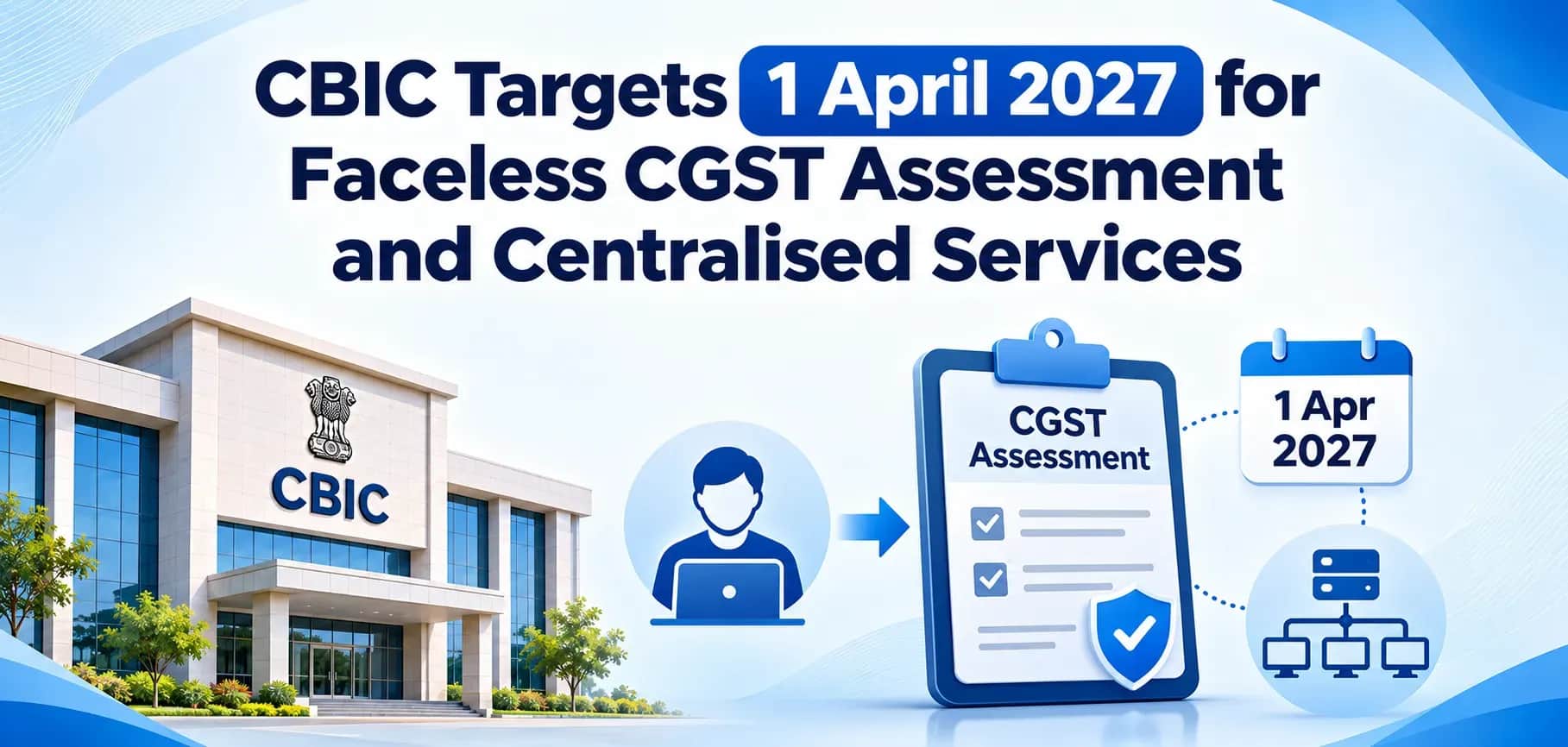
The proposal pairs two changes. Large taxpayers that deal with several Central GST jurisdictions would have a single office for services now handled across jurisdictions. Under the proposal, smaller taxpayers would receive faceless assistance from the CBIC. The April date is a target, with consultation still ahead as of 19 November.
A company can hold several Goods and Services Tax Identification Numbers (GSTINs) within one state or across states. Chaturvedi described a setup in which a large taxpayer could go to one physical office for registration, scrutiny of returns, adjudication, reviews and appeals. That would give a business dealing with different Central GST offices a common point of contact for those functions.
Union Finance Minister Nirmala Sitharaman put the number of taxpayers under Central GST jurisdiction at around 69.5 lakh in October. About 2 lakh operated under multiple Central GST jurisdictions. Chaturvedi described the broader group in November as roughly 70 lakh. The 2 lakh figure identifies the group at the centre of the plan for centralised services.
A single point of contact could cut duplicate work and make it easier for businesses with several GST registrations to coordinate with tax authorities, said Abhishek A Rastogi, partner at Rastogi Chambers.
The proposal envisages a national platform for tax notices, hearings and orders. The draft will show how that platform would operate and how taxpayers would interact with it. Chaturvedi invited industry bodies, businesses and tax professionals to submit feedback once the text is available.
Some exchanges already happen online. In May 2023, the CBIC introduced an automated return scrutiny module for taxpayers administered by the Centre. It allows officers to review returns selected using risk indicators. An officer who spots a discrepancy can send Form GST ASMT-10 through the GST portal. The taxpayer can reply in Form GST ASMT-11. The officer can communicate acceptance in Form GST ASMT-12. The November proposal has a broader scope, extending to hearings and orders as well as notices.
The Centre and states divide responsibility for GST administration under a formula agreed by the GST Council. State authorities administer 90% of taxpayers with annual turnover below ₹1.5 crore, with the Centre handling the remaining 10%. Above ₹1.5 crore, the two administrations split taxpayers equally. These percentages describe how taxpayers are allocated between authorities. The roughly 70 lakh figure in the November update refers to the Centre’s share of the taxpayer base.
Separate GST registrations also serve a different purpose from a single administrative office. Under the current rules, a business that is liable to register in more than one state or Union Territory obtains a registration in each. The proposal Chaturvedi outlined addresses where those taxpayers deal with the Central GST department.
Sitharaman set out the Centre’s plan after the 57th GST Council meeting on 8 October 2026. She said a framework would be put out for public consultation before the next Union Budget, with implementation intended during FY 2027–28. She pointed to the experience of faceless income tax administration when describing the proposal.
The Council’s own recommendations at that meeting dealt with changes to registration, returns, refunds and adjudication. The faceless and centralised CGST framework is a separate Central government initiative, Chaturvedi said. His November update narrowed the expected start to 1 April 2027 and put the release of the draft next on the timetable.
The CBIC’s next step is to publish the draft and gather feedback before the proposed 1 April 2027 rollout. For businesses with several GST registrations, the draft should explain how a single office would take up work across existing Central GST jurisdictions. Smaller taxpayers will be looking for details on how notices are served and how hearings take place under faceless assessment. Once consultation opens, taxpayers and industry bodies can flag where the proposed procedures could cause delays or uncertainty.
The CBIC is targeting 1 April 2027, when the next financial year begins. The department expects to release the draft for public consultation before implementation.
The proposed framework would cover around 70 lakh taxpayers administered by the Centre. About 2 lakh taxpayers have registrations across multiple Central GST jurisdictions today.
The proposal would give large taxpayers with multiple registrations access to one physical office for registration, return scrutiny, adjudication, reviews and appeals under Central GST.
GST applies to taxable purchases of goods and services. The April proposal concerns how the Centre administers registered taxpayers. It proposes no change to rates.
A business must register separately in each state or Union Territory where it is liable to register. Each such registration has its own unique GSTIN.
Start your journey today
Apply Now*T&C apply