
By continuing, you agree to LoansJagat's Credit Report Terms of Use, Terms and Conditions, Privacy Policy, and authorize contact via Call, SMS, Email, or WhatsApp
Disclaimer: The information published on LoansJagat is intended for general informational and educational purposes only and should not be considered financial, legal, or investment advice. Interest rates, loan terms, statistics, and other data may change over time and may vary by lender or source. Please verify the latest information and consult a qualified financial advisor or the respective Bank/NBFC before making any financial decisions.
Subscribe Now
About the author

Arshathul Afia
Arshathul Afia is a journalism graduate and fintech content writer with 4+ years of experience in digital publishing and research-led writing. She has written 200+ articles covering personal finance, lending, banking, digital payments, credit, insurance, and major financial developments in India. At LoansJagat, she focuses on simplifying complex fintech news, RBI updates, loan-related changes, policy developments, and industry trends for everyday readers. Her journalism background helps her approach stories with research, context, and clarity, while her SEO experience ensures content remains discoverable and relevant. She aims to make financial news easier to understand, practical, and useful for readers across India.
Related News
Simplify All Your Loans Into One Affordable EMI

Customers Served

Debt Consolidated

1200+ Reviews

Locations in India
Club all Loans & Credit Card Bills into Single EMI

Quick Apply Loan
Consolidate your debts into one easy EMI.

Takes less than 2 minutes. No paperwork.

10 Lakhs+
Trusted Customers

2000 Cr+
Loans Disbursed

4.7/5
Google Reviews

50+
Banks & NBFCs Offers
Other services mentioned in this article
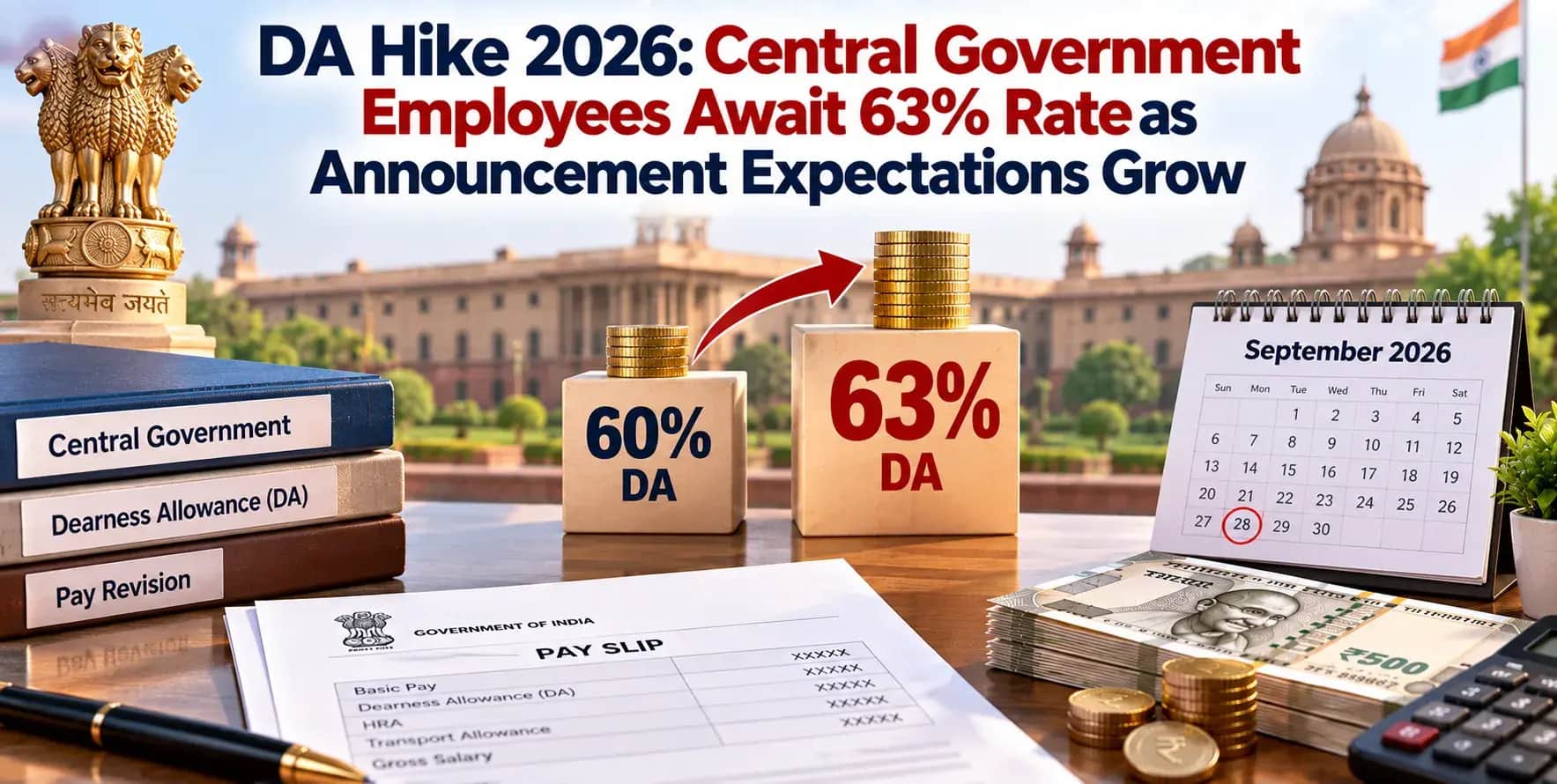
The Central Government Employees Union has given an update that the July DA is being finalised and will be released at 63% of basic.
Key Highlights
Central government employees in India are awaiting the July 2026 dearness allowance revision. Manjeet Singh Patel, president of the All India New Pension Scheme Employees’ Federation, expects an announcement within a week, according to his comments published on 28 September 2026. The projected rate remains subject to government approval.
For households managing regular bills, an approved increase would add to monthly income. DA compensates employees for rising prices, while eligible pensioners receive Dearness Relief (DR). The practical benefit depends on basic pay or pension. Committing that expected income to fresh spending, however, could leave a household short before revised payments arrive.
The government’s 18 April 2026 announcement estimated that the January revision would benefit 50.46 lakh central government employees and 68.27 lakh pensioners. These figures describe the earlier approved instalment. They show the reach of the allowance but should not be labelled a fresh beneficiary count for the pending revision.
For an employee, additional DA provides room within the existing budget. It may help absorb higher grocery bills or leave more income available after loan repayments. The effect varies between households because basic pay differs, and deductions influence the amount received. A higher allowance also does not automatically change a borrower’s loan instalment. Salary income and the repayment terms agreed with a lender remain separate.
Alongside Patel’s assessment, an unnamed All India Defence Employees’ Federation source said the file was being processed. An unnamed official from the Confederation of Central Government Employees & Workers suggested the first week of October. The comments appeared in the 28 September 2026 report and reflect employee organisations’ expectations.
Those statements offer a possible announcement window, not an approved payment date. The useful distinction for employees is between a representative’s forecast and a government decision. Salary calculations based on an expected rate remain estimates until approval. The April revision provides a documented example of how the announcement, effective date and departmental order can fall on different dates.
The Union Cabinet announced the previous increase on 18 April 2026. DA and DR rose from 58% to 60%, effective from 1 January 2026. As mentioned in Release ID 2253245, the increase is in accordance with the prescribed formula. This was concluded after the 7th Central Pay Commission.
The Department of Expenditure then issued Office Memorandum No. 1/1(i)/2026-E.II(B) on 22 April 2026. A copy circulated by Kendriya Vidyalaya Sangathan on 23 April 2026 includes the original memorandum. The following records establish what the government approved and when.
January was the effective month, while April brought the announcement and implementation order. The dates serve different purposes. An effective date identifies the period covered by a revision; it does not identify the day money enters an employee’s bank account.
The preceding July-cycle decision was announced on 1 October 2025. It raised DA and DR from 55% to 58%, effective from 1 July 2025. The later employee order was dated 6 October 2025. Treating the order date as the original announcement date would give readers the wrong chronology.
The 22 April 2026 memorandum defines basic pay as pay drawn in the prescribed Pay Matrix level under the accepted 7th Central Pay Commission recommendations. It excludes other types of pay, including special pay. The order also keeps DA as a distinct element of remuneration.
That distinction prevents a common calculation error. Multiplying total take-home salary by the expected DA increase would not reproduce the calculation specified in the memorandum. Employees need the relevant basic-pay figure from their salary record, rather than the amount credited after allowances and deductions.
A rate expressed as a share of basic pay also describes the allowance, not the growth in the entire salary. Comparing those figures as though they measure the same thing overstates the change a household can expect.
The borrower-focused assessment is straightforward: additional recurring income can improve repayment capacity without making an existing loan cheaper. Interest costs still depend on the loan’s terms. Employees comparing their finances therefore need to separate a possible improvement in monthly cash flow from a reduction in borrowing costs.
Related coverage by LoansJagat, updated on 5 June 2026, warned employees about fraudulent salary-calculator links circulated through messaging apps. Its advice was to use verified sources and avoid installing files from forwarded messages. That published viewpoint is relevant while employees search for revised-pay estimates.
For household planning, the original analytical point is the difference between recurring income and a retrospective payment. Any arrears paid together would cover a past period. Treating that larger credit as normal monthly income could distort the budget used to assess a new EMI.
The DA discussion combines an expected revision with a documented history of government decisions. Employees have reason to follow the announcement closely, but useful salary planning starts with the applicable basic pay and actual recurring income. A headline rate alone cannot show what remains after deductions and household commitments.
The reported estimate is 63% of basic pay. It remains an expectation subject to government approval.
The previous approved increase took effect from 1 January 2026. The government announced it on 18 April 2026.
Eligible pensioners receive Dearness Relief. The April 2026 Cabinet decision covered both employee DA and pensioner DR.
The employee memorandum dated 22 April 2026 calculates DA on basic pay, not the final amount credited after deductions.
A DA revision changes the allowance. The April 2026 memorandum treats DA as a separate element of remuneration.









.png&w=3840&q=75)


