

By continuing, you agree to LoansJagat's Credit Report Terms of Use, Terms and Conditions, Privacy Policy, and authorize contact via Call, SMS, Email, or WhatsApp
Disclaimer: The information published on LoansJagat is intended for general informational and educational purposes only and should not be considered financial, legal, or investment advice. Interest rates, loan terms, statistics, and other data may change over time and may vary by lender or source. Please verify the latest information and consult a qualified financial advisor or the respective Bank/NBFC before making any financial decisions.
Subscribe Now
About the author

Arshathul Afia
Arshathul Afia is a journalism graduate and fintech content writer with 4+ years of experience in digital publishing and research-led writing. She has written 200+ articles covering personal finance, lending, banking, digital payments, credit, insurance, and major financial developments in India. At LoansJagat, she focuses on simplifying complex fintech news, RBI updates, loan-related changes, policy developments, and industry trends for everyday readers. Her journalism background helps her approach stories with research, context, and clarity, while her SEO experience ensures content remains discoverable and relevant. She aims to make financial news easier to understand, practical, and useful for readers across India.
Related News
Simplify All Your Loans Into One Affordable EMI

Customers Served

Debt Consolidated

1200+ Reviews

Locations in India
Club all Loans & Credit Card Bills into Single EMI

Quick Apply Loan
Consolidate your debts into one easy EMI.

Takes less than 2 minutes. No paperwork.

10 Lakhs+
Trusted Customers

2000 Cr+
Loans Disbursed

4.7/5
Google Reviews

50+
Banks & NBFCs Offers
Other services mentioned in this article
CBDT data show India’s net direct tax collections rose 12.96% to ₹12.12 lakh crore by September 17, 2026, led by stronger corporate tax payments nationwide.
The Central Board of Direct Taxes, under the Ministry of Finance, released the latest FY27 figures on September 18, 2026. The Income Tax Department’s Direct Taxes Data page carries the official collection series. The numbers cover April 1 to September 17 across India and show that corporate tax and advance-tax payments were major contributors to the year-on-year rise.
For taxpayers, the update does not bring a new slab, surcharge or tax rate. Stronger receipts give the Centre a better revenue position for Budget spending, but there is a drag too. Refunds have risen quickly, so gross collections are growing faster than the amount retained after refunds are paid.
A 13% rise in national collections does not mean a salaried employee will automatically pay 13% more tax. Personal liability still depends on taxable income, the chosen regime, capital gains and other income. The headline is an aggregate covering companies and several categories of non-corporate taxpayers.
“Non-corporate tax” also extends beyond salary earners. CBDT includes individuals, Hindu Undivided Families, firms, associations of persons, bodies of individuals, local authorities and artificial juridical persons in this category. It would therefore be wrong to read the entire non-corporate figure as tax paid only by salaried Indians.
Refunds are the more immediate household angle. Around ₹2.20 lakh crore had been issued as refunds by September 17, up 29.19% from the comparable period last year. LoansJagat’s direct-tax guide explains that direct tax is paid straight to the government on income, profits or specified gains. Applied here, the borrower-facing reading is straightforward: the national collection jump does not change an EMI or create a fresh tax liability by itself. A taxpayer still needs to check the return, TDS credit, AIS and refund position individually.
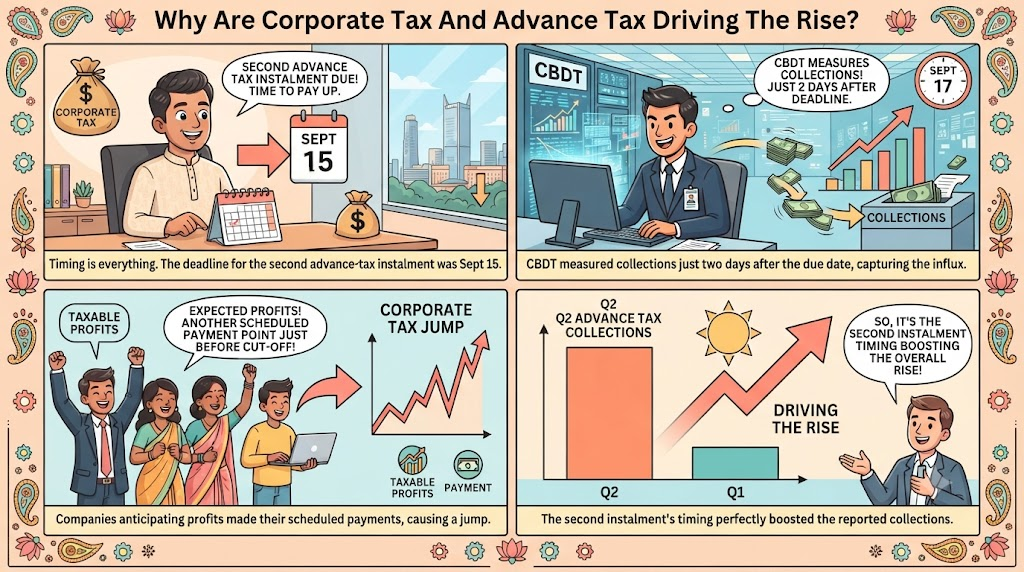
The timing of the release helps explain the corporate jump. The second advance-tax instalment for Tax Year 2026-27 fell due on September 15, and CBDT measured collections only 2 days later. Companies expecting taxable profits during the year had another scheduled payment point just before the cut-off.
Corporate advance tax rose to about ₹4.16 lakh crore, while total advance-tax receipts reached roughly ₹5.22 lakh crore. Net corporate tax moved to around ₹5.56 lakh crore, 19.48% above the corresponding FY26 period. That was much faster than the 12.96% increase in overall net direct taxes.
The table below keeps the main figures together. The September collection numbers come from CBDT, while the annual target comes from the Union Budget 2026-27 documents released through the Press Information Bureau on February 1, 2026.
The table also explains why gross and net growth differ. Before refunds, collections stood near ₹14.32 lakh crore. After refunds, the number came down to ₹12.12 lakh crore. STT rose sharply too, although FY27 rate changes on derivatives mean the increase should not be treated as a pure measure of trading-volume growth.
The Budget changed STT rates on derivatives from April 1, 2026, including higher rates on futures and options. That makes the STT jump harder to read as a simple increase in investor activity. A part of the rise comes from the tax-rate change itself, rather than only from more trades taking place.
CBDT’s official June 17 release put net direct tax collections at ₹5.21 lakh crore, up 14.64% from the comparable FY26 period. Advance tax was ₹1.78 lakh crore then, after the first instalment of the tax year. By August 10, net collections had reached ₹8.11 lakh crore, and the reported growth rate was 23.09%. September’s 12.96% growth is lower, yet the amount collected has continued to rise. The change comes from a different comparison base, fresh advance-tax payments and a larger refund outgo. A growth percentage recorded earlier in the year cannot simply be carried forward.
September also arrived immediately after another advance-tax due date, bringing more estimated company profits into the tax system. The Ministry of Finance’s FY27 fiscal framework, published through PIB on February 1, set direct taxes at ₹26.97 lakh crore, or 61.2% of projected gross tax revenue. The ₹12.12 lakh crore collected by September 17 is roughly 45% of that annual estimate.
The earlier numbers are useful because tax collection does not move evenly every month. Due dates bring large payments into the system, while refunds can pull net receipts down later. That helps explain why the growth rate can fall from August to September even while the actual amount of tax collected continues to climb.
Jayesh Sanghvi, Tax Partner at EY India, described the collection trend as broad-based and pointed to corporate and non-corporate taxes contributing almost equal shares of gross direct taxes. He also compared tax growth with nominal GDP assumptions in the FY27 Budget, saying tax buoyancy had improved from the previous financial year.
Richa Sawhney, Partner, Tax at Grant Thornton Bharat, linked the advance-tax performance with business earnings and taxpayers’ expectations for the year. She said steady advance-tax payments indicate healthy economic activity and strength in the tax base. That reading is relevant because advance tax is paid on estimated income before the year closes.
For businesses, the response is fairly basic. Profit estimates should be revisited before later instalments, TDS and other credits should be matched, and any shortfall should be corrected before year-end. A business that earns more than it expected earlier in FY27 may need to adjust its next advance-tax payment rather than leaving a large balance for later.
For households, the national collection figure should not drive a tax decision. Form 26AS, AIS, the filed return and the refund claim are far more relevant to an individual case. This is also where the wider numbers need some restraint. Higher collections can come from stronger profits, higher taxable incomes, better compliance, rate changes or timing differences. One headline number cannot separate every factor.
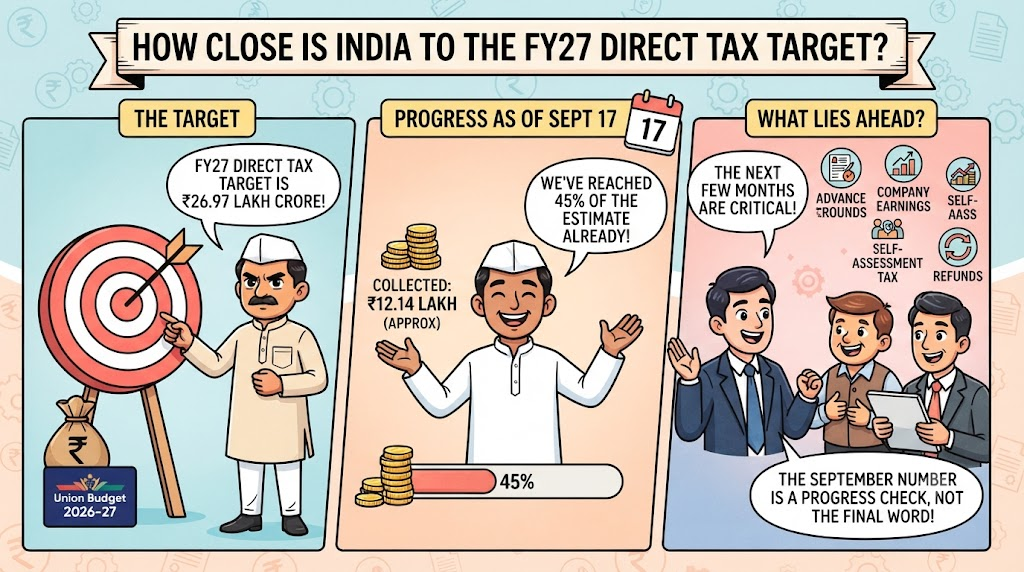
The Union Budget 2026-27 has put the direct tax target at ₹26.97 lakh crore. By September 17, collections had reached about 45% of that estimate. That is a sizeable portion for this stage of FY27, though there is still a long stretch left before the financial year closes. What happens next will depend on the later advance-tax rounds, company earnings and the amount paid through self-assessment tax. Refunds can change the final net figure as well. So, even with collections moving at a healthy pace now, the September number should be read as a progress check rather than an indication of where FY27 will finish.
FY26 provides a useful comparison. Provisional net direct tax collections for that year were about ₹23.40 lakh crore. The FY27 estimate is therefore higher by a noticeable amount. September has brought the government closer to its annual goal, but much of the collection still has to come from the second half of the year.
The next few months will be more revealing. December and March advance-tax payments usually bring another round of receipts, while refunds continue alongside them. That push and pull will decide how close the final FY27 figure comes to the Budget estimate.
India’s direct tax collections have entered the second half of September with corporate payments doing much of the heavy lifting. Net receipts reached ₹12.12 lakh crore by September 17, while corporate tax grew 19.48%. Advance tax also rose after the September 15 instalment.
The stronger intake helps the government’s FY27 revenue position, but the story is still developing. Refunds are rising quickly, and more than half of the annual direct-tax target remains to be collected. For taxpayers, there is no new levy hidden inside the 13% headline. Companies are paying more tax, advance collections are holding up, and the Centre has reached about 45% of its full-year direct-tax estimate before the financial year’s halfway point.
It does not mean salary tax rates have risen by 13%. The figure compares total net direct tax receipts with the same period last year. An employee’s liability still depends on taxable income, the applicable regime and the details reported in the return.
Corporate tax received support from company payments and the September advance-tax instalment. Net corporate tax rose 19.48%, while overall net direct tax collections grew 12.96%. Higher refunds and slower growth in some non-corporate receipts kept the combined rate lower.
No such conclusion can be drawn from this release. The September data are a collection update, not a tax-policy announcement. Any new rate, levy or slab would require a separate legal or Budget change.
Gross collections show what the tax department receives before refunds. Net collections subtract refunds from that amount. In FY27 so far, refunds have increased faster than gross receipts, which is why net growth is lower.
Not yet. Net receipts of ₹12.12 lakh crore are roughly 45% of the ₹26.97 lakh crore Budget estimate. Later advance-tax instalments, company profits, self-assessment tax and refunds will decide how quickly the remaining gap closes.









.png&w=3840&q=75)


