
By continuing, you agree to LoansJagat's Credit Report Terms of Use, Terms and Conditions, Privacy Policy, and authorize contact via Call, SMS, Email, or WhatsApp
Disclaimer: The information published on LoansJagat is intended for general informational and educational purposes only and should not be considered financial, legal, or investment advice. Interest rates, loan terms, statistics, and other data may change over time and may vary by lender or source. Please verify the latest information and consult a qualified financial advisor or the respective Bank/NBFC before making any financial decisions.
Subscribe Now
About the author

LoansJagat Team
‘Simplify Finance for Everyone.’ This is the common goal of our team, as we try to explain any topic with relatable examples. From personal to business finance, managing EMIs to becoming debt-free, we do extensive research on each and every parameter, so you don’t have to. Scroll up and have a look at what 15+ years of experience in the BFSI sector looks like.
Related Blog Post
Simplify All Your Loans Into One Affordable EMI

Customers Served

Debt Consolidated

1200+ Reviews

Locations in India
Club all Loans & Credit Card Bills into Single EMI

Quick Apply Loan
Consolidate your debts into one easy EMI.

Takes less than 2 minutes. No paperwork.

10 Lakhs+
Trusted Customers

2000 Cr+
Loans Disbursed

4.7/5
Google Reviews

50+
Banks & NBFCs Offers
Other services mentioned in this article
Key Takeaways
The Indian currency witnessed an all-time low level of 95.73 in relation to the US dollar in the interbank foreign exchange markets on May 12, 2026.
This decline is caused by soaring crude oil rates and the increasing risk of the volatile US-Iran cease-fire.
The analysts at ANZ Research predict that the Indian currency will be valued at 97.5 against the US dollar by the end of 2026.
From the short-term perspective, this indicates increased costs for importing goods and other products into India.
From the long-term perspective, such currency fluctuations might lead to inflation in India and problems with the country's trade balance.
Currently, the currency rate of the rupee has fallen by 5.48% in the calendar year against the US dollar.
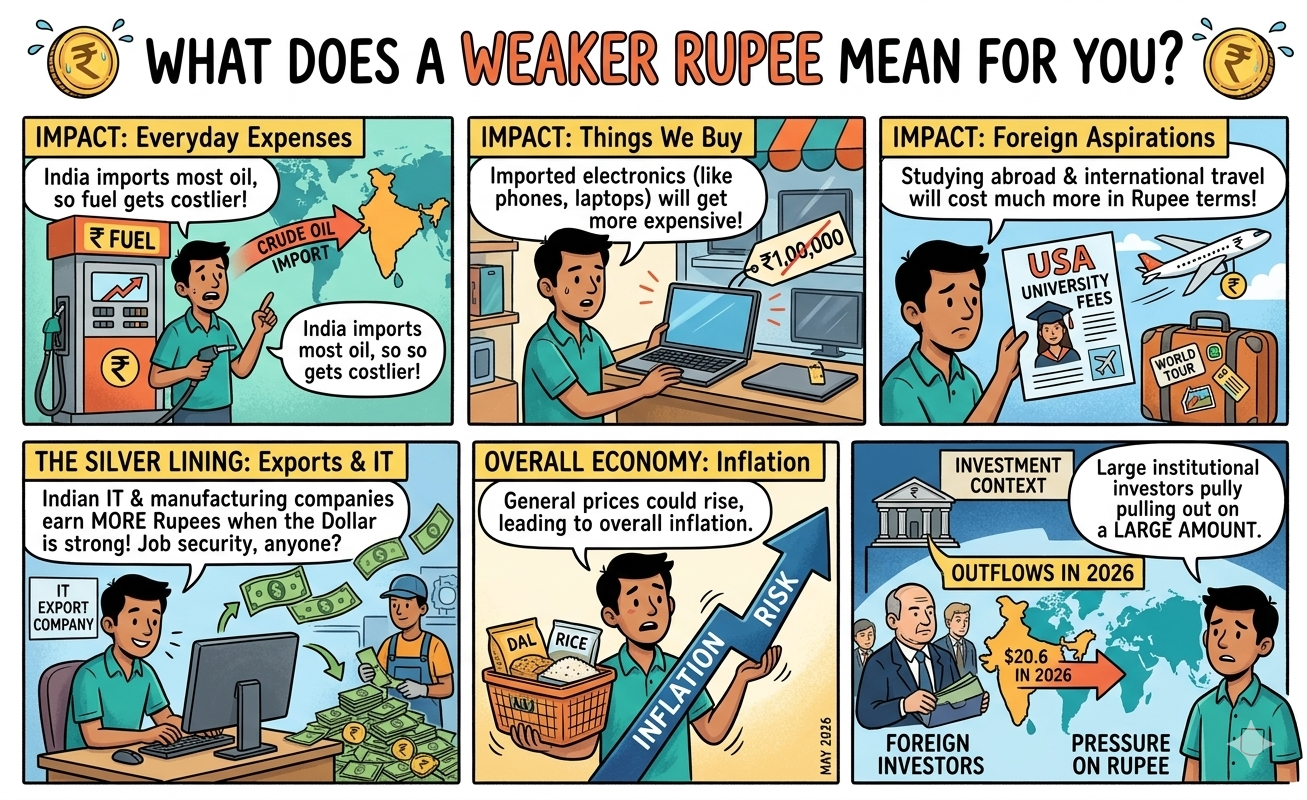
A falling rupee directly raises costs for everyday Indians. Fuel prices could go up as India imports most of its crude oil. Foreign education fees and overseas travel will become more expensive.
However, one silver lining exists: Indian exporters, especially in IT and manufacturing, earn more in rupee terms when the dollar is strong.
Foreign investors have pulled out around $20.6 billion so far in 2026, exceeding total outflows for all of 2025. This has added direct pressure on the rupee.
Dhiraj Nim, Economist and FX Strategist at ANZ Research, told CNBC-TV18 that the RBI is unlikely to let the rupee touch 100. “We do not think that the RBI will let the rupee go to that 100 level in the near future,” he said. He added that a rupee at 100 would complicate inflation and force a policy shift.
Nim also noted that “every option for the RBI is on the table,” including FCNR(B) deposit schemes and interest rate hikes. Market participants say the RBI may revive an FCNR deposit scheme similar to 2013, which had mobilised around $38 billion over three years by attracting dollar deposits from non-resident Indians.
The RBI has also capped banks’ net open onshore positions at $100 million and banned banks from offering non-deliverable derivatives to residents as immediate steps to curb volatility.
The rupee is under real and sustained pressure. ANZ’s forecast of 97.5 by year-end signals more weakness ahead, but a managed one. RBI is well equipped with means, and they have also shown a willingness to employ them. For the time being, crude oil prices and the US-Iran standoff will be the key points.
Why is the Indian rupee falling so sharply against the US dollar in 2026, and how will it affect inflation in India?
A weak rupee makes foreign goods more expensive for India, especially crude oil, electronic items, and machinery bought from other countries. Higher oil prices and consistent sales by foreign entities have added pressure to the rupee recently. With increasing costs of imports, businesses raise prices, resulting in increased prices of fuel, transportation, and everyday commodities for the masses.
In case the dollar appreciates near ₹100, what measures can be taken to strengthen the rupee position?
The Reserve Bank of India can conduct sales of dollars in the foreign exchange market. The other way to do so is by increasing the inflow of foreign currencies via NRI deposit accounts. This can be done by increasing the interest rate and imposing stricter regulations in the foreign currency market. Apart from that, low oil prices and new foreign investments will also contribute to stabilizing the currency.
Related Finance News | |||
*T&C Apply









.png&w=3840&q=75)



