By continuing, you agree to LoansJagat's Credit Report Terms of Use, Terms and Conditions, Privacy Policy, and authorize contact via Call, SMS, Email, or WhatsApp
Disclaimer: The information published on LoansJagat is intended for general informational and educational purposes only and should not be considered financial, legal, or investment advice. Interest rates, loan terms, statistics, and other data may change over time and may vary by lender or source. Please verify the latest information and consult a qualified financial advisor or the respective Bank/NBFC before making any financial decisions.
Subscribe Now
About the author

Arshathul Afia
Arshathul Afia is a journalism graduate and fintech content writer with 4+ years of experience in digital publishing and research-led writing. She has written 200+ articles covering personal finance, lending, banking, digital payments, credit, insurance, and major financial developments in India. At LoansJagat, she focuses on simplifying complex fintech news, RBI updates, loan-related changes, policy developments, and industry trends for everyday readers. Her journalism background helps her approach stories with research, context, and clarity, while her SEO experience ensures content remains discoverable and relevant. She aims to make financial news easier to understand, practical, and useful for readers across India.
Related News
Simplify All Your Loans Into One Affordable EMI

Customers Served

Debt Consolidated

1200+ Reviews

Locations in India
Club all Loans & Credit Card Bills into Single EMI

Quick Apply Loan
Consolidate your debts into one easy EMI.

Takes less than 2 minutes. No paperwork.

10 Lakhs+
Trusted Customers

2000 Cr+
Loans Disbursed

4.7/5
Google Reviews

50+
Banks & NBFCs Offers
Other services mentioned in this article
GSTN has paused 2 e-Way Bill changes due from August 1, giving businesses more time while the current compliance system continues without disruption nationwide.
The Goods and Services Tax Network stopped 2 proposed e-Way Bill changes just days before their scheduled launch. According to Advisory No. 668 published on the GST Portal on July 29, 2026, mandatory Ship-To GSTIN capture and voluntary closure will not enter the production system on August 1. The instruction applies to taxpayers, transporters, ERP vendors, GST Suvidha Providers, Application Suvidha Providers and private Invoice Registration Portals across India.
For businesses, the immediate result is fewer last-minute software problems. A missing consignee GSTIN could have blocked an e-Way Bill at the warehouse gate, while an unfinished closure workflow might have confused staff handling delivered consignments. That risk has reduced for now. The longer-term difficulty has not gone away because GSTN has not announced another date. Companies have to keep their technical work ready without switching it on.
Consumers are unlikely to notice any direct change in tax, pricing or paperwork. The effect will be inside the supply chain. Manufacturers, distributors, online sellers and wholesalers often create invoices and e-Way Bills shortly before a vehicle leaves. A failed validation at that stage can delay loading. One truck missing its slot can also disturb the next delivery on the same route.
Consider a distributor in Delhi that bills a retailer in Jaipur but sends goods directly to a warehouse in Ajmer. Under the proposed rule, the system would ask for the GSTIN linked to the delivery location. If the sales team entered an old registration or received the details late, the document could fail. The August 1 freeze allows that consignment to move through the existing process while the supplier corrects its records.
The Press Information Bureau has described the e-Way Bill as part of the digital framework used to record movement of goods under GST. Current legal requirements still apply. Businesses must generate an e-Way Bill wherever required, update vehicle information and follow validity rules. GSTN has paused only the 2 proposed additions.
Prashanth Agarwal, Partner at PwC India, had warned that the proposed changes would require alterations to ERP systems and customer databases. Business Standard reported his comments on July 28, 2026, a day before GSTN announced the freeze. He suggested giving businesses at least 3 to 6 months for preparation and testing.
Agarwal also raised questions about transactions where billing and delivery locations use the same GSTIN. Automated systems need precise rules for such cases. Without them, a genuine branch or warehouse delivery may be pushed into the wrong transaction category, leading to rejection or manual correction.
ERP teams should retain new data fields, API changes, and closure screens in a testing environment. Tax teams can continue checking GSTINs, PIN codes and delivery addresses. Production systems should remain untouched until GSTN issues another advisory. This is especially important for companies using automatic e-Invoice and e-Way Bill generation.
Businesses can use the gap to review direct deliveries, branch transfers, rejected goods and consignments involving unregistered recipients.
The first proposal concerned the Ship-To GSTIN field in Bill-to/Ship-to transactions. Such a transaction involves an invoice raised on 1 party while the goods travel to another person or location. This arrangement is common in distribution, contract manufacturing, and online commerce.
Suppose a manufacturer in Gujarat sells machinery to a dealer in Maharashtra. The dealer asks the manufacturer to send the machine directly to a factory in Karnataka. The Maharashtra dealer is the billed party, while the Karnataka factory is the delivery party. GSTN wanted the GSTIN of the actual recipient entered in the Ship-To field.
Where the final consignee did not have a GSTIN, the user could enter “URP”, meaning unregistered person. The proposed validations also expected the Bill-To and Ship-To GSTINs to differ. GSTIN, address, state and PIN-code details had to match the selected transaction.
The second feature was voluntary closure after delivery. A supplier, recipient, transporter, driver or another authorised person could record that goods had reached the destination. Cancellation covers a wrong or unused e-Way Bill. Closure would show that the journey had finished.
Earlier GSTN FAQs said users could close a bill on the delivery date or the next day, with access available until 1 day after its validity expired. The facility was voluntary at launch. Companies still wanted answers about edits after closure, missed closure dates and possible audit questions.
Technology preparation was the largest concern. Some firms use the government portal directly. Others rely on ERP software, GST Suvidha Providers, e-Invoice systems or private Invoice Registration Portals. A field change can pass through several connected systems before a document reaches the transporter.
A company may need to revise its customer master, billing screen and API request. Testing must also cover cancellations, returns, multi-state deliveries and unregistered buyers.
Commercial confidentiality created another problem. A dealer may not want a manufacturer to identify the final customer. Although GSTN had said the Ship-To GSTIN would not appear on the printed e-Way Bill or through GET e-Way Bill APIs, businesses still had to control who could view it internally.
Data quality was another weak point. Customer records may carry an old address, cancelled GSTIN or an incomplete PIN code. Sales teams sometimes save a branch name without its registered details. The proposed validation could expose those errors during dispatch.
From a LoansJagat editorial view, the pause is useful only when businesses use it to repair those records. Readers looking for the present process can refer to the LoansJagat e-Way Bill guide.
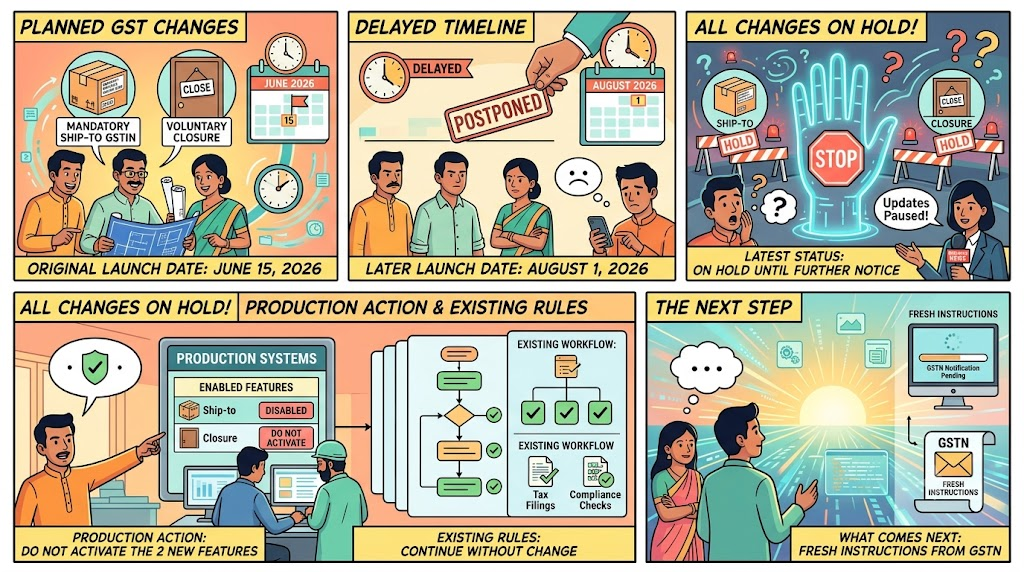
The changes passed through an initial launch plan, a postponement, technical instructions and FAQs before GSTN stopped them. The sequence is set out below.
The July 29 decision differs from the June postponement. GSTN has removed the deadline without giving a replacement. Earlier advisories and FAQs connected with the rollout were also marked for withdrawal from the portal.
Development work may still be useful, but the old technical instructions are not final. GSTN could return with revised validations or a different closure process.
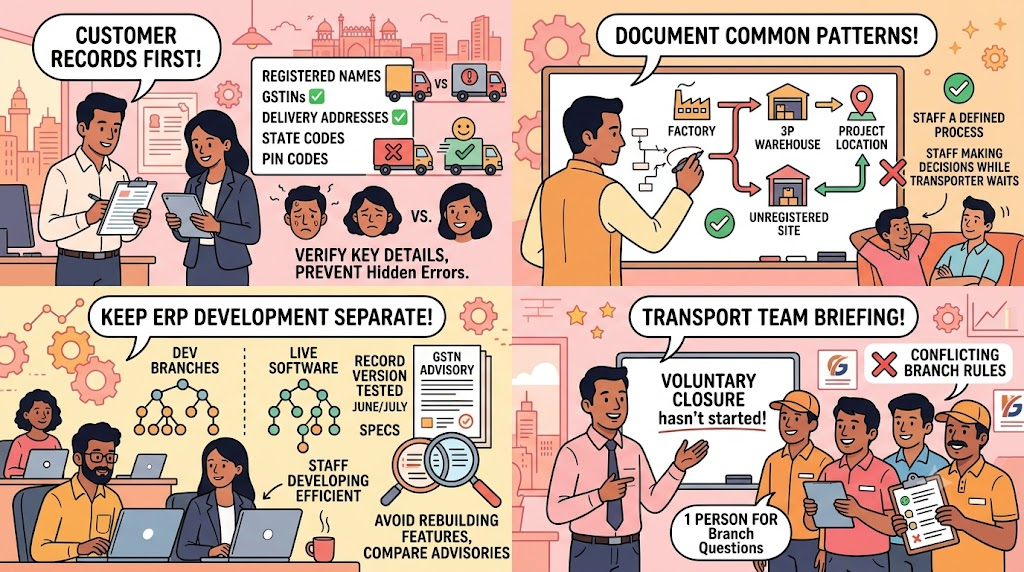
Customer records should come first. Businesses can verify registered names, GSTINs, delivery addresses, state codes and PIN codes. Errors often remain hidden until a vehicle is ready to leave.
Tax teams should document common Bill-to/Ship-to patterns. A company may deliver to a factory, third-party warehouse, project location or unregistered site. Each pattern needs a defined process. Staff should not have to decide the transaction type while a transporter waits.
ERP vendors can keep development branches separate from live software and record which version was tested against the June and July specifications. When GSTN releases another advisory, developers can compare the instructions instead of rebuilding the feature.
Transport teams need a short briefing too. Drivers and warehouse operators should know that voluntary closure has not started. No delivery should be delayed because a closure option is missing. Companies with several branches can assign 1 person to collect questions and avoid conflicting internal rules.
GSTN’s July 29 advisory has stopped 2 e-Way Bill changes that were due to begin on August 1. Mandatory Ship-To GSTIN capture and voluntary closure will remain outside the production system until another notice arrives.
The decision reduces immediate pressure on businesses handling large customer databases, direct deliveries and automated invoice systems. It may also prevent genuine consignments from being delayed by untested validations.
The pause is temporary, not a withdrawal of the proposals. Companies should continue with the existing e-Way Bill process, retain completed technology work and use the extra time to correct consignee data. The next GSTN notice will decide whether the 2 features return in the same form or with revised rules.
It usually reports e-Way Bills linked to a GSTIN and does not mean the paused changes have started.










.png&w=3840&q=75)


