
By continuing, you agree to LoansJagat's Credit Report Terms of Use, Terms and Conditions, Privacy Policy, and authorize contact via Call, SMS, Email, or WhatsApp
Disclaimer: The information published on LoansJagat is intended for general informational and educational purposes only and should not be considered financial, legal, or investment advice. Interest rates, loan terms, statistics, and other data may change over time and may vary by lender or source. Please verify the latest information and consult a qualified financial advisor or the respective Bank/NBFC before making any financial decisions.
Subscribe Now
About the author

Arshathul Afia
Arshathul Afia is a journalism graduate and fintech content writer with 4+ years of experience in digital publishing and research-led writing. She has written 200+ articles covering personal finance, lending, banking, digital payments, credit, insurance, and major financial developments in India. At LoansJagat, she focuses on simplifying complex fintech news, RBI updates, loan-related changes, policy developments, and industry trends for everyday readers. Her journalism background helps her approach stories with research, context, and clarity, while her SEO experience ensures content remains discoverable and relevant. She aims to make financial news easier to understand, practical, and useful for readers across India.
Related News
Simplify All Your Loans Into One Affordable EMI

Customers Served

Debt Consolidated

1200+ Reviews

Locations in India
Club all Loans & Credit Card Bills into Single EMI

Quick Apply Loan
Consolidate your debts into one easy EMI.

Takes less than 2 minutes. No paperwork.

10 Lakhs+
Trusted Customers

2000 Cr+
Loans Disbursed

4.7/5
Google Reviews

50+
Banks & NBFCs Offers
Other services mentioned in this article
Borrowers who close loans early can cut interest costs, but credit score benefits depend on closure status, repayment history and bureau reporting accuracy after payment.
Early loan closure has become a personal finance talking point after a Mint report dated 5 August 2026 said borrowers may save interest by paying off loans early, but they should not expect a quick credit score jump. The report involved borrowers, lenders, credit bureaus and financial advisers in India. The issue is simple: a paid loan helps only when the credit file shows the right status.
For Indian borrowers, the short-term impact is useful. One EMI goes away. Interest cost falls. A household gets more money for rent, school fees or daily expenses. The long-term impact is slower. If the lender reports the closure late, or if the account is marked as “settled” instead of “closed”, the borrower may face trouble during the next loan application.
A credit score is not based on one repayment event. It reads the borrower’s overall repayment behaviour, credit card usage, active accounts, old credit history, loan enquiries and past defaults. So a borrower who closes a personal loan early but keeps a high credit card balance may not see a fast rise.
There is another point borrowers often miss. A long-running loan with on-time EMI history can support the credit file while it stays active. Once it closes, the borrower has less active credit history showing fresh repayments. That does not make early closure bad. It only means the score may move slowly, and sometimes it may fall a little before stabilising.
The effect can show up when a borrower applies for fresh credit soon after closing an old loan. A salaried borrower in Bengaluru may close a consumer durable loan and apply for a car loan after 30 days. If the old loan still appears active, the lender may calculate a higher debt burden. The approval can get delayed, or the loan offer may become less favourable.
The positive side is still strong. Borrowers who close high-interest loans early can protect their monthly cash flow. For small traders, self-employed workers and young salaried customers, removing 1 costly EMI can reduce pressure. It can also make room for insurance, emergency savings or business stock. The benefit is financial first, credit score second.
Before reading the numbers, the borrower should keep one thing in mind. India’s credit base is no longer limited to big-city salaried customers. Formal banking and small-ticket loans now reach villages, semi-urban areas and first-time borrowers.
These numbers show why loan closure reporting has become a borrower-level issue. A wrong credit entry can now affect a first-time loan seeker, a MUDRA borrower, a salaried employee or a shop owner using digital loan channels.
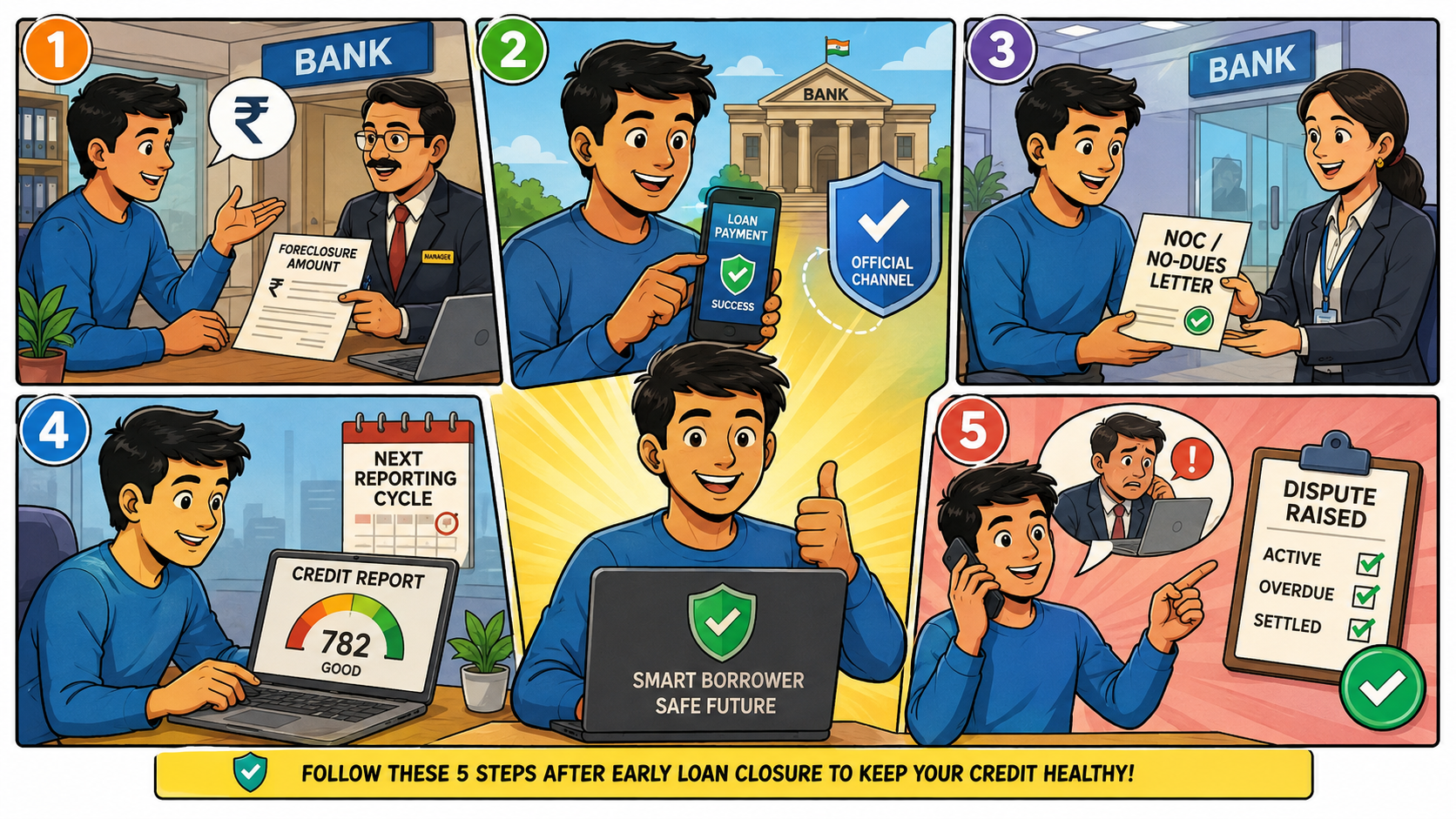
Loan closure should not end with the final payment. Borrowers should follow this 5-step check:
This is a small habit, but it can save borrowers from rejection later. A person applying for a home loan after closing a personal loan should not wait until the lender finds the error.
Kaushik Chatterjee, Founder and CEO of LendingPlate, told Mint that early repayment reflects responsible financial behaviour, but it may not immediately raise a credit score. The stronger credit signals still come from timely repayments, responsible borrowing and consistent account management.
Atul Monga, CEO and Co-founder of BASIC Home Loan, said early repayment can reduce interest burden and improve the borrower’s financial position. Vijendra Singh Shekhawat, CEO of Choice Finserv Pvt. Ltd., added that clean foreclosure is reported as “closed”, while borrowers should avoid a “settled” tag.
The practical answer is not to keep an expensive loan alive only for the score. If the loan carries high interest and the borrower has enough emergency savings, early closure can be a smart move. But the borrower should protect the credit file after payment. That means keeping proof, checking the report and correcting errors quickly.
LoansJagat has also pointed out in its borrower guide that timely repayment, lower credit use and regular report checks can improve approval chances. Its credit report guidance also flags wrong active loans, duplicate accounts and delayed closure updates as entries that can hurt borrowers even after payment. This is where the borrower’s own follow-up becomes important, not optional.
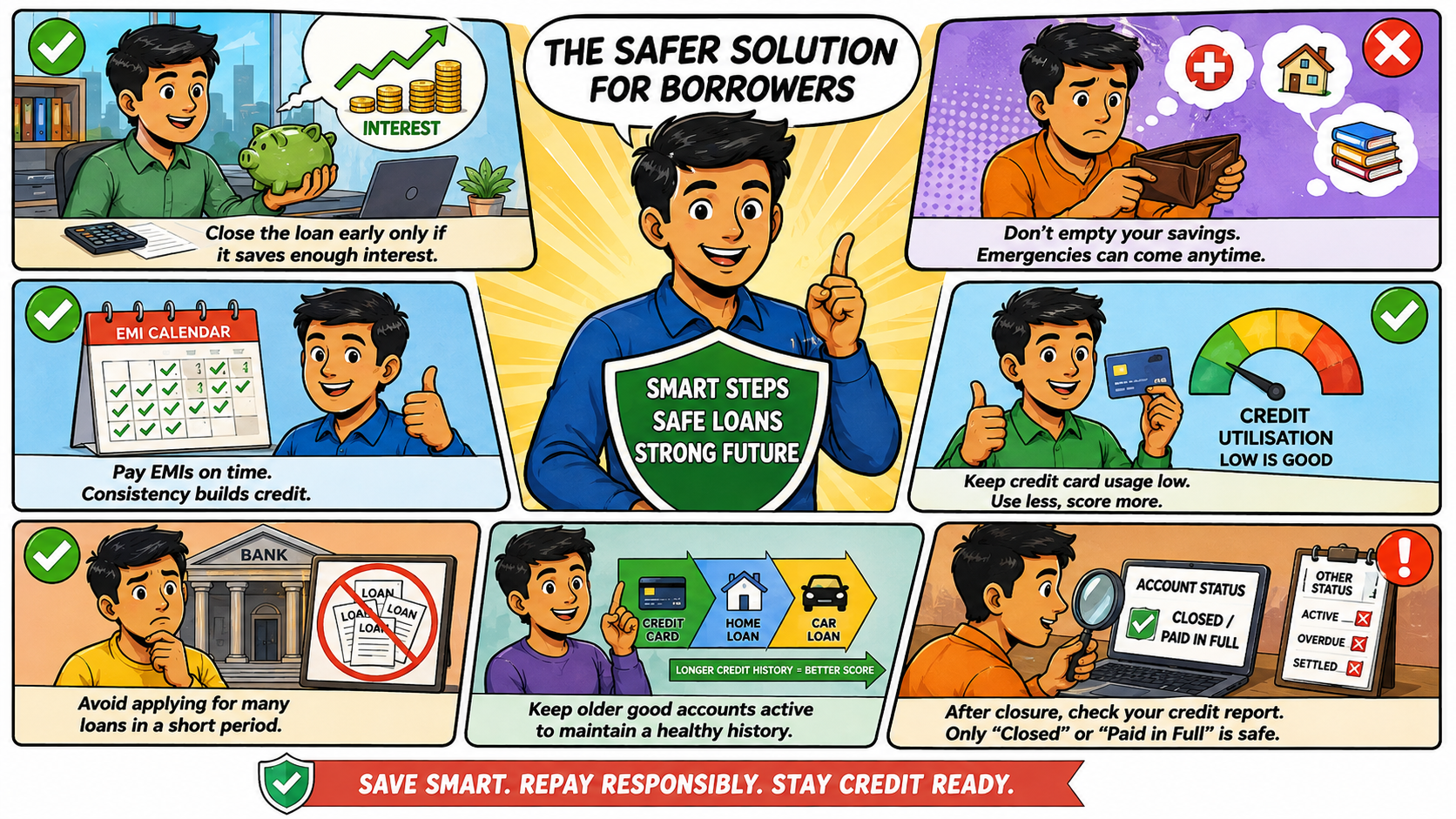
The safest route is simple. Close the loan early only if it saves enough interest and does not empty emergency savings. A borrower should not use all available cash to close a loan and then borrow again for medical bills, rent or school fees after 2 months.
Credit score repair needs slower work. Pay EMIs on time. Keep credit card usage low. Do not apply for too many loans within a short period. Keep older good accounts active when possible. After closing a loan, check whether the account says “closed” or “paid in full." Anything else needs attention.
Early loan closure can help borrowers save money. That part is real. A costly personal loan, consumer loan or vehicle loan can drain income if it continues for the full tenure. Paying it early can free the borrower from that pressure.
The credit score result is different. It depends on the whole credit file and the way the lender reports the closure. Borrowers should close loans for the right reason: interest saving and lower debt. For the score, they should watch the report, keep documents ready and fix wrong entries before the next loan application.
It may help the credit profile, but it does not guarantee an immediate credit score rise.
The score may dip if the closed loan reduced active credit history or changed credit profile.
Close it early if interest savings are high and emergency savings remain safe after payment.
Loan closure means the borrower has paid the full loan amount with interest and charges. Loan settlement means the lender accepted a lower amount because the borrower could not repay fully. A closed loan is better for credit history, while a settled loan can hurt future loan approvals.
Collect the NOC, keep payment proof and check the credit report after the lender updates.









.png&w=3840&q=75)


