
.png&w=3840&q=65)
By continuing, you agree to LoansJagat's Credit Report Terms of Use, Terms and Conditions, Privacy Policy, and authorize contact via Call, SMS, Email, or WhatsApp
Disclaimer: The information published on LoansJagat is intended for general informational and educational purposes only and should not be considered financial, legal, or investment advice. Interest rates, loan terms, statistics, and other data may change over time and may vary by lender or source. Please verify the latest information and consult a qualified financial advisor or the respective Bank/NBFC before making any financial decisions.
Subscribe Now
About the author

Arshathul Afia
Arshathul Afia is a journalism graduate and fintech content writer with 4+ years of experience in digital publishing and research-led writing. She has written 200+ articles covering personal finance, lending, banking, digital payments, credit, insurance, and major financial developments in India. At LoansJagat, she focuses on simplifying complex fintech news, RBI updates, loan-related changes, policy developments, and industry trends for everyday readers. Her journalism background helps her approach stories with research, context, and clarity, while her SEO experience ensures content remains discoverable and relevant. She aims to make financial news easier to understand, practical, and useful for readers across India.
Related Blog Post
Simplify All Your Loans Into One Affordable EMI

Customers Served

Debt Consolidated

1200+ Reviews

Locations in India
Club all Loans & Credit Card Bills into Single EMI

Quick Apply Loan
Consolidate your debts into one easy EMI.

Takes less than 2 minutes. No paperwork.

10 Lakhs+
Trusted Customers

2000 Cr+
Loans Disbursed

4.7/5
Google Reviews

50+
Banks & NBFCs Offers
Other services mentioned in this article
EPF Scheme 2026 lets employers stop voluntary PF above ₹15,000, but the compulsory ₹1,800 monthly employer contribution remains protected for eligible employees in payroll reviews.
The Ministry of Labour and Employment notified the EPF Scheme 2026 through
The change does not permit an employer to stop statutory PF. The compulsory contribution continues at 12% from the employee and 12% from the employer on wages up to ₹15,000. That means ₹1,800 from each side every month. The issue begins only when a company has been paying more than this through a voluntary arrangement.
Employees whose PF already follows the ₹15,000 ceiling may not see any change. Their salary slip already shows the compulsory contribution pattern. The sharper impact falls on employees in private companies where PF is calculated on full basic pay or a higher wage base.
There is a small positive side too. If the employee’s own PF deduction is reduced, monthly take-home pay may rise. That can help households handling rent, EMIs, school fees or medical bills. But this benefit works only when the worker does not spend the full extra amount. A part of that money should move into another retirement product.
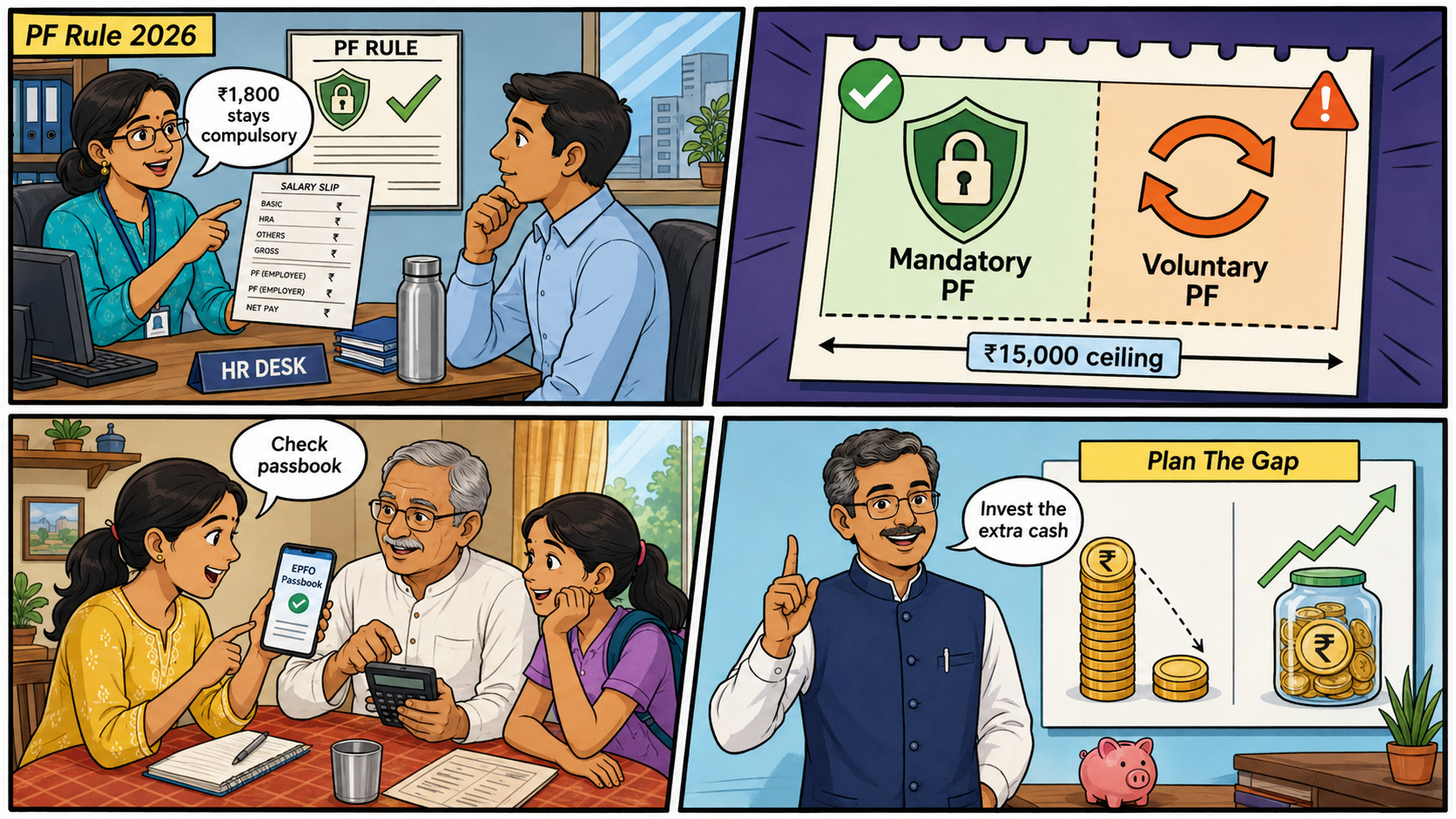
The 2026 scheme says contributions may be restricted to the amount payable on the wage ceiling when wages cross that ceiling. Any contribution above this level is voluntary. Either the employer or employee can reduce or discontinue the extra amount later.
The table below shows the basic position employees need to check before reading the change as a salary hike.
Employees need to know that a voluntary PF cut is not the same as PF default. It is a compliance failure when the employer deducts PF from the salary and does not make a deposit in the EPFO account. If the employer only stops the additional contribution above ₹1,800, we will address it based on the employment contract, the CTC structure, and the company policy.
The first sign of change will not arrive as a separate government notice for most workers. It will appear in the salary slip, probably as a smaller employer PF figure or a changed deduction line. That is why employees should compare the new payslip with the previous 2 or 3 months before accepting the revision. A drop from ₹6,000 to ₹1,800 may look like extra salary, but the employer-side reduction may simply stay within the company’s cost structure.
A practical check starts with 3 documents: the appointment letter, the CTC annexure and the EPFO passbook. If the offer letter promised PF on actual basic salary, employees can ask HR whether the company is changing that term formally. If the CTC sheet shows employer PF separately, the employee should ask where the reduced amount will move. It may go to monthly pay, another allowance or no visible line at all, depending on the company policy.
The bigger concern is habit. Many salaried workers treat EPF as forced savings because the money leaves before monthly spending begins. Once that deduction falls, the extra cash can disappear into groceries, fuel, rent hikes or card bills. Employees who gain take-home pay should set up a separate monthly investment on salary day itself. Otherwise, the PF change may feel harmless in 2026, then show up as a weaker retirement balance years later.
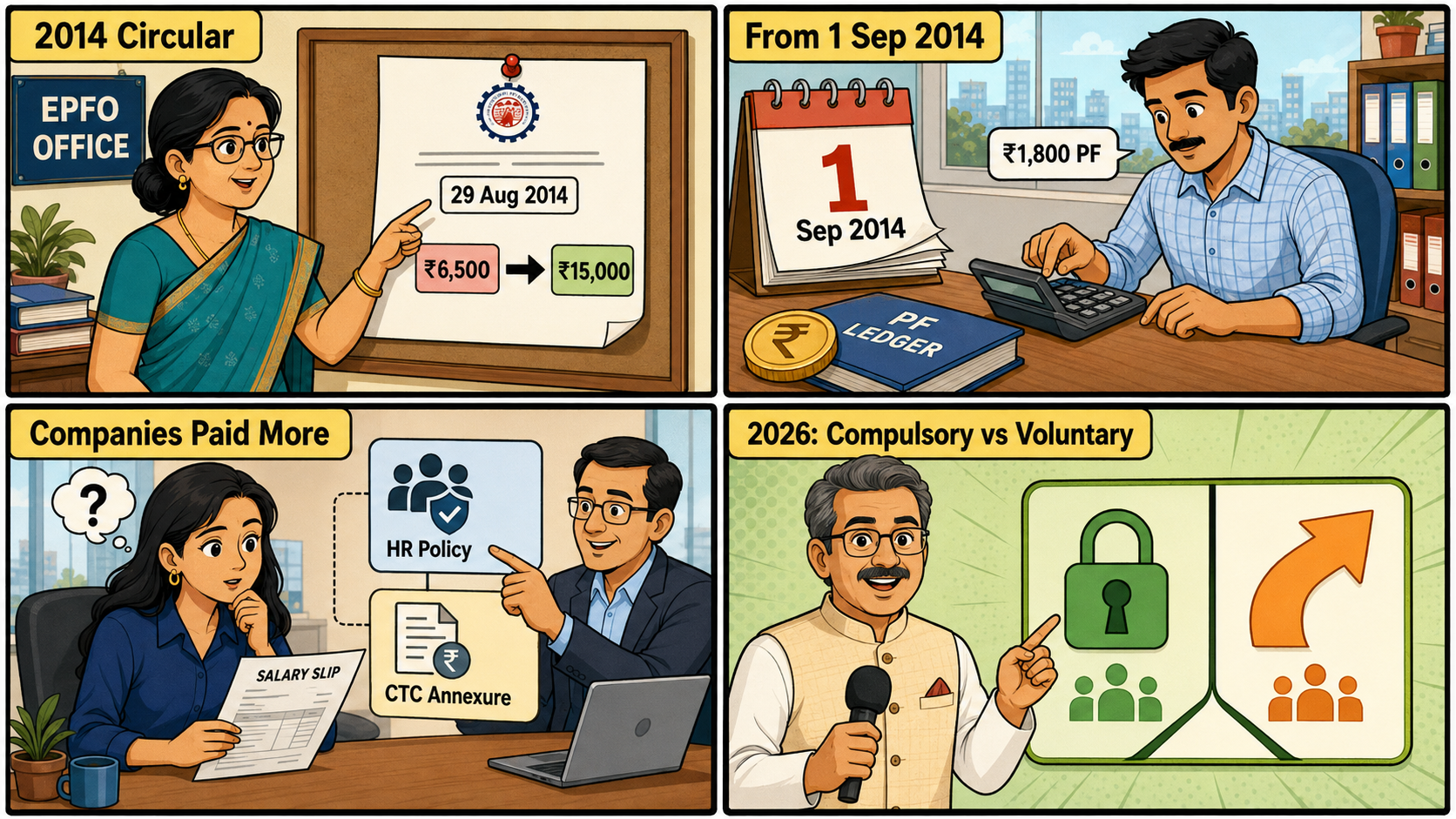
The ₹15,000 wage limit isn't something that just showed up. EPFO had already raised it once before, from ₹6,500, through a circular dated 29 August 2014, and this came into effect from 1 September 2014. Since then, ₹1,800 has remained the common statutory monthly employer contribution where PF is restricted to the ceiling.
Many companies still paid more. Some did it through internal HR policy. Some showed higher employer PF in the CTC annexure. For employees, this looked like a fixed part of retirement savings. EPF Scheme 2026 now gives employers stronger wording to separate compulsory PF from voluntary PF.
Tarun Garg, Partner at Deloitte India, has said employees can contribute more voluntarily, while employers are not bound to match the extra amount. He also indicated that existing contribution patterns may not fall automatically because employers must revisit their current arrangement first. Parizad Sirwalla of KPMG India has pointed to wage-definition issues under labour codes, which may affect how companies calculate the contribution base.
The practical solution is not panic. Employees should ask HR for a written breakup of compulsory PF, voluntary employer PF and the revised CTC impact. They should check the EPFO passbook after the next salary cycle. LoansJagat’s reading of this update is that a higher salary credit may help cash flow, but the worker should invest the freed-up amount instead of treating it as spare spending money.
The Central Board of Trustees examined the new EPF, EPS, and EDLI schemes at the 239th meeting dated 2 March 2026. The Press Information Bureau states that the Board suggested that the annual EPF interest be fixed at 8.25% for FY 2025-26 and noted that EPFO’s corpus is above ₹28.34 lakh crore in March 2025.
That background matters for employees because PF is not only a monthly deduction. It earns annual interest after the government process is completed. A lower employer deposit today can remove both the monthly contribution and the future interest on that contribution.
EPF Scheme 2026 gives employers the option to stop voluntary PF contributions above the statutory wage ceiling. It does not remove the compulsory ₹1,800 monthly employer contribution where the ceiling applies.
Employees should read the next salary slip carefully, check the EPFO passbook and ask HR for the revised breakup in writing. A bigger salary credit may look useful now, but a missing monthly PF deposit can reduce retirement savings over several years.
No. The employer cannot stop compulsory PF. The rule applies only to voluntary contributions above the ₹15,000 wage ceiling.
It may increase if the employee-side deduction is reduced. Employer-side savings depend on the CTC and payroll policy.
Employees who need retirement savings can continue voluntary PF from their side, but they should compare liquidity and tax needs first.
It can feel like one if the employer-side PF was part of CTC. Employees should check the appointment letter and CTC annexure.
Employees can check the EPFO passbook after salary processing. Any deduction not deposited should be raised with payroll in writing.








.png&w=3840&q=75)


