
By continuing, you agree to LoansJagat's Credit Report Terms of Use, Terms and Conditions, Privacy Policy, and authorize contact via Call, SMS, Email, or WhatsApp
Disclaimer: The information published on LoansJagat is intended for general informational and educational purposes only and should not be considered financial, legal, or investment advice. Interest rates, loan terms, statistics, and other data may change over time and may vary by lender or source. Please verify the latest information and consult a qualified financial advisor or the respective Bank/NBFC before making any financial decisions.
Subscribe Now
About the author

Arshathul Afia
Arshathul Afia is a journalism graduate and fintech content writer with 4+ years of experience in digital publishing and research-led writing. She has written 200+ articles covering personal finance, lending, banking, digital payments, credit, insurance, and major financial developments in India. At LoansJagat, she focuses on simplifying complex fintech news, RBI updates, loan-related changes, policy developments, and industry trends for everyday readers. Her journalism background helps her approach stories with research, context, and clarity, while her SEO experience ensures content remains discoverable and relevant. She aims to make financial news easier to understand, practical, and useful for readers across India.
Related Blog Post
Simplify All Your Loans Into One Affordable EMI

Customers Served

Debt Consolidated

1200+ Reviews

Locations in India
Club all Loans & Credit Card Bills into Single EMI

Quick Apply Loan
Consolidate your debts into one easy EMI.

Takes less than 2 minutes. No paperwork.

10 Lakhs+
Trusted Customers

2000 Cr+
Loans Disbursed

4.7/5
Google Reviews

50+
Banks & NBFCs Offers
Other services mentioned in this article
India’s new EPF rules tighten oversight of exempted company trusts, requiring digital accounts, regular audits, electronic claims and stronger employer responsibility for worker savings nationwide.
Key Highlights
The Union Government notified the Employees’ Provident Funds Scheme, 2026 on 29 June 2026, replacing the Employees’ Provident Funds Scheme, 1952 after 74 years. The Official Gazette notification G.S.R. 525(E), published in Gazette No. 473, places tighter operating conditions on employers and trustees managing exempted provident fund trusts. The rules apply across India and require electronic member accounts, online claims, annual audits, regulated investments and stronger protection against losses.
Employees may face temporary account corrections while older trusts update KYC details, investment records and member-wise balances. Some claims may also require additional verification during this shift. The longer-term effect should be more useful. A worker should have online access to contributions, interest and withdrawals instead of depending entirely on the employer’s HR team for every account update.
A company with an exempted PF trust manages employee provident fund balances through its approved trust instead of placing the full administration with EPFO. That freedom now comes with sharper checks. The employer must transfer both employer and employee contributions to the board of trustees by the 15th of the following month. A delay can attract interest and damages under the Code on Social Security, 2020.
For employees, the greatest change is visibility. Trustees must maintain accounts electronically and issue annual statements within 2 months after the financial year closes. Members must also receive online balance access. This allows an employee to compare the PF deduction printed on a salary slip with the credit shown by the trust, rather than waiting until resignation to discover a missing entry.
The trust must accept withdrawal, advance and transfer claims electronically. It must also maintain a detailed record showing contributions credited, withdrawals made and interest earned. The board of trustees has to meet at least once every 3 months, with its meeting minutes submitted to the Regional Provident Fund Commissioner.
These changes will not automatically remove every delay. Data errors, old service records and incomplete Aadhaar or bank details can still hold up a claim. Yet an electronic acknowledgement gives the member dated evidence. That becomes useful when a trust says it never received an application or cannot trace an earlier transfer request.

The new scheme keeps the exemption route open for employers that offer provident fund benefits similar to or better than the statutory scheme. It does not permit a trust to operate as a closed company arrangement with limited employee access. EPFO can examine its accounts, returns, investments and claim records.
The main employee-facing requirements are listed below.
The annual audit requirement remains in place. A chartered accountant must audit the trust’s accounts every year, while the Regional Provident Fund Commissioner can order another audit when required. The same auditor cannot serve for 2 consecutive years and cannot handle the trust for more than 2 years within a 6-year block.
Employer responsibility also extends beyond paperwork. Any deficiency in the interest payable to members must be covered by the employer. A loss caused by fraud, defalcation or a wrong investment decision must also be restored within the period specified by the scheme.
The interest rule requires careful reading. A trust may declare an annual rate based on the income it earned, but the declared rate cannot exceed the Union Government’s EPF rate by more than 200 basis points, or 2 percentage points. That 2% figure is a ceiling, not an extra return promised to every exempted trust member.
Concerns over exempted trust administration appeared before the June notification. At the 238th CBT meeting held on 13 October 2025, members raised cases involving incomplete KYC records, pending audits, old trustee arrangements and workers who had struggled to receive PF balances after an exemption was cancelled.
The discussion moved forward at the 239th CBT meeting on 2 March 2026. According to the Press Information Bureau release ID 2234502, posted at 3:37 PM, the Board approved a simplified exemption SOP, revised conditions for exempted establishments and a one-time Amnesty Scheme. The SOP combined 4 earlier procedures and the Exemption Manual into one digital process.
The Board said the amnesty could address more than 100 active litigation cases, along with other pending disputes. It targeted trusts recognised under income tax law that had not obtained a formal EPF exemption, provided employees had received statutory benefits.
EPFO later issued Circular No. Exemption/AMNESTY-2026/[E.III/10(58)/2025] on 11 July 2026. The 6-month window runs up to 28 December 2026, though the Central Board can recommend an extension of up to another 6 months. The scheme does not wipe out proven contribution shortages, unpaid interest or delayed claims. Financial defaults remain recoverable.
Another concern involved unusually high interest declarations when only a small group of members remained in a trust. The 239th CBT minutes referred to earlier cases where rates reached 34%, allowing a limited number of members to receive a large share of the remaining corpus. The 200-basis-point ceiling aims to stop that outcome.
The Central Provident Fund Commissioner told the 239th CBT that supervision of exempted trusts required stronger member-level reporting. The proposed returns would record contributions, interest, settlements and withdrawals for each employee. The CPFC also supported passbook-style statements for members of exempted trusts.
Worker representatives wanted the rules followed on the ground. S.P. Tiwari proposed that employers should correct audit observations within 6 months before receiving a show-cause notice. R. Karumalaiyan asked for the SOP to remain focused on subscribers. Ashish Wig sought fixed timelines for granting, surrendering and cancelling exemptions.
Sunkari Mallesham raised a harder position. He said trusts remaining in default for several years should face withdrawal of exemption and transfer of their funds to EPFO. Vineet Nahata supported the combined SOP but asked officials to pursue recoveries in older violation cases.
The employee solution starts with records. A member should keep salary slips, annual trust statements, online claim acknowledgements and UAN details together. Any difference between the payslip and trust credit should be reported in writing, first to the trustees and then to the jurisdictional EPFO office if it remains unresolved.
LoansJagat’s assessment is that the strongest employee benefit comes from this new evidence trail. Salary deductions, trust credits, interest entries and claim dates can now be checked against each other. That will not prevent every mistake, but it gives a worker stronger documents when money is missing. The wider LoansJagat EPF Scheme 2026 explainer also finds that the bigger change is procedural, rather than a new deduction from salaries.
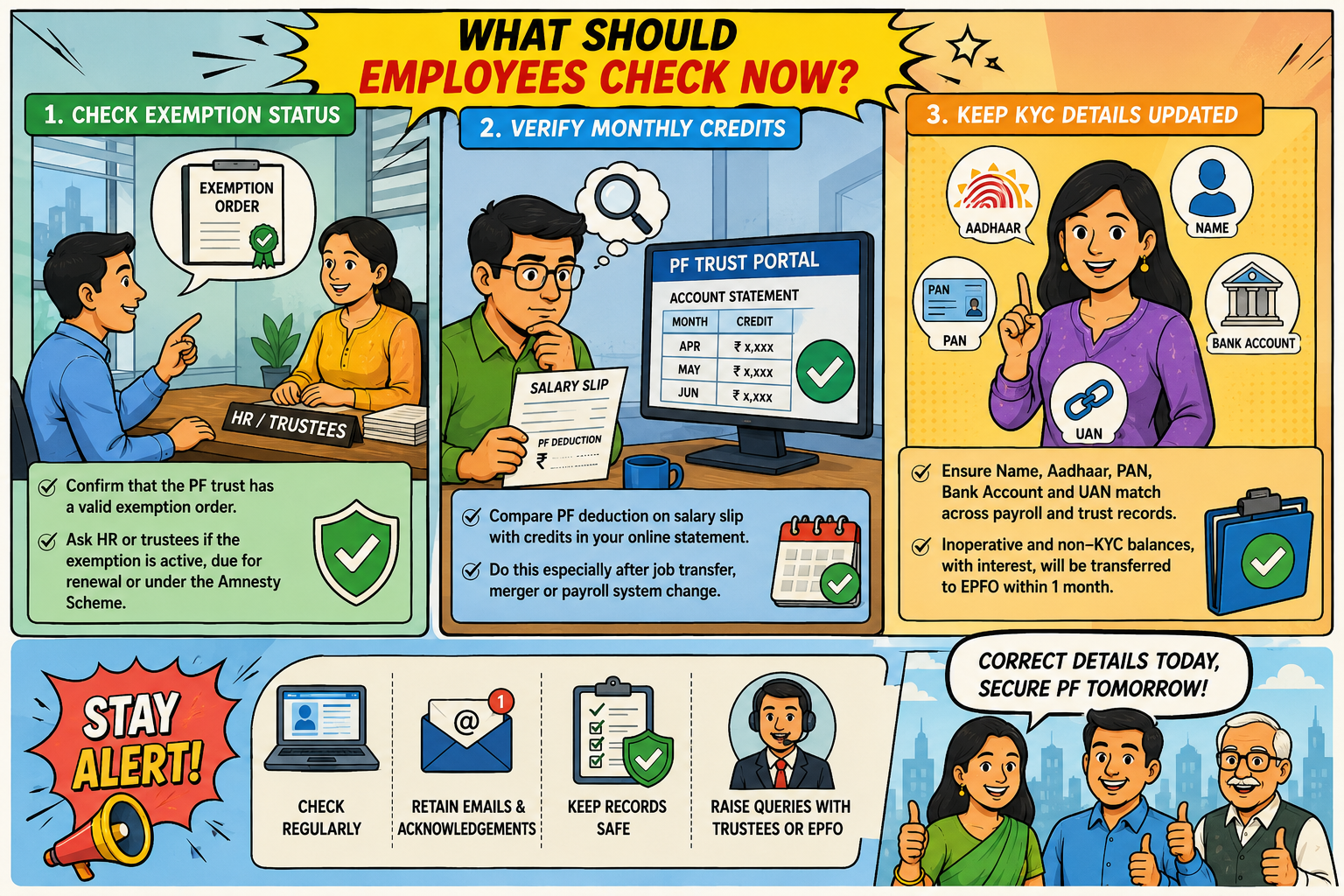
Employees covered by a company PF trust should confirm that the trust has a valid exemption order. HR or the trustees should also explain whether the exemption is active, due for renewal or being regularised under the Amnesty Scheme.
The monthly credit deserves close attention. A PF deduction on a salary slip does not by itself prove that the trust received the money. Members should compare each deduction with the online statement, especially after a job transfer, merger or payroll system change.
KYC details require the same care. The name, Aadhaar number, PAN, bank account and UAN should match across payroll and trust records. Under the new scheme, inoperative and non-KYC balances, along with applicable interest, must be transferred to EPFO within 1 month. Correct records can reduce later verification work.
The EPF Scheme 2026 keeps exempted PF trusts in India’s retirement system, but removes much of the room for closed records and weak follow-up. Employers must transfer contributions on time, trustees must provide online accounts, and annual audits remain compulsory.
Employees should not wait for a final withdrawal to examine their PF records. Monthly credits, annual interest, KYC details and pending claims deserve regular checks. The new rules provide better documentation and stronger employer liability. Their success will depend on how quickly each trust applies them to everyday account handling.
What is an exempted PF trust?
It is an employer-managed provident fund trust approved to provide benefits similar to or better than EPFO.
Has the employee's PF contribution rate changed for exempted trusts?
The tighter trust rules focus on administration, audits, claims and investments, not a separate contribution rate for trust members.
When should an employee receive the annual PF statement?
An exempted trust must issue it within 2 months after the financial year closes.
Can an exempted PF trust accept only paper claims?
No. Withdrawal, advance and transfer claims must be accepted electronically under the 2026 scheme.
Who pays when the trust suffers a specified financial loss?
The employer must restore losses caused by fraud, defalcation or wrong investment decisions.









.png&w=3840&q=75)


