

By continuing, you agree to LoansJagat's Credit Report Terms of Use, Terms and Conditions, Privacy Policy, and authorize contact via Call, SMS, Email, or WhatsApp
Disclaimer: The information published on LoansJagat is intended for general informational and educational purposes only and should not be considered financial, legal, or investment advice. Interest rates, loan terms, statistics, and other data may change over time and may vary by lender or source. Please verify the latest information and consult a qualified financial advisor or the respective Bank/NBFC before making any financial decisions.
Subscribe Now
About the author

Arshathul Afia
Arshathul Afia is a journalism graduate and fintech content writer with 4+ years of experience in digital publishing and research-led writing. She has written 200+ articles covering personal finance, lending, banking, digital payments, credit, insurance, and major financial developments in India. At LoansJagat, she focuses on simplifying complex fintech news, RBI updates, loan-related changes, policy developments, and industry trends for everyday readers. Her journalism background helps her approach stories with research, context, and clarity, while her SEO experience ensures content remains discoverable and relevant. She aims to make financial news easier to understand, practical, and useful for readers across India.
Related Blog Post
Simplify All Your Loans Into One Affordable EMI

Customers Served

Debt Consolidated

1200+ Reviews

Locations in India
Club all Loans & Credit Card Bills into Single EMI

Quick Apply Loan
Consolidate your debts into one easy EMI.

Takes less than 2 minutes. No paperwork.

10 Lakhs+
Trusted Customers

2000 Cr+
Loans Disbursed

4.7/5
Google Reviews

50+
Banks & NBFCs Offers
EPFO’s 2026 changes give salaried workers faster access to provident fund savings, 8.25% interest, pension continuity, and insurance protection during financial stress and job loss.
These changes can help during a medical expense, temporary loss of salary, education cost, marriage expense or another permitted need. There is a trade-off. Money withdrawn early stops earning future EPF interest, and the protected portion cannot always be used immediately. That may be difficult during a long spell without work. For employees who return to a salary sooner, however, it preserves part of the retirement corpus.
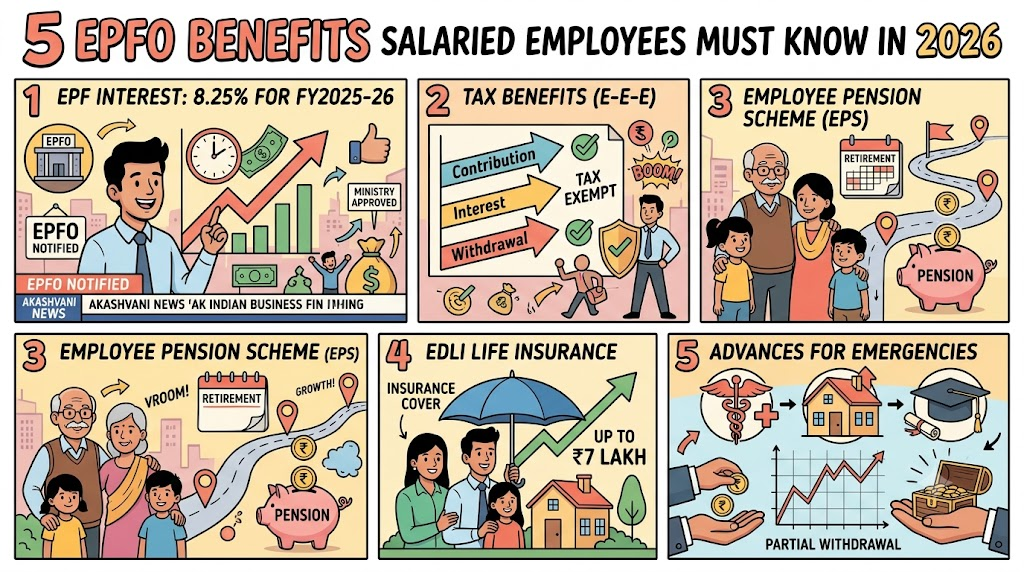
The first benefit is the annual return on EPF savings. EPFO had officially notified an 8.25% interest rate for FY 2025-26 following approval by the Ministry of Labour and Employment. The Central Board of Trustees had recommended the same rate at its 239th meeting on 2 March 2026.
The second benefit is wider PF access during an eligible need. A qualifying member can access up to 75% of the eligible PF balance, subject to the rules attached to the claim. The protected portion keeps part of the retirement corpus invested instead of allowing repeated withdrawals to empty the account.
The third benefit is faster claim processing. Eligible advances up to ₹5 lakh can enter auto-settlement. That figure is a processing ceiling, not a guaranteed withdrawal amount. The fourth benefit comes through the Employees’ Pension Scheme, which supports eligible pension rights. The fifth is Employees’ Deposit Linked Insurance, which protects eligible dependants if a covered member dies while in service.
The table below separates the 5 benefits by purpose.
These are not 5 versions of the same facility. Interest builds the corpus. Withdrawals provide controlled access. Auto-settlement changes processing speed. EPS and EDLI protect different stages of an employee’s financial life.
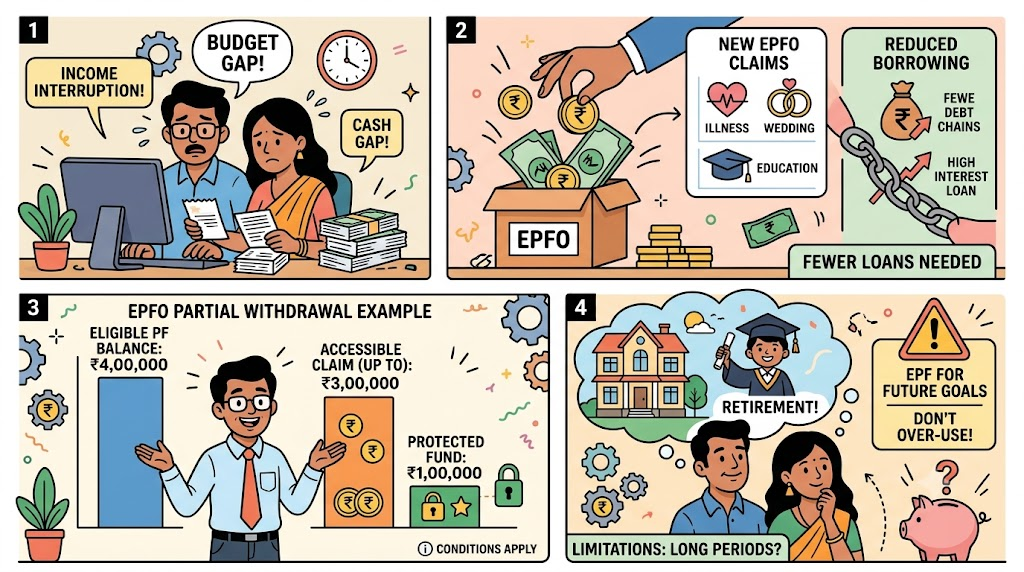
For a family dealing with a sudden cash gap, partial withdrawal can reduce the amount that needs to be borrowed elsewhere. An employee with an eligible PF balance of ₹4,00,000 could access up to ₹3,00,000 if the claim meets the scheme conditions, leaving ₹1,00,000 protected. That may be useful during a short interruption in income, though it may not cover a long period without salary.
A recent LoansJagat analysis of EPF emergency withdrawal rules raises the same borrower-side issue. The protected 25% can continue earning interest when the worker returns to employment, but the restriction can become difficult for a household whose salary stops for several months. PF can reduce immediate dependence on credit. It should not be treated as unlimited emergency cash.
Faster settlement can also change the household calculation. The 4 August 2026 government update said 84% of Form 31 advance claims were being auto-settled nationally. Delays can still happen when Aadhaar, PAN, bank details, UAN or employment records do not match.
The benefit is practical. A worker facing a permitted expense gets a route to personal savings without automatically taking a high-cost personal loan or rolling over a credit-card balance. The cost appears later. Every rupee withdrawn stops earning future EPF interest, so repeated claims can shrink retirement savings.
Regional Provident Fund Commissioner-I Uttam Prakash addressed the operational issue in the 4 August 2026 government update. He urged members to keep the UAN authenticated and linked with Aadhaar, PAN and a mobile number. The update connected accurate KYC records with stronger auto-settlement performance under the Centralised IT Enabled System.
Members can act on that advice before an emergency arrives. They should check the name, date of birth, Aadhaar linkage, PAN, active bank account, mobile number, and service history. A hospital bill or sudden job loss is a poor time to discover that an old bank account remains linked or that employment records are incomplete.
There is also a policy reason behind the protected portion. EPFO is trying to give workers access without allowing the entire retirement account to disappear through repeated advances. That will affect households differently. A family with another income may value the protected corpus. A worker who has lost the only salary in the home may place rent, food, and EMI payments first.
That is where individual judgement enters. PF is best used for a genuine eligible need, after checking whether insurance or other savings can cover part of the cost. Taking the maximum simply because the portal permits it can leave a larger retirement gap later.
The present system grew out of decisions taken in 2025. At the 238th Central Board of Trustees meeting on 13 October 2025, EPFO approved a major simplification of partial withdrawals. The earlier 13 provisions were grouped into 3 categories covering essential needs, housing needs and special circumstances. The common minimum membership requirement for partial withdrawals was brought to 12 months.
The Ministry of Labour and Employment later said the reform was designed to make claims easier while preventing members from exhausting retirement savings too early. Education withdrawals were expanded, marriage withdrawals were widened, and special-circumstance claims became simpler. Part of the corpus remained protected.
The legal transition followed in 2026. The Central government notified the Employees’ Provident Fund Scheme, 2026, with effect from 29 June 2026, replacing the older 1952 scheme under the new social-security framework. The official EPFO website also remains the primary member-facing platform for UAN, passbook, transfer and claim services. July brought the notified 8.25% EPF interest rate, while August showed how centralised claim settlement was performing.
The sequence helps separate old rules from new ones. October 2025 brought the policy decision. June 2026 brought the new scheme into force. July confirmed the interest rate. August provided a nationwide auto-settlement figure.
EPFO’s 2026 changes give salaried workers 5 forms of financial protection: interest on retirement savings, controlled access during permitted needs, quicker automated claims, pension support and insurance cover for eligible families. Together, they make the provident fund more usable during working life without removing its retirement purpose.
The main caution is early withdrawal. Faster access can help a family avoid expensive borrowing, but repeated PF use reduces the amount left to grow for later years. Employees who keep KYC records updated, distinguish the ₹5 lakh processing ceiling from actual withdrawal eligibility, and use partial claims only when required can benefit without weakening their future corpus unnecessarily.
An eligible member can access up to 75% of the eligible PF balance, subject to contributory service, claim category, available balance, and other scheme conditions. It is a ceiling, not an automatic payment in every case.
No. ₹5 lakh is the ceiling for automated processing of eligible advance claims. EPFO still calculates the amount a member can receive from the balance, service history, and claim rules.
EPS can provide pension benefits to eligible members and beneficiaries. EDLI provides insurance-linked protection for eligible dependants if a covered member dies during service.
Yes. Partial PF withdrawal is permitted while employed for specified eligible needs. The member does not have to close the PF account. Eligibility depends on purpose, membership period, available balance, and scheme conditions.
The next eligible amount is not simply 75% of whatever appears in the passbook. EPFO recalculates eligibility while preserving the required protected portion and considering new contributions and applicable claim rules.








.png&w=3840&q=75)


