
By continuing, you agree to LoansJagat's Credit Report Terms of Use, Terms and Conditions, Privacy Policy, and authorize contact via Call, SMS, Email, or WhatsApp
Disclaimer: The information published on LoansJagat is intended for general informational and educational purposes only and should not be considered financial, legal, or investment advice. Interest rates, loan terms, statistics, and other data may change over time and may vary by lender or source. Please verify the latest information and consult a qualified financial advisor or the respective Bank/NBFC before making any financial decisions.
Subscribe Now
About the author

Arshathul Afia
Arshathul Afia is a journalism graduate and fintech content writer with 4+ years of experience in digital publishing and research-led writing. She has written 200+ articles covering personal finance, lending, banking, digital payments, credit, insurance, and major financial developments in India. At LoansJagat, she focuses on simplifying complex fintech news, RBI updates, loan-related changes, policy developments, and industry trends for everyday readers. Her journalism background helps her approach stories with research, context, and clarity, while her SEO experience ensures content remains discoverable and relevant. She aims to make financial news easier to understand, practical, and useful for readers across India.
Related Blog Post
Simplify All Your Loans Into One Affordable EMI

Customers Served

Debt Consolidated

1200+ Reviews

Locations in India
Club all Loans & Credit Card Bills into Single EMI

Quick Apply Loan
Consolidate your debts into one easy EMI.

Takes less than 2 minutes. No paperwork.

10 Lakhs+
Trusted Customers

2000 Cr+
Loans Disbursed

4.7/5
Google Reviews

50+
Banks & NBFCs Offers
EPFO must pay 6% interest after a 35-day delay in a ₹14.06 lakh PF claim, a Mumbai consumer ruling that sharpens focus on settlement timelines.
Key Highlights
The Mumbai Suburban District Consumer Disputes Redressal Commission, in an order reported on September 9, 2026, directed the Employees' Provident Fund Organisation to pay 6% annual interest on ₹14,06,272 for a 35-day delay from November 9 to December 13, 2016. The claimant was a retired employee of Fleet Maritime Services (India) Pvt Ltd. EPFO had paid the PF amount on December 14, 2016. The commission held that the organisation had not proved that the employee's original October 19 claim was incomplete and treated the delay as a deficiency in service.
For PF members across India, the ruling has a direct impact. Retirement money is often earmarked for rent, treatment, debt payments, or basic expenses after salary income stops. A delay of a few weeks can upset those plans. The negative side is procedural too. If a claim gets returned but the member cannot later show what EPFO asked for, a small documentation problem can grow into a dispute over when the settlement clock began.
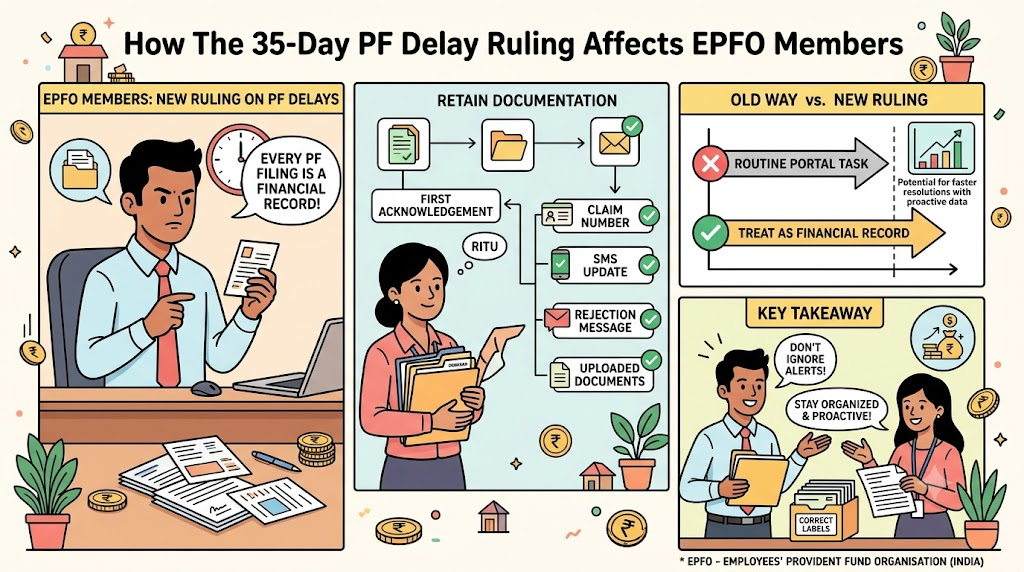
The order gives members a reason to treat every PF filing like a financial record rather than a routine portal task. The first acknowledgement, claim number, SMS update, rejection message, and any document uploaded later should be retained. Those records can establish whether the original application was complete and when EPFO first raised a deficiency. In this case, that point separated the retiree's version from EPFO's defence.
Current claimants have one advantage. EPFO now processes many eligible claims digitally. A Press Information Bureau (PIB) update dated August 4, 2026 said 84% of Form-31 advance claims and 50% of Form-19 final-settlement claims were being auto-settled nationally through the Centralised IT Enabled System. Regional Provident Fund Commissioner-I Uttam Prakash also asked members to keep UAN-linked KYC, Aadhaar, PAN and mobile details updated. Faster processing helps, but inaccurate records can still send a claim for further checks.
The retired employee said he submitted a complete PF claim on October 19, 2016. EPFO said the joint declaration was missing, the papers were returned on November 7, and a complete set reached the organisation only on December 2. EPFO paid ₹14,06,272 on December 14. On its version, payment came within 20 days of receiving a complete claim.
The commission rejected that defence because EPFO could not produce a written rejection letter or deficiency communication showing that the claimant had been told his October 19 submission was incomplete. It said EPFO had “failed to satisfactorily establish that the claim was incomplete”. The dispute therefore came down to proof of what happened after the first filing.
The timeline shows where the 2 versions separated:
The ruling does not mean every claim crossing 20 days automatically earns 6% interest. A claim may need correction or additional verification. The important point is the record. If EPFO says a document was missing and the member later challenges the delay, the communication history can decide which submission date counts.
Read Also: EPFO 2026 Update: 5 Benefits for Salaried Employees
Uttam Prakash's August 4, 2026 guidance puts much of the preventive work before filing. Members should check whether the UAN is authenticated, Aadhaar details match, PAN is linked where required, the mobile number works, and the bank account is current. A mismatch in a name, date of birth, or bank record may send a simple withdrawal for manual review.
A LoansJagat review published on August 10, 2026 makes another useful distinction. A same-day or 24-hour settlement is an operational target for eligible automated claims, not a promise for every member. For this case, the stronger takeaway is proof rather than the headline rate. A dated acknowledgement and a saved deficiency message can be more useful than repeated calls if the claim later turns into a formal grievance.
EPFO's official guidance says a claim is required to be settled within 20 days and directs members to EPFiGMS for grievance redressal. A member whose complete claim remains pending can check the status, lodge a grievance with the claim details, and retain the grievance number and response. If EPFO asks for another document, that submission should also be saved.
The dispute began in 2016. The employee filed his claim on October 19. EPFO said it returned the papers on November 7 because a joint declaration was absent. The claimant maintained that the original submission had been complete. Payment reached him on December 14.
The 20-day framework was already relevant then. The commission recognised a 35-day delay from November 9 to December 13 after examining the competing dates. The case continued until the 2026 order. A short payment delay had therefore produced a much longer dispute over the original paperwork.
EPFO's claim process has changed since 2016. Online filing, UAN-based records, Aadhaar-linked verification and centralised processing now leave a stronger digital trail. That can help members show when a claim was filed, returned, corrected and settled. It also gives EPFO a better record when it says a claim was incomplete.
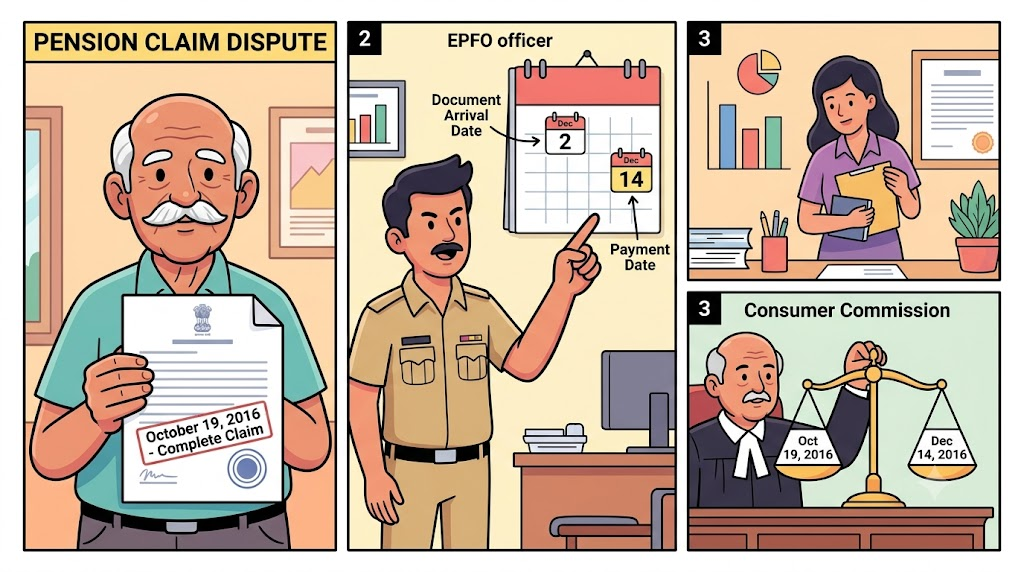
The retiree maintained that October 19, 2016 was the date of a complete claim. EPFO treated December 2 as the relevant date because it said that was when the full documents arrived. Its December 14 payment would then fall inside the 20-day period.
The commission found that EPFO's paperwork did not support that explanation. No written rejection or deficiency notice for the October claim was produced. It found a deficiency in service, ordered 6% annual interest for the 35-day delayed period, and gave EPFO 45 days to comply.
One financial detail also needs context. The order does not award 6% of ₹14.06 lakh as a full-year payout. The annual rate applies only to the recognised 35-day delay. The case carries greater value as a ruling on delayed service and documentation than as a large interest award.
The ₹14.06 lakh case turned on ordinary paperwork. EPFO said the first application lacked a joint declaration. The retiree said his October 19 claim was complete. Because EPFO could not produce written communication proving the original filing was deficient, the commission counted a 35-day delay and ordered 6% annual interest for that period.
For current PF members, the lesson is simple. Account and KYC details should be checked before filing, while acknowledgements and deficiency messages should be saved afterwards. EPFO's technology may move eligible claims much faster in 2026, but dated records still become decisive when a delay is challenged.
EPFO's official FAQ says a claim is required to be settled within 20 days. That applies to a claim complete and ready for processing. A claim needing correction may move differently because the deficiency has to be resolved.
The member should check the online status and confirm whether EPFO has raised any deficiency. If a complete claim remains pending, a grievance can be filed through EPFiGMS. The acknowledgement, grievance number and response should be retained.
No. The 6% rate came from the consumer commission's order in this specific dispute. It should not be treated as an automatic rate for every PF claim that takes longer than 20 days.
The member can verify the claim status, check for any request for documents and use EPFiGMS if the complete claim remains pending. A written record helps establish the filing date and EPFO's response.
Eligible automated claims can move faster than 20 days, but the official timeline remains the safer reference for a complete application. If it stalls, the member can raise an EPFiGMS grievance and keep the response for follow-up.








.png&w=3840&q=75)


