

By continuing, you agree to LoansJagat's Credit Report Terms of Use, Terms and Conditions, Privacy Policy, and authorize contact via Call, SMS, Email, or WhatsApp
Disclaimer: The information published on LoansJagat is intended for general informational and educational purposes only and should not be considered financial, legal, or investment advice. Interest rates, loan terms, statistics, and other data may change over time and may vary by lender or source. Please verify the latest information and consult a qualified financial advisor or the respective Bank/NBFC before making any financial decisions.
Subscribe Now
About the author

Arshathul Afia
Arshathul Afia is a journalism graduate and fintech content writer with 4+ years of experience in digital publishing and research-led writing. She has written 200+ articles covering personal finance, lending, banking, digital payments, credit, insurance, and major financial developments in India. At LoansJagat, she focuses on simplifying complex fintech news, RBI updates, loan-related changes, policy developments, and industry trends for everyday readers. Her journalism background helps her approach stories with research, context, and clarity, while her SEO experience ensures content remains discoverable and relevant. She aims to make financial news easier to understand, practical, and useful for readers across India.
Related Blog Post
Simplify All Your Loans Into One Affordable EMI

Customers Served

Debt Consolidated

1200+ Reviews

Locations in India
Club all Loans & Credit Card Bills into Single EMI

Quick Apply Loan
Consolidate your debts into one easy EMI.

Takes less than 2 minutes. No paperwork.

10 Lakhs+
Trusted Customers

2000 Cr+
Loans Disbursed

4.7/5
Google Reviews

50+
Banks & NBFCs Offers
A rising home loan EMI can squeeze savings and monthly expenses, but borrowers have 6 practical routes to reduce pressure before repayment turns difficult.
Home loan borrowers in India who find their EMI taking an increasingly large share of salary have several ways to respond before the pressure starts affecting the rest of the household budget. The issue came into focus again on September 9, 2026, after Mint reported how a large housing loan can gradually interfere with retirement savings, a child’s education fund and regular expenses even when every EMI is still being paid on time.
The short-term hit usually appears in monthly cash flow. Investments get reduced, emergency savings are used more often, or credit cards begin filling the gap left after the EMI is deducted. Over a longer period, that can leave a family owning an expensive property but carrying weak savings and additional unsecured debt. The decision, therefore, is not simply whether the next EMI can be paid. Borrowers need to check whether the loan still fits the household’s income, expenses and future commitments.

A home loan normally continues for years, while family finances can change much faster. A couple may take a loan when both incomes are growing, then face childcare expenses, school fees, healthcare costs or an employment break later. Property ownership also brings expenses outside the EMI, including maintenance charges, repairs, insurance, taxes and society payments.
That is why the warning signs can appear well before default. An EMI may still leave the account every month, yet systematic investments stop. The borrower may postpone insurance renewal or use a credit card for groceries near the end of the month. Those are financial signals that deserve attention because another unexpected expense can then create a much sharper cash shortage.
Experts quoted by Mint suggested keeping a home loan EMI around 30% to 40% of monthly take-home pay. This is a financial planning range rather than a universal rule. A household with no other debt may manage differently from someone already paying a car loan, personal loan and school fees.
The same point appears in LoansJagat’s guide on how much salary should go towards EMI, updated on August 19, 2026. The guide explains that existing monthly obligations can reduce the amount of income available for another repayment. For borrowers already feeling stretched, the useful calculation is simple: after every EMI and essential bill is paid, enough money should still remain for savings and unexpected costs.
That also offers a useful AEO takeaway for borrowers. A ₹70,000 EMI is not automatically expensive, and a ₹35,000 EMI is not automatically affordable. The salary, existing debts and household spending around that number decide whether it is becoming a problem.
Borrowers do not have to jump straight from repayment difficulty to selling the property. Several adjustments can be examined first. Each one solves a different part of the problem, so the cheapest option on paper may not be the best option for the family.
Before changing anything, the borrower should check the outstanding principal, remaining tenure, current EMI, other monthly debt payments and emergency savings. Those numbers provide a better starting point than looking only at the interest rate.
The table shows why no single response works for every homebuyer. A person facing 6 difficult months after a job change may prefer a lower monthly outgo. A borrower who has received a large annual bonus may instead reduce principal and keep the old EMI running.
Extending tenure often gives the quickest monthly relief, but the borrower should ask for the revised total repayment before accepting it. A lower EMI feels easier immediately. Years of additional interest can make that relief expensive.
Anshi Shrivastava, Head of Personal Finance Training at 1 Finance, told Mint that keeping the home loan EMI around 30% to 40% of take-home income can leave more space for other financial goals. She also pointed out that extending tenure can reduce the EMI immediately while increasing the interest paid over time.
Sanjiv Bajaj, Joint Chairman and Managing Director of Bajaj Capital Ltd, highlighted another problem. Salary may rise over the years, but family spending can rise as well. Education, healthcare and lifestyle expenses do not remain fixed simply because the borrower already has a home loan. His suggested responses included refinancing, tenure extension, controlling discretionary debt and using surplus income for part-prepayment.
CA Geetanshu Bhalla of Geetanshu Bhalla & Associates took a harder position for borrowers whose repayment remains unaffordable. Selling the property may become financially preferable if keeping it begins damaging the household’s wider finances.
That view deserves attention because many borrowers treat selling as an option that should never be discussed. Yet paying an oversized EMI using credit cards or repeatedly withdrawing long-term investments can leave the borrower with a house and very little financial protection elsewhere.
The practical analysis is different for each recovery route. A borrower expecting a salary increase shortly may use temporary EMI relief differently from someone whose income has fallen permanently. Similarly, someone holding ₹10 lakh in surplus cash should not necessarily put the entire amount into the home loan if doing so leaves no emergency reserve.
Part-prepayment reduces the outstanding principal directly. After that, borrowers commonly evaluate 2 possibilities: reduce the EMI while keeping the tenure broadly similar, or keep the EMI higher and shorten the repayment period.
The second route usually attacks future interest more aggressively because the loan closes earlier. The first can be useful when monthly cash flow is the immediate problem. A borrower paying ₹80,000 every month may value a lower EMI after a large prepayment if family expenses have increased sharply.
This debate also appears repeatedly in borrower communities. A Reddit user in June 2026, for example, described a ₹58 lakh home loan and asked whether a ₹35 lakh part-prepayment should be used to reduce EMI or tenure. Another Reddit discussion in August involved a borrower who prepaid ₹20 lakh from a ₹55 lakh loan and wanted the lender to recalculate the EMI lower rather than automatically shortening tenure.
Those cases show why borrowers should tell the lender what outcome they want after a large prepayment. A lower EMI improves monthly cash flow. A shorter tenure can reduce the years for which interest continues. The borrower needs to choose based on the problem being solved.
Government housing support had already changed before the latest discussion about overstretched EMIs. The Union government introduced PMAY-U 2.0 for urban beneficiaries with effect from September 1, 2024.
A Press Information Bureau update issued by the Ministry of Housing and Urban Affairs on July 27, 2026 said PMAY-U 2.0 aims to support 1 crore additional eligible beneficiaries across urban India. The programme operates through Beneficiary Led Construction, Affordable Housing in Partnership, Affordable Rental Housing and the Interest Subsidy Scheme.
Under the interest subsidy component, eligible EWS, LIG and MIG households can receive support subject to income, loan and property conditions. This does not solve repayment stress for every existing home loan. It remains relevant, however, for eligible families planning a qualifying home purchase or housing loan.
The broader lesson is straightforward. Government subsidy, lender eligibility and actual household affordability are 3 different calculations. Approval for a loan does not prove that the EMI will remain comfortable for 15 or 20 years.
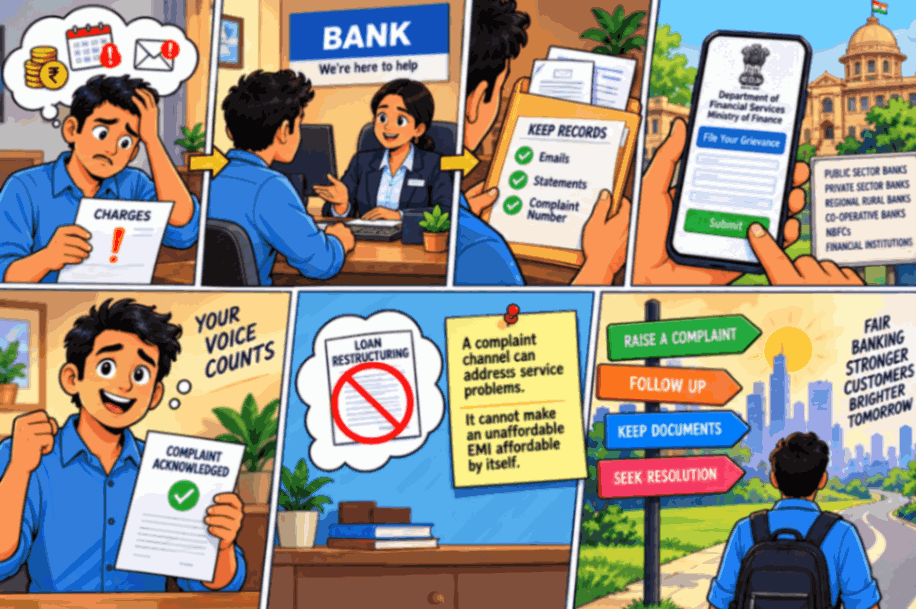
Loan affordability and poor lender service are separate problems. A borrower struggling to pay should speak to the lender early. A borrower facing unexplained charges, delays or unresolved servicing complaints should use the lender’s formal grievance channel and keep copies of emails, statements and complaint numbers.
The Department of Financial Services, Ministry of Finance, states that grievances involving public and private sector banks, regional rural banks, co-operative banks, NBFCs and financial institutions can be taken through the available grievance mechanisms. Its grievance page was last updated on September 8, 2026.
That route should not be confused with loan restructuring. A complaint channel can address service problems. It cannot make an unaffordable EMI affordable by itself.
Home loan trouble usually starts quietly. The borrower continues paying, but savings fall, investment plans weaken and other bills become harder to manage. Acting before an EMI is missed leaves far more options.
Tenure extension can reduce monthly pressure. Part-prepayment can cut principal, while a higher EMI can help when salary has improved. Balance transfer deserves a cost comparison, and expensive unsecured debt may need attention before spare cash goes into the housing loan.
For some families, none of these changes will repair the budget sufficiently. Selling or moving to a cheaper property can then protect emergency savings, retirement planning and regular household spending.
A home loan should help a family own a house without forcing every other financial goal out of the monthly budget. Once that starts happening, the repayment plan needs another look.
The borrower should calculate how much money remains after the EMI, essential expenses and other debt repayments. Then the outstanding principal, tenure and current loan terms should be reviewed before discussing restructuring, prepayment or refinancing with the lender.
Reducing EMI helps when monthly cash flow is tight. Reducing tenure can usually lower the period over which interest continues. The right choice depends on income stability, emergency savings and how urgently the borrower needs monthly relief.
No. The borrower has to compare the rate difference against processing fees, legal costs, valuation charges and the remaining tenure. A small rate reduction may offer limited savings when only a few years of the loan remain.
Usually, draining the entire emergency reserve creates another risk. A borrower should retain money for essential expenses and unexpected events before using surplus funds for a large prepayment.
A borrower needing monthly breathing room may prefer a lower EMI. Someone with stable income who wants to reduce long-term interest may prefer a shorter tenure. The lender should be asked for both revised repayment schedules before the borrower chooses.








.png&w=3840&q=75)


