
By continuing, you agree to LoansJagat's Credit Report Terms of Use, Terms and Conditions, Privacy Policy, and authorize contact via Call, SMS, Email, or WhatsApp
Disclaimer: The information published on LoansJagat is intended for general informational and educational purposes only and should not be considered financial, legal, or investment advice. Interest rates, loan terms, statistics, and other data may change over time and may vary by lender or source. Please verify the latest information and consult a qualified financial advisor or the respective Bank/NBFC before making any financial decisions.
Subscribe Now
About the author

Arshathul Afia
Arshathul Afia is a journalism graduate and fintech content writer with 4+ years of experience in digital publishing and research-led writing. She has written 200+ articles covering personal finance, lending, banking, digital payments, credit, insurance, and major financial developments in India. At LoansJagat, she focuses on simplifying complex fintech news, RBI updates, loan-related changes, policy developments, and industry trends for everyday readers. Her journalism background helps her approach stories with research, context, and clarity, while her SEO experience ensures content remains discoverable and relevant. She aims to make financial news easier to understand, practical, and useful for readers across India.
Related Blog Post
Simplify All Your Loans Into One Affordable EMI

Customers Served

Debt Consolidated

1200+ Reviews

Locations in India
Club all Loans & Credit Card Bills into Single EMI

Quick Apply Loan
Consolidate your debts into one easy EMI.

Takes less than 2 minutes. No paperwork.

10 Lakhs+
Trusted Customers

2000 Cr+
Loans Disbursed

4.7/5
Google Reviews

50+
Banks & NBFCs Offers
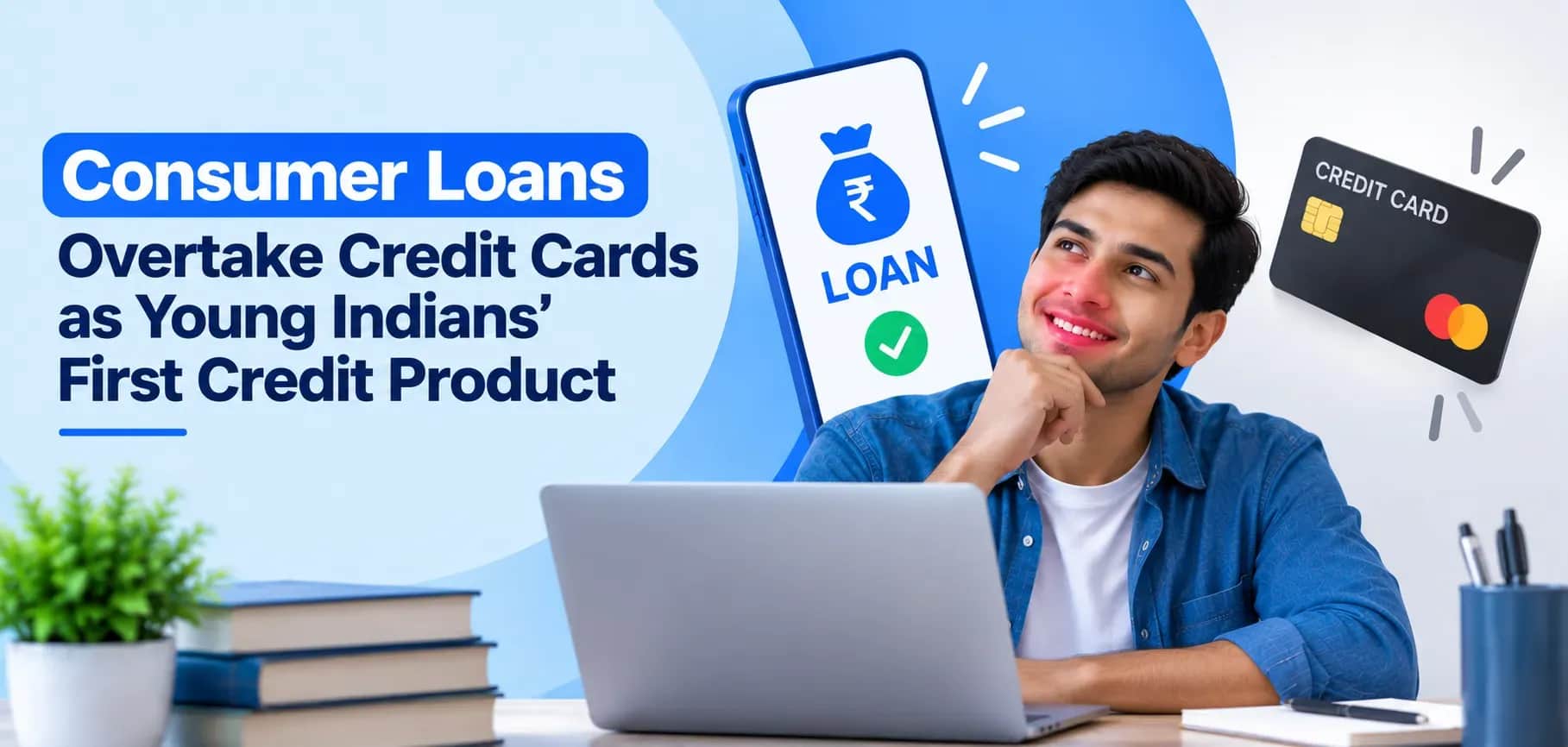
Young borrowers now meet credit at checkout, where a phone EMI or pay-later button can open a formal loan before the purchase feels like borrowing.
Key Highlights
Consumer loans have overtaken credit cards as the first formal credit product used by young Indians classified as Lifestyle Seekers. Moneycontrol reported the finding on 9 September 2026, citing Equifax India’s Aspirational India: Retail Credit Market Performance report. Consumer loans formed 36% of first products in this group, followed by two-wheeler loans at 29%. Credit cards accounted for 15%. The borrowers are largely young, with Gen Z forming 55% of the segment and Millennials another 31%.
The change is playing out wherever a phone, laptop, appliance or scooter comes with instant finance. Such credit can fund work or travel and regular repayment may build a credit record. Trouble starts when a buyer notices a small EMI but misses the full cost, or carries several loans against the same salary.
The old first-loan experience was hard to mistake. A borrower visited a branch, submitted records and waited. Now the buyer picks a smartphone, reaches checkout and sees a monthly instalment beside the full price. The application may take only a few taps.
Two-wheeler dealers offer finance at the showroom. Apps may place pay-later products near the payment button, while digital lenders provide small personal loans for rent, repairs or a shortage before payday. Each route creates a repayment obligation.
Equifax calls these borrowers Lifestyle Seekers because consumption and mobility shape much of their credit use. Fintech firms account for 68% of their entry lenders. The average initial ticket is around ₹67,000, enough to claim a large part of a first salary when the tenure is short.
The table below shows the routes that now lead young borrowers into formal credit. It keeps the focus on the first product rather than the value of the wider loan market.
A cardholder applies for a borrowing facility and later decides where to spend. With checkout finance, the purchase comes first. The offer arrives when the buyer is already close to paying, leaving less time to compare charges and repayment dates.
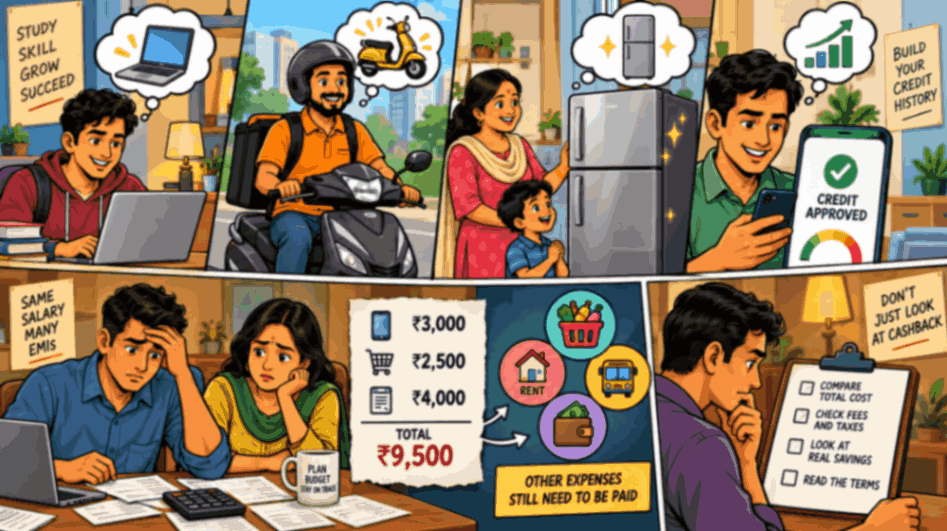
Small-ticket finance can solve an immediate problem. A graduate may need a laptop before the first salary. A delivery worker can finance a scooter to begin earning, while a family can replace a failed refrigerator without emptying its savings. Formal credit can also be safer than informal borrowing at an uncertain rate.
Timely repayment gives a new borrower a payment history that may support a later application. TransUnion CIBIL’s 31 March 2026 update found that people below 35 formed 58% of first-time borrowers in the quarter ended December 2025.
The strain appears when several small commitments overlap. A ₹3,000 phone EMI, a ₹2,500 pay-later bill and a ₹4,000 personal-loan instalment remove ₹9,500 from the next salary. Food, rent and travel still need to be paid. One delayed salary can then turn an ordinary month into a repayment problem.
Cashback, instant approval and “no-cost EMI” may pull attention away from fees, taxes or the loss of a cash discount. Buyers should compare the amount received, the amount repaid and each charge in between.
Read Also: EPFO’s 3 New EPF Withdrawal Rules Bring 10 Education Claims and 5 for Marriage
The trend appeared earlier. TransUnion CIBIL said on 26 March 2025 that Gen Z represented 41% of first-time borrowers during the quarter ended December 2024. Yet many eligible young adults still had no formal loan or card account.
Consumer-durable finance had already become a common starting product. It linked credit to a named item, divided the price into fixed payments and completed the application while the customer shopped. Small personal loans followed through mobile apps, although they served cash needs rather than one purchase.
Credit-bureau records also made these small facilities more visible. A customer who thought of a pay-later account as a shopping feature could later find a consumer loan listed in the credit report. Questions posted by Indian users on Reddit show that some borrowers only discovered those accounts when checking their scores months or years later. That gap between the product label and the recorded loan remains one of the sharpest consumer issues in the story.
Read Also: EPFO 2026 Update: 5 Benefits for Salaried Employees
Subhankar Mishra, Interim Managing Director of Equifax India, said newer borrowers will increasingly be assessed through financial and transaction records rather than long credit histories. This can help workers with irregular income, small traders and new earners whose bank inflows may show repayment capacity.
Bhavesh Jain, Managing Director and CEO of TransUnion CIBIL, linked the rise in young first-time borrowers to wider formal credit access. Faster approval should still account for income, existing repayments and the loan’s purpose. Another loan can hurt a customer who already carries several short EMIs.
Borrowers need their own check before accepting an offer. The final payable amount, due date, processing fee, late fee and lender’s legal name should appear on that list. A comparison across lenders helps too. LoansJagat says on its personal-loan platform that it has analysed more than 1 crore loans and allows users to compare offers from over 50 banks and NBFCs. Its borrower-side guidance asks applicants to inspect processing fees and tenure before calculating the first EMI. That advice applies equally to a checkout loan.
The government’s consumer material reaches the same practical point. The Department of Consumer Affairs warns that a repayment default can appear on a credit report and hurt later loan applications. A small first loan therefore deserves the same care as a large one. If an account appears without recognition, the borrower should contact the named lender and raise a dispute instead of leaving it untouched.
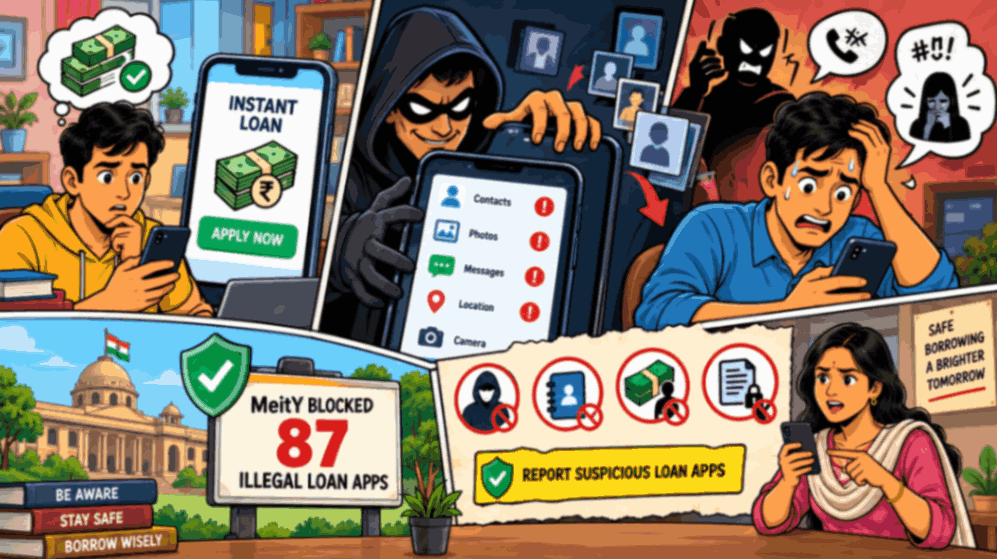
Convenient credit has also given fraudulent operators an easier route to a borrower’s phone. A Ministry of Finance statement published by the Press Information Bureau on 21 July 2026 said MeitY had blocked 87 illegal loan-lending applications. The statement advised citizens to use official complaint channels when they encounter a suspicious app or abusive collection practice.
Read Also: Home Loan EMI Burden: 6 Ways to Reduce Your Financial Stress
Warning signs include an app that hides the lender’s legal name, demands access to contacts and photographs without a valid reason, or asks the borrower to repay into a personal account. Threats and public shaming are not normal recovery methods. A genuine credit need should not force a customer to surrender unrelated phone data.
Consumer loans have overtaken credit cards as the first credit product among young Lifestyle Seekers because finance now appears where shopping happens. The shift can support work, mobility and urgent household purchases. It can also make debt less visible at the exact moment a person accepts it.
The safer approach is plain. Every EMI needs a place in the monthly budget before the purchase goes through. Young borrowers should identify the lender, compare the total payable amount and keep track of every open account. A checkout button may take seconds to press. The repayment follows for months.
Consumer loans appear during the purchase, often with quick approval and a visible EMI. Credit cards require a separate application, so many new borrowers meet checkout finance earlier.
Yes, when a regulated lender finances the purchase and reports the account to a credit bureau. Timely payments may support the record, while missed instalments can hurt it.
Neither product is automatically better. The right choice depends on cost, purpose and repayment ability. A fixed consumer loan may suit one planned purchase, while a card offers reusable credit and needs tighter spending control.
It can. Many pay-later facilities operate through a lender and may appear as consumer loans or credit lines. The borrower should check the credit report and repay every due amount on time.
The borrower should identify the lender, compare the full repayment with the cash price, inspect all fees, note the due date and count every existing EMI before proceeding.








.png&w=3840&q=75)


