
By continuing, you agree to LoansJagat's Credit Report Terms of Use, Terms and Conditions, Privacy Policy, and authorize contact via Call, SMS, Email, or WhatsApp
The information published on LoansJagat is intended for general informational and educational purposes only and should not be considered financial, legal, or investment advice. Interest rates, loan terms, statistics, and other data may change over time and may vary by lender or source. Please verify the latest information and consult a qualified financial advisor or the respective Bank/NBFC before making any financial decisions.
Subscribe Now
About the author

‘Simplify Finance for Everyone.’ This is the common goal of our team, as we try to explain any topic with relatable examples. From personal to business finance, managing EMIs to becoming debt-free, we do extensive research on each and every parameter, so you don’t have to. Scroll up and have a look at what 15+ years of experience in the BFSI sector looks like.
Related News
Simplify All Your Loans Into One Affordable EMI

Customers Served

Debt Consolidated

1200+ Reviews

Locations in India
Club all Loans & Credit Card Bills into Single EMI

Quick Apply Loan
Consolidate your debts into one easy EMI.

Takes less than 2 minutes. No paperwork.

10 Lakhs+
Trusted Customers

2000 Cr+
Loans Disbursed

4.7/5
Google Reviews

50+
Banks & NBFCs Offers
Other services mentioned in this article
Urban youth is borrowing earlier, spending faster and saving less. That mix is pushing many salaried households into a month-end squeeze across India’s big cities.
The issue is now bigger than careless spending. In cities, rent, transport, food delivery, gadgets and EMI commitments are landing in the same monthly budget. In the short term, that leaves little room for emergencies. In the long term, it can hold back savings and delay asset creation.
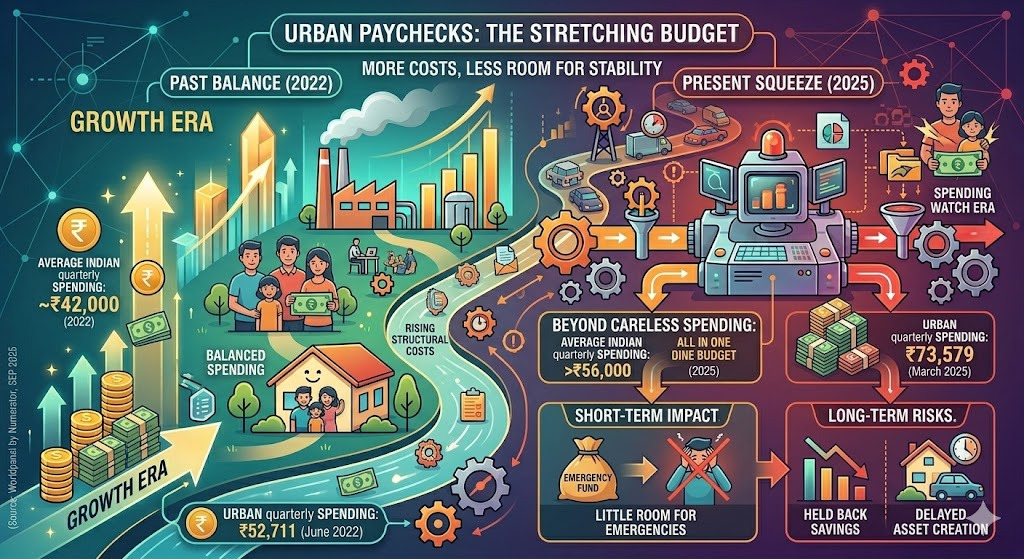
A Worldpanel by Numerator report, carried by The Economic Times and PTI on 9 September 2025, said average Indian household quarterly spending rose from around Rs 42,000 in 2022 to over Rs 56,000 in 2025. Urban quarterly spending climbed from Rs 52,711 in June 2022 to Rs 73,579 in March 2025.
Before the first data table, the larger backdrop is worth noting. CareEdge Ratings data, cited by The Economic Times in June 2025, showed household savings at 18.1% of GDP in FY24, while liabilities rose to 6.2% of GDP. That is why the month-end strain is showing up more often.
After the table, the public effect is fairly direct. Salaried workers may still be paying on time, but many are doing it with almost no buffer left. That raises the risk of one missed payment, one medical bill or one job shock turning into a bigger problem.
The credit side tells the other half of the story. Mint reported on 31 December 2025 that non-housing retail loans made up 55.3% of household borrowings in H1 FY26. That shows more borrowing is now linked to present consumption than long-term asset buying.
TransUnion CIBIL’s Credit Market Indicator, March 2026, released on 1 March 2026, said borrowers under 35 formed 58% of first-time borrowers. In the December 2025 quarter, first-time borrower originations rose 17%, with personal loans up 20% and consumer durable loans up 22%. Moneycontrol reported the same shift on 31 March 2026.
Earlier, TransUnion CIBIL had said on 26 March 2025 that 41% of first-time borrowers were Gen Z. Bain’s How India Shops Online 2025, released on 26 March 2025, added that Gen Z accounts for 40% of India’s e-retail shoppers and has 1.5x spend share in lifestyle, beauty and electronics.
The stakeholder view is fairly blunt. TransUnion CIBIL MD and CEO Bhavesh Jain said lender actions in unsecured credit had hit first-time borrowers harder, while stressing better analytics and technology-led credit decisions. For borrowers, one basic fix is to check repayment load before taking the next loan, including through tools such as LoansJagat’s EMI calculator.
Urban youth is not just spending more. It is living through a phase where city costs, quick credit and lifestyle buying are colliding. That is why more paychecks are getting used up before the month is over.
Related Financial News | |||
*T&C Apply









.png&w=3840&q=75)



