

By continuing, you agree to LoansJagat's Credit Report Terms of Use, Terms and Conditions, Privacy Policy, and authorize contact via Call, SMS, Email, or WhatsApp
Disclaimer: The information published on LoansJagat is intended for general informational and educational purposes only and should not be considered financial, legal, or investment advice. Interest rates, loan terms, statistics, and other data may change over time and may vary by lender or source. Please verify the latest information and consult a qualified financial advisor or the respective Bank/NBFC before making any financial decisions.
Subscribe Now
About the author

Arshathul Afia
Arshathul Afia is a journalism graduate and fintech content writer with 4+ years of experience in digital publishing and research-led writing. She has written 200+ articles covering personal finance, lending, banking, digital payments, credit, insurance, and major financial developments in India. At LoansJagat, she focuses on simplifying complex fintech news, RBI updates, loan-related changes, policy developments, and industry trends for everyday readers. Her journalism background helps her approach stories with research, context, and clarity, while her SEO experience ensures content remains discoverable and relevant. She aims to make financial news easier to understand, practical, and useful for readers across India.
Related Blog Post
Simplify All Your Loans Into One Affordable EMI

Customers Served

Debt Consolidated

1200+ Reviews

Locations in India
Club all Loans & Credit Card Bills into Single EMI

Quick Apply Loan
Consolidate your debts into one easy EMI.

Takes less than 2 minutes. No paperwork.

10 Lakhs+
Trusted Customers

2000 Cr+
Loans Disbursed

4.7/5
Google Reviews

50+
Banks & NBFCs Offers
EPFO has clarified the 2026 partial-withdrawal rules, giving members wider access to PF savings for education, marriage and illness while keeping 25% protected for retirement.
The Employees’ Provident Fund Organisation clarified its revised EPF partial-withdrawal rules on September 8, 2026, through a series of posts on X. The update applies to EPF members across India and focuses on 3 essential needs: illness, education, and marriage. Members can now seek education advances up to 10 times during membership and marriage advances up to 5 times. For illness, Paragraph 46 of the Employees’ Provident Funds Scheme, 2026 does not prescribe a numerical frequency limit. The new scheme took effect from July 1, 2026.
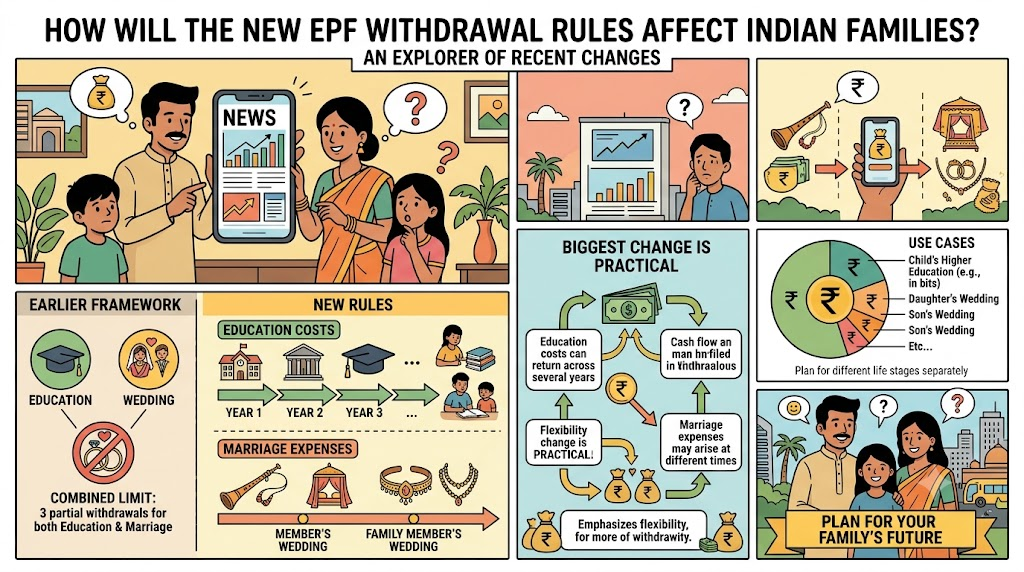
The biggest change is practical. Education costs can return across several years, while marriage expenses may arise for the member or eligible family members at different times. Under the earlier framework, education and marriage together were limited to a combined 3 partial withdrawals. The revised system separates them, allowing 10 education withdrawals and 5 marriage withdrawals. The Press Information Bureau (PIB) recorded this decision after the 238th meeting of the Central Board of Trustees on October 13, 2025.
Illness gets broader treatment. A member who meets the applicable membership condition can seek an advance for treatment of self or family, and the final 2026 scheme does not place a numerical lifetime cap on such withdrawals. The amount still depends on the Eligible Member Balance. “Up to 100% of Eligible Member Balance” does not mean 100% of the entire PF corpus.
The main limits are easier to compare in one place.
The table shows why the new framework is easier to follow than the older arrangement. The Employees’ Provident Fund Organisation also said the new rules keep 25% of contributions as a minimum balance. In effect, partial withdrawals can reach the remaining eligible portion, subject to the claim category and other conditions.
For households, the change can reduce the need to preserve a small number of claims for later years. A parent paying college fees may no longer have to treat an earlier education claim as one of only 3 combined education-and-marriage opportunities. The new limits are ceilings, though. Repeated withdrawals still reduce the amount that can continue earning PF interest for retirement.
Mayank Parashar, Associate at Clasis Law, told Moneycontrol on September 8, 2026, that the revised framework replaces the earlier multiple-purpose advance structure with a simpler 3-category system, along with changed eligibility, limits and frequency conditions. His comment points to the main benefit for members. The reform reduces the number of rules a worker must check before filing a claim.
Members should still match the claim to the correct category and check the eligible amount before committing that money elsewhere. A PF passbook may show a larger total than the amount available under a partial-withdrawal request. UAN details, bank information, and employment records should also be checked before filing.
There is a borrower angle too. A LoansJagat analysis published on July 9, 2026 pointed out that full PF settlement after an ordinary job loss now follows a 12-month non-employment condition, while 75% access remains available during unemployment. The analysis also flagged a practical risk for workers with rent, EMIs, or other bills during a long job search. That rule is separate from an education, marriage, or illness advance, but the difference directly affects household cash flow.
The practical takeaway is simple. PF can help with a genuine family expense, but using the maximum amount at every opportunity can weaken retirement savings. A salaried borrower with EMIs, school fees, and a medical expense may need to decide which cost should come from PF and which should stay within monthly income. That decision becomes more important when another claim may be needed a few years later.
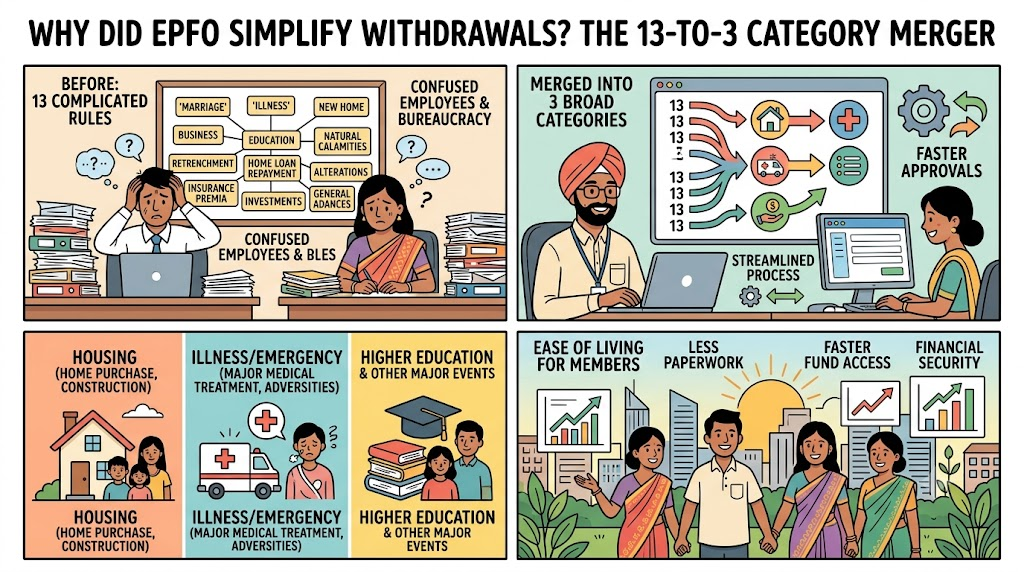
The current clarification did not begin in September 2026. At EPFO’s 238th Central Board of Trustees meeting in New Delhi on October 13, 2025, chaired by Union Labour and Employment Minister Dr Mansukh Mandaviya, the board approved a plan to merge 13 partial-withdrawal provisions into 3 groups: Essential Needs, Housing Needs and Special Circumstances. The same decision raised education withdrawals to 10 and marriage withdrawals to 5.
The board also moved to a common 12-month membership condition for partial withdrawals. Earlier provisions carried different qualifying periods, with some extending for years depending on the purpose. Under Special Circumstances, the older system asked members to specify reasons such as natural calamity, closure or lockout, unemployment or an epidemic. The revised route allows a claim without assigning one of those earlier listed reasons.
Another change came with the minimum-balance rule. The government said 25% of contributions should remain in the account so members continue building retirement savings. An official Employees’ Provident Fund Organisation (EPFO) press brief issued after the October 2025 board meeting said the protected portion was intended to preserve interest and compounding benefits. It also said the withdrawable amount could include the employer contribution along with the employee contribution and interest.
The Employees’ Provident Funds Scheme, 2026 later gave the framework legal force. That timing is important for readers who saw different rules online earlier in 2026. Some older explainers still referred to 7 years of service for marriage or education and lower withdrawal limits. Those were based on the previous scheme. Members checking eligibility now need to separate those older provisions from the rules operating under the 2026 framework.
EPFO’s position is that easier partial access and a protected retirement portion can work together. Its official communication argues that members should be able to meet immediate needs without repeatedly draining the entire account. The organisation has also linked simpler withdrawal rules with greater use of automated claim settlement.
The difficult part appears when a household needs more than the eligible portion. A member may have enough total PF on paper but still be unable to use the final 25% through an ordinary partial-withdrawal claim. That can push some families towards personal loans, credit cards or help from relatives during a large emergency. The protection helps retirement savings, but the immediate cash shortage remains real for a household with no other reserve.
For employers and HR teams, the change reduces the number of rule categories but increases the need for accurate records. Employees are likely to ask whether an old claim counts towards new frequency limits, which category applies, and how much remains available after the 25% retention. An incorrect exit date, bank details, or member record can complicate a claim even when the person meets the basic eligibility rule.
EPFO’s September 8, 2026 clarification gives salaried members 3 headline rules: up to 10 education withdrawals, up to 5 marriage withdrawals, and no stated numerical frequency cap for illness advances. The broader 2026 framework also keeps a 25% minimum balance and generally uses a 12-month membership condition.
The change gives families more room to use their PF for genuine needs, especially where education or marriage costs arise more than once. It does not turn EPF into unrestricted cash. Members still need to check the claim category, eligible balance, and account records before treating a PF advance as money already available for spending.
An EPF member can make education-related partial withdrawals up to 10 times during membership, subject to the applicable eligibility rules and the Eligible Member Balance available when the claim is filed.
Marriage-related EPF advances can be taken up to 5 times during membership. The revised framework separates marriage from education, which earlier shared a combined limit of 3 withdrawals.
Not through an ordinary partial-withdrawal claim. Illness has no stated numerical frequency cap, but the amount available remains linked to the Eligible Member Balance and the 25% minimum-balance requirement.
Yes. Under the 2026 rules, education advances can be taken up to 10 times during EPF membership. Each claim still depends on eligibility and the amount available in the member’s PF account at that point.
Yes. A July 2026 Reddit discussion showed that members were still finding older 7-year eligibility information online. Under the revised framework, the common membership requirement for partial withdrawals is generally 12 months, so a member with 5 years of EPF membership crosses that requirement.








.png&w=3840&q=75)


