
By continuing, you agree to LoansJagat's Credit Report Terms of Use, Terms and Conditions, Privacy Policy, and authorize contact via Call, SMS, Email, or WhatsApp
Disclaimer: The information published on LoansJagat is intended for general informational and educational purposes only and should not be considered financial, legal, or investment advice. Interest rates, loan terms, statistics, and other data may change over time and may vary by lender or source. Please verify the latest information and consult a qualified financial advisor or the respective Bank/NBFC before making any financial decisions.
Subscribe Now
About the author

Arshathul Afia
Arshathul Afia is a journalism graduate and fintech content writer with 4+ years of experience in digital publishing and research-led writing. She has written 200+ articles covering personal finance, lending, banking, digital payments, credit, insurance, and major financial developments in India. At LoansJagat, she focuses on simplifying complex fintech news, RBI updates, loan-related changes, policy developments, and industry trends for everyday readers. Her journalism background helps her approach stories with research, context, and clarity, while her SEO experience ensures content remains discoverable and relevant. She aims to make financial news easier to understand, practical, and useful for readers across India.
Related News
Simplify All Your Loans Into One Affordable EMI

Customers Served

Debt Consolidated

1200+ Reviews

Locations in India
Club all Loans & Credit Card Bills into Single EMI

Quick Apply Loan
Consolidate your debts into one easy EMI.

Takes less than 2 minutes. No paperwork.

10 Lakhs+
Trusted Customers

2000 Cr+
Loans Disbursed

4.7/5
Google Reviews

50+
Banks & NBFCs Offers
EPFO 3.0 is reshaping provident fund access through centralised records and faster claims, while UPI and ATM withdrawals still await a nationwide public launch notice.
The Employees’ Provident Fund Organisation has moved claim processing to its Centralised IT Enabled System, known as CITES, while preparing new digital payment options under EPFO 3.0. A Press Information Bureau update published on 4 August 2026 said EPFO was automatically settling 84% of Form 31 advance claims and 50% of Form 19 final-settlement claims nationally. The change affects salaried employees, pensioners and people transferring PF after a job change.
In the short term, eligible members may receive claims faster and face fewer office visits. Over a longer period, centralised records could make transfers and corrections easier across states. The switch has brought problems too. Members reported login failures, missing service records and delays after migration. EPFO officials acknowledged initial technical issues. UPI and ATM withdrawal reports have also caused confusion because those facilities do not yet have final nationwide public instructions.
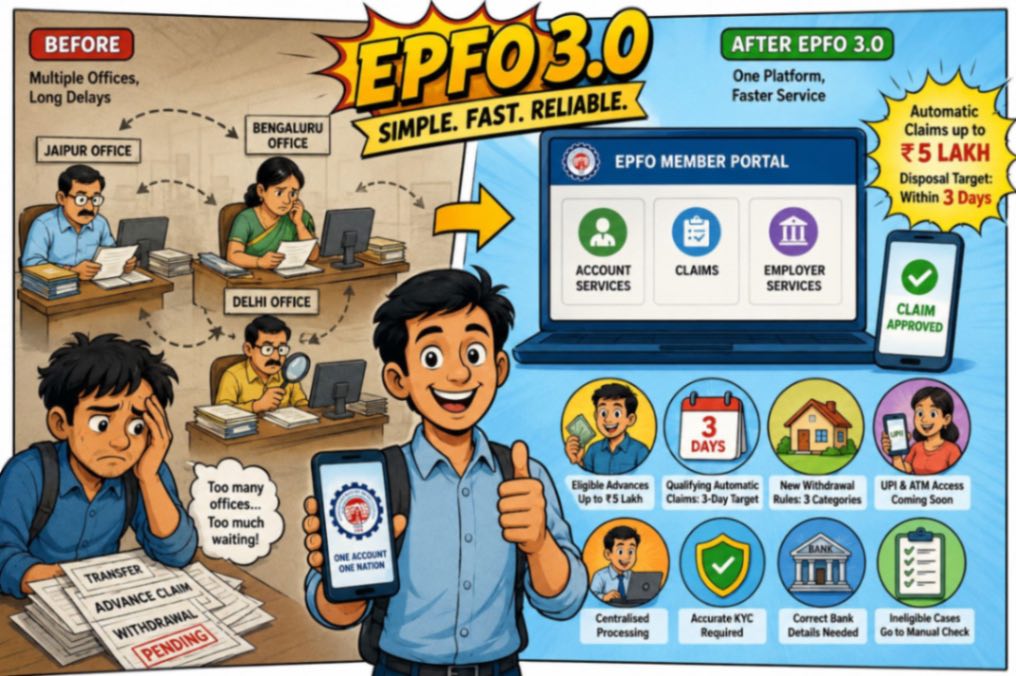
CITES places member accounts, claims and pension processing on a common national platform. Earlier, separate field offices handled parts of the same account journey. A worker who moved from Jaipur to Bengaluru, changed employers twice and later filed a transfer could end up waiting while offices checked different records. Centralised processing reduces that dependence, although correct data remains necessary.
The table separates changes already operating from facilities still being prepared. One point needs attention. Faster technology does not make every claim eligible.
The ₹5 lakh automatic settlement limit predates the latest CITES migration. The Ministry of Labour and Employment announced it on 24 June 2025, raising the previous ₹1 lakh limit. Eligible illness, education, marriage and housing advances were covered. The 3-day target applies to qualifying automatic claims. Claims with conflicting KYC, insufficient service, incorrect bank information or an ineligible purpose can still move to manual checking.
The biggest practical benefit is reduced procedural delay. A hospital expense cannot wait for repeated office visits. Nor can a family repairing a damaged home always spend weeks following up on a claim. When the member’s UAN, Aadhaar, PAN, bank account and service history match, automated checks can examine the application without placing the entire file before an officer.
Job changes may become less cumbersome as well. India’s salaried workforce often moves between employers, cities and payroll systems. Each move can leave a separate Member ID under the same UAN. A national processing platform gives EPFO offices a common account record, which should help with transfers and final settlements. It may also reduce cases where a contribution appears in one record but not in another.
There is a limit to that advantage. Automation reads the data available to it. A wrong exit date entered by an old employer, a name difference between Aadhaar and UAN, or an unverified bank account may stop the process. Faster software can reject an incorrect application faster too. Members should therefore check the claim category and eligible amount before submission instead of assuming that every digital application will be approved.
For Indian workers, the main policy effect is lower procedural friction, not unrestricted access to retirement savings. EPFO still treats the fund as long-term financial protection. Withdrawal reasons, service requirements and retained-balance rules continue to apply. The new system changes how an eligible claim moves. It does not remove the conditions attached to that claim.
The current system follows decisions taken at the 238th meeting of EPFO’s Central Board of Trustees in New Delhi on 13 October 2025. The Board merged 13 partial-withdrawal provisions into 3 categories. It reduced the common minimum membership period for partial withdrawals to 12 months and removed the requirement to provide documents for eligible claims under the revised framework.
A Ministry of Labour and Employment update dated 15 October 2025 said members could withdraw 75% of the eligible amount without documentation, subject to the applicable provision. EPFO earmarked 25% of contributions as a minimum retirement balance. Full withdrawal remained available in specified situations such as retirement, permanent disability, retrenchment, voluntary retirement or permanent departure from India.
The government also changed the treatment of unemployment-related withdrawals. Labour and Employment Minister Mansukh Mandaviya said on 15 October 2025 that an employee leaving a job could withdraw 75% immediately, while the remaining amount could become available after the prescribed unemployment period. He linked the retained portion with service continuity and future pension protection.
That policy choice has received mixed responses from members. Some workers welcome quick access to most of the eligible balance. Others argue that their own savings should remain fully available after job loss. EPFO’s position is that keeping part of the corpus invested can prevent the worker from losing accumulated retirement and pension benefits during a temporary break in employment.
Regional Provident Fund Commissioner-I Uttam Prakash, asked members to update their KYC while releasing CITES performance details on 4 August 2026. He said properly authenticated UAN records linked with Aadhaar, PAN and a mobile number were helping eligible claims move faster. He also accepted that a few transition problems had appeared and said EPFO was resolving them progressively.
Central Provident Fund Commissioner Ramesh Krishnamurthi indicated on 31 July 2026 that BHIM-based claim settlement could arrive within 1 month. That expected period has passed without a nationwide public notice explaining how members can activate the service. A LoansJagat review published on 12 August 2026 found that EPFO had not announced a public launch date, KYC deadline or final UPI transaction limit.
LoansJagat’s assessment points to a common reporting error around the update. UPI is expected to become a payment and claim route, but it will not rewrite withdrawal eligibility. A member may see the eligible amount, submit the request and receive approved money in a verified UPI-linked bank account. EPFO must still approve the claim under the relevant withdrawal provision.
ATM-linked access needs similar caution. Reports have referred to ATM withdrawals, UPI-enabled ATMs and EPFO-linked cards, yet complete public instructions remain unavailable. EPFO has not named participating banks or published a standard process for card issuance, authentication and daily limits. Members should avoid unofficial applications, messages or agents claiming to activate such access.
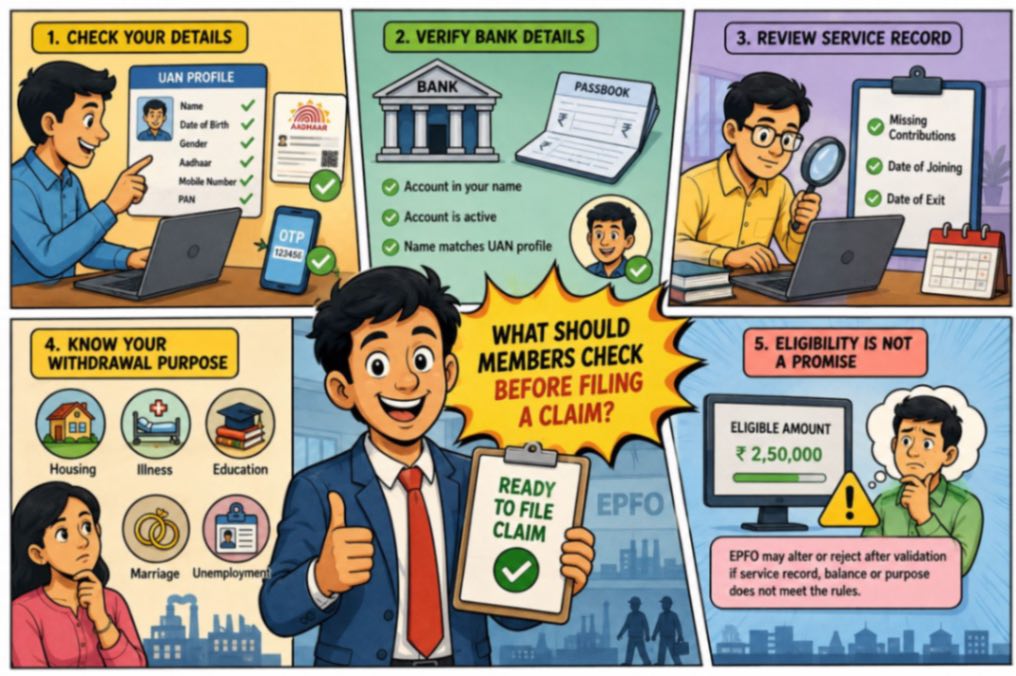
Subscribers can prepare without waiting for the UPI launch. The name, date of birth and gender in the UAN profile should match Aadhaar. The registered mobile number must remain active because authentication may require an OTP. PAN details should also appear correctly, especially where tax treatment applies.
Bank verification deserves a separate check. The account should belong to the EPFO member, remain active and display the same name used in the UAN profile. Members should review their passbook for missing contributions and check the date of joining and exit recorded by each employer. Any error found before a claim is filed is usually easier to handle than a rejection received during an emergency.
The withdrawal category also changes the result. Housing, illness, education, marriage and unemployment claims follow different conditions. The amount displayed on the portal is an eligibility indicator, not a promise of payment. EPFO may alter or reject it after validation if the service record, available balance or selected purpose does not meet the rule.
EPFO 3.0 has already changed the system behind provident fund claims. Centralised records and wider automatic settlement can reduce paperwork for eligible subscribers. Transfers may become easier, and qualifying advances can move within the stated 3-day target.
UPI and ATM-linked options could make the process more convenient after EPFO publishes final instructions. Until that happens, members should use the official portal or UMANG app. Accurate KYC remains the safest preparation for faster processing.
EPFO 3.0 is a digital reform programme covering centralised member records, automated claim processing, simplified withdrawals and planned payment options. CITES currently supports the centralised claim system, while BHIM-UPI and ATM-linked facilities remain pending for general public use.
Eligible automatic claims are targeted for settlement within 3 days. That timeline does not cover every application. Claims requiring manual checks may take longer, particularly when KYC details, bank information, employment records or withdrawal eligibility need verification.
No nationwide public facility has been formally opened with complete operating instructions. Members should continue filing eligible claims through the EPFO Member Portal or UMANG. UPI access should be used only after EPFO publishes an official activation process.
The revised framework allows withdrawal of up to 75% of the eligible amount in applicable cases while retaining 25% for retirement protection. The displayed amount may also depend on the claim category, service period, available balance and earlier withdrawals.
The UAN profile should match Aadhaar for the member’s name, birth date and gender. PAN, bank account and mobile details should remain active and verified. Members should also review joining dates, exit dates and contributions recorded under previous employers.









.png&w=3840&q=75)


