By continuing, you agree to LoansJagat's Credit Report Terms of Use, Terms and Conditions, Privacy Policy, and authorize contact via Call, SMS, Email, or WhatsApp
Disclaimer: The information published on LoansJagat is intended for general informational and educational purposes only and should not be considered financial, legal, or investment advice. Interest rates, loan terms, statistics, and other data may change over time and may vary by lender or source. Please verify the latest information and consult a qualified financial advisor or the respective Bank/NBFC before making any financial decisions.
Subscribe Now
About the author

Arshathul Afia
Arshathul Afia is a journalism graduate and fintech content writer with 4+ years of experience in digital publishing and research-led writing. She has written 200+ articles covering personal finance, lending, banking, digital payments, credit, insurance, and major financial developments in India. At LoansJagat, she focuses on simplifying complex fintech news, RBI updates, loan-related changes, policy developments, and industry trends for everyday readers. Her journalism background helps her approach stories with research, context, and clarity, while her SEO experience ensures content remains discoverable and relevant. She aims to make financial news easier to understand, practical, and useful for readers across India.
Related Blog Post
Simplify All Your Loans Into One Affordable EMI

Customers Served

Debt Consolidated

1200+ Reviews

Locations in India
Club all Loans & Credit Card Bills into Single EMI

Quick Apply Loan
Consolidate your debts into one easy EMI.

Takes less than 2 minutes. No paperwork.

10 Lakhs+
Trusted Customers

2000 Cr+
Loans Disbursed

4.7/5
Google Reviews

50+
Banks & NBFCs Offers
Other services mentioned in this article
EPFO’s new settlement window gives employers 6 months to close eligible PF damages disputes, while employee contributions and statutory interest remain fully protected throughout India.
Key Takeaways
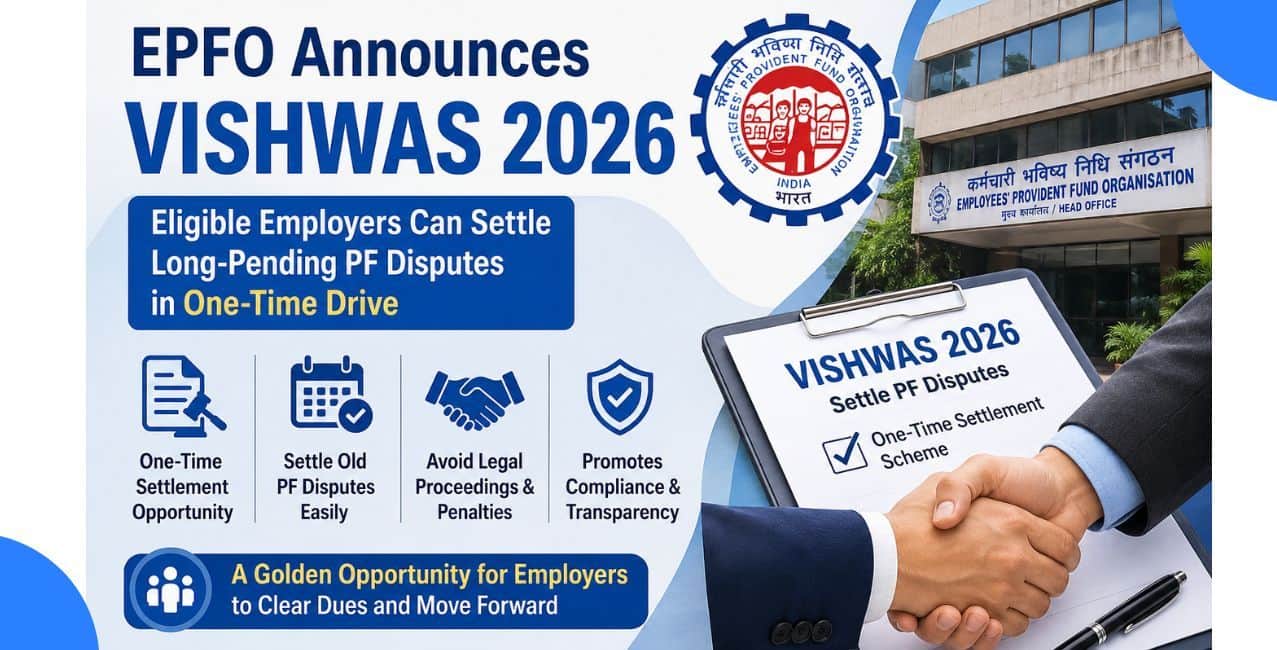
The Employees’ Provident Fund Organisation has launched VISHWAS 2026, a one-time settlement scheme for employers involved in long-pending disputes over damages charged for delayed provident fund payments. The initiative applies across India, started on 29 June 2026, and will remain available for 6 months. Employers must apply through the EPFO portal. The DD India report published on 17 July 2026 confirms that applicants need a Digital Signature Certificate or e-Sign to complete the online filing.
For businesses carrying old PF demands, the immediate benefit is a chance to close eligible proceedings at revised damage rates. Court costs may fall. Files that have moved between notices, hearings and appeals for years may finally reach closure. The longer result could be fewer cases before industrial tribunals and courts, though employers still have to pay the principal PF contribution and full statutory interest. VISHWAS 2026 reduces eligible damages. It does not erase the original employee dues.
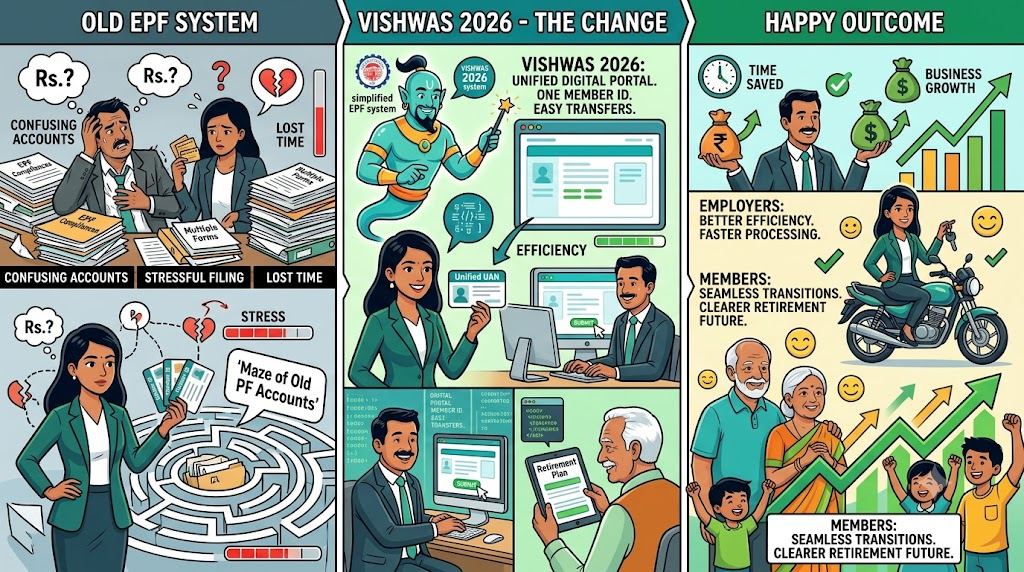
The scheme directly helps establishments facing damages under Section 14B of the Employees’ Provident Funds and Miscellaneous Provisions Act, 1952, or Section 128 of the Code on Social Security, 2020. An employer may have received a final order years ago, challenged it, and kept the amount under dispute. Another establishment may still be replying to an early notice. VISHWAS 2026 can cover both situations when the case meets the notified conditions.
Small businesses could gain more from early closure because an old damages demand often stays on the balance sheet while legal expenses keep rising. Consider a factory that delayed PF payments during a period of financial stress, later paid the contribution and interest, but continued to contest the damages. The scheme allows such an establishment to examine whether paying the revised amount costs less than another round of litigation.
EPF members do not receive a separate payout from the scheme. Their protection comes from the payment conditions. Employers must clear the original contribution and statutory interest, so the concession cannot reduce the worker’s account entitlement. Faster settlement may also help EPFO finish recovery work without waiting for a final court decision.
There is still a risk for workers when an employer treats the scheme as permission to delay future payments. It is not. VISHWAS 2026 deals with eligible older defaults. Fresh delays remain open to enforcement under the current provident fund rules.
EPFO has not limited VISHWAS 2026 to cases already pending in court. The scheme reaches several stages of a dispute, from an early notice to a final order where recovery remains incomplete. Employers should check each period separately because one establishment may have both eligible and excluded defaults.
The main provisions are listed below.
The reduced rates apply to qualifying defaults connected with periods before 14 June 2024. EPFO may adjust amounts already paid towards damages while calculating the final settlement figure. A statutory deposit made during an appeal may also be considered. However, an employer should not expect a refund when an earlier payment exceeds the revised liability.
Settlement also closes the road to another appeal on the same issue. The employer must give an undertaking that the dispute will not be pursued after the application is accepted. That condition prevents a company from taking the concession and then reopening the demand elsewhere.
Old PF files often contain small mismatches. A challan may show one payment date, while the EPFO portal reflects another. An appeal deposit may appear under a separate reference number. These details can slow the application even when the case appears eligible at first glance.
The employer should begin with a month-wise review. Contribution dates, delayed periods, interest payments, and damages already deposited need to match the notices and orders. Court papers should also carry the same establishment code used in the EPFO records.
Funds need attention, too. Full statutory interest must be paid before filing. The employer should also keep money ready for the revised damages demand because the settlement process runs within a fixed window. Filing near the closing date leaves little time to repair missing records or arrange payment.
Regional EPFO offices are expected to operate VISHWAS Cells and help desks. Establishments with several PF codes, old mergers, or multiple appeals may need assistance before submitting the form. A rushed application can create more paperwork than it removes.
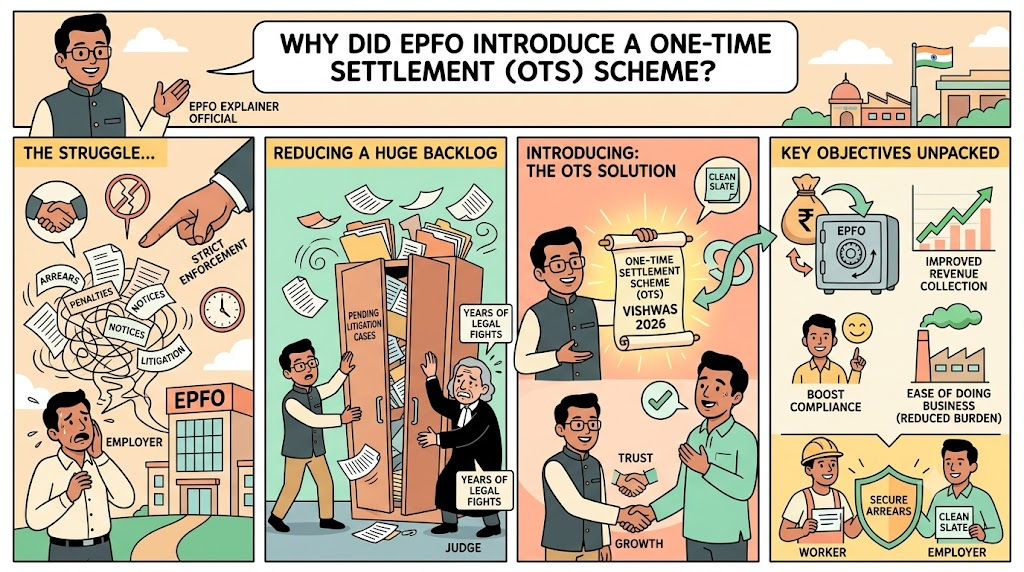
The Central Board of Trustees approved the VISHWAS proposal during its 238th meeting on 13 October 2025. At that point, outstanding penal damages stood at ₹2,406 crore as of May 2025. More than 6,000 cases were pending before High Courts, Central Government Industrial Tribunals, and the Supreme Court. EPFO’s e-proceedings portal also carried nearly 21,000 potential disputes.
Older penalty structures had helped create that backlog. Before the 2024 revision, annual damages generally ranged from 5% to 25%. Certain delayed remittances linked to periods before 2008 could attract annual rates between 17% and 37%. When proceedings continued for several years, employers faced demands that were difficult to settle without another appeal.
The board approved lower graded rates for eligible older cases. The government later included the process in the EPF Scheme, 2026, which came into force on 29 June 2026. EPFO then instructed its field offices to begin handling applications.
The timing also fits a wider attempt to revise provident fund administration. A LoansJagat review of the EPF Scheme 2026 found that several recent changes affect the way employers manage records, exemptions, and member services. VISHWAS 2026 deals with one difficult part of that workload, old damage disputes that have remained open despite payment of the original contribution.
Regional Provident Fund Commissioner-I Lokesh Gupta asked employers to use the scheme for early and amicable settlement of eligible Section 14B disputes. His statement focused on quicker closure for both EPFO and establishments.
Employer representatives had supported the proposal during the Central Board discussion. Smaller industries were a repeated concern because old damage claims can strain cash flow long after the delayed contribution has been paid.
Worker representatives also raised an important point. Lower damages should not weaken the deterrent against delayed deposits. EPFO has addressed part of that concern by keeping the employee contribution and statutory interest outside the concession. Fraud, misappropriation, and deliberate falsification also remain excluded.
The scheme will work only when regional offices handle cases consistently. Two employers with similar default periods should not receive different interpretations because they filed in separate cities. Proper review, written reasons, and accurate portal records will decide whether VISHWAS 2026 reduces disputes or creates a new set of objections.
A closer reading shows that VISHWAS 2026 offers procedural relief, not free financial relief. Employers still need to find the original contribution, pay the full interest and then pay recalculated damages. Businesses with weak records may struggle more with documentation than with the revised rate.
The stronger benefit lies in finality. A company that has carried a disputed PF demand for 5 or 7 years can compare the settlement amount against future legal fees, management time, and continued uncertainty in its accounts. In many eligible cases, closure may be cheaper even when the employer believes the earlier demand was excessive.
For EPFO members, the result is less visible. There is no new withdrawal benefit or higher interest rate. Yet quicker recovery of delayed dues can improve account processing, especially where an employer has already contributed, but the related case remains open in the system.
The 6-month period may appear generous, but older cases take time to rebuild. A company may need records from a former accountant, a closed bank account, or an advocate who handled the appeal years ago. One missing challan can delay the review.
Another risk comes from assuming that every pending case qualifies. Unpaid statutory interest alone can block the application. Fully recovered damages cannot be reopened merely to claim a lower rate. Cases involving deliberate wrongdoing also stay outside.
An unsuccessful application does not cancel the original demand. Recovery proceedings may continue. Employers should therefore file only after checking the payment trail and confirming that the dispute falls within the notified categories.
VISHWAS 2026 gives eligible employers a fixed opportunity to settle old PF damages disputes through EPFO’s online system. Revised rates may reduce the cost of closure, especially in cases that have remained under appeal for years.
The concession comes with strict conditions. Employers must pay the full statutory interest, submit accurate records, and stop further litigation after settlement. Serious violations cannot enter the process.
The scheme may reduce EPFO’s legal backlog and bring delayed cases closer to recovery. Its success will depend on how quickly employers prepare their files and how consistently field offices process them. Waiting until the final weeks would be a poor choice for any establishment with scattered records.
What is VISHWAS 2026?
VISHWAS 2026 is an EPFO scheme for settling eligible disputes over damages charged for delayed provident fund payments.
When did the scheme start?
It became operational on 29 June 2026. The application window remains open for 6 months from that date.
Does the scheme reduce an employee’s PF balance?
No. Employee contributions and statutory interest remain payable. The concession applies only to eligible employer damages.
What must an employer pay before filing?
The full statutory interest must be deposited first. An application with unpaid interest does not qualify.
What rates apply under VISHWAS 2026?
Eligible damages may be recalculated at 0.25%, 0.50%, or 1% per month, depending on the length of delay.
What if a company misses PF payments?
The employee should ask the employer to correct missed contributions or consider VPF after professional advice.
How can employers apply for VISHWAS 2026?
Employers can apply online through the EPFO Employer Portal using a Digital Signature Certificate or e-Sign.









.png&w=3840&q=75)


