By continuing, you agree to LoansJagat's Credit Report Terms of Use, Terms and Conditions, Privacy Policy, and authorize contact via Call, SMS, Email, or WhatsApp
Disclaimer: The information published on LoansJagat is intended for general informational and educational purposes only and should not be considered financial, legal, or investment advice. Interest rates, loan terms, statistics, and other data may change over time and may vary by lender or source. Please verify the latest information and consult a qualified financial advisor or the respective Bank/NBFC before making any financial decisions.
Subscribe Now
About the author

Arshathul Afia
Arshathul Afia is a journalism graduate and fintech content writer with 4+ years of experience in digital publishing and research-led writing. She has written 200+ articles covering personal finance, lending, banking, digital payments, credit, insurance, and major financial developments in India. At LoansJagat, she focuses on simplifying complex fintech news, RBI updates, loan-related changes, policy developments, and industry trends for everyday readers. Her journalism background helps her approach stories with research, context, and clarity, while her SEO experience ensures content remains discoverable and relevant. She aims to make financial news easier to understand, practical, and useful for readers across India.
Related News
Simplify All Your Loans Into One Affordable EMI

Customers Served

Debt Consolidated

1200+ Reviews

Locations in India
Club all Loans & Credit Card Bills into Single EMI

Quick Apply Loan
Consolidate your debts into one easy EMI.

Takes less than 2 minutes. No paperwork.

10 Lakhs+
Trusted Customers

2000 Cr+
Loans Disbursed

4.7/5
Google Reviews

50+
Banks & NBFCs Offers
Other services mentioned in this article
EPFO’s June 2026 digital migration has left many PF members waiting for claims, while UMANG-linked access and portal disruption continue to trigger complaints.
Key Highlights
EPFO’s digital upgrade has become a service headache for salaried workers across India. The issue involves the Employees’ Provident Fund Organisation, PF members, employers and users of UMANG-linked EPFO services. The disruption began on June 26, 2026, after EPFO started a planned database consolidation and software system upgrade under EPFO 2.01.
The short-term impact is direct. A delayed PF claim can disturb rent, loan EMIs, hospital payments or job-loss support. In the long run, the upgraded system may reduce duplicate records and speed up claim checks, but members will judge it by 1 thing only: whether the claim is filed, tracked and settled without repeated failure.
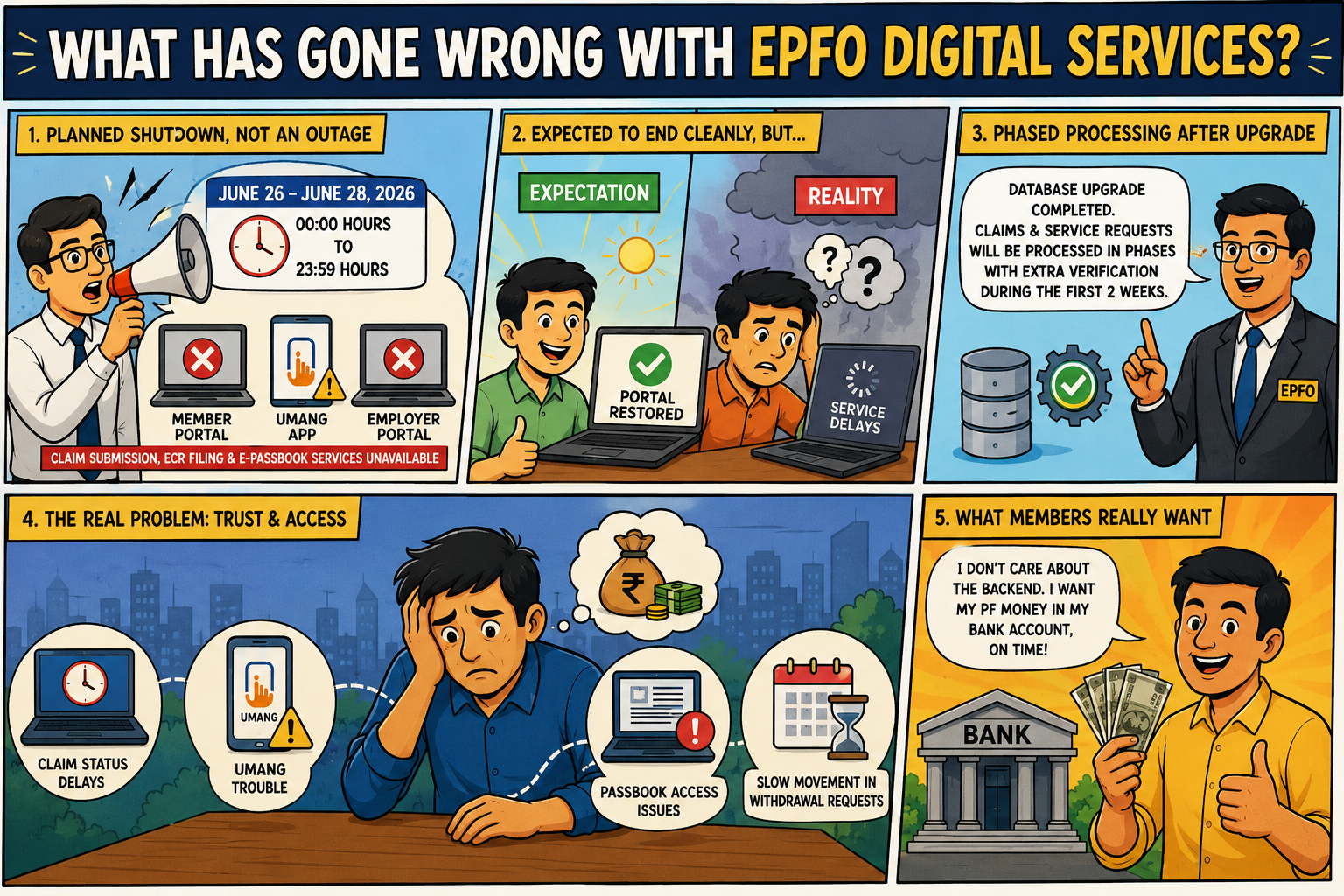
EPFO’s problem started with a planned shutdown, not an accidental outage. The Press Information Bureau said the Member Portal, UMANG App and Employer Portal would remain down from June 26, 2026, 00:00 hours to June 28, 2026, 23:59 hours. It also said claim submission, ECR filing and e-passbook services would remain unavailable during this period.
That shutdown window was expected to end cleanly. It did not feel that way for many users. EPFO later said its database consolidation and software upgrade had been completed, but claims and service requests would go through phased processing and extra verification during the first 2 weeks after migration. So the portal returned, but the service experience stayed uneven.
The main concern now is not only downtime. It is trust in digital access. Members are reporting claim status delays, UMANG trouble, passbook access issues and slow movement in withdrawal requests. A person waiting for PF money after leaving a job does not care whether the backend has been modernised. The person wants to know when the money will reach the bank account.
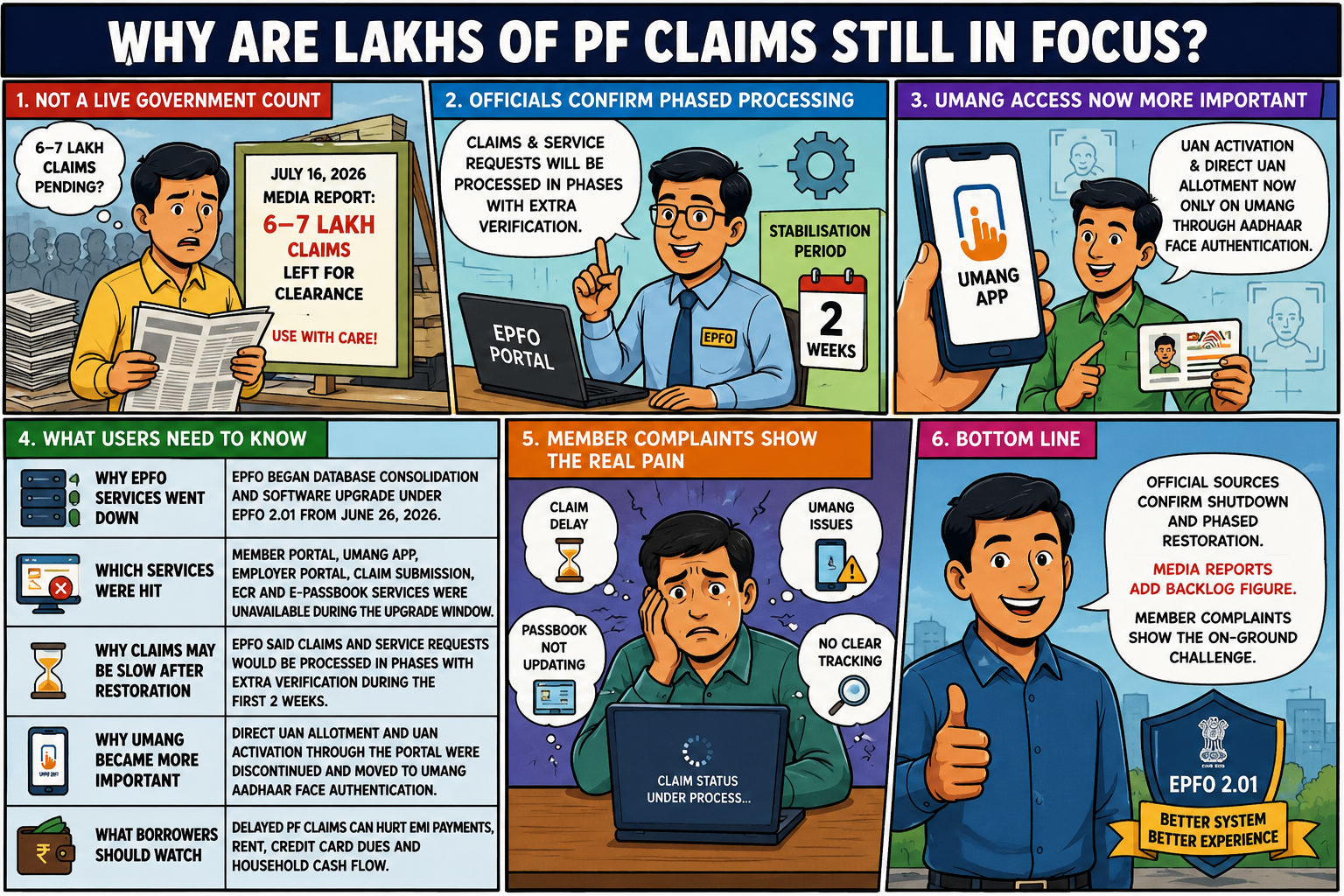
The 6-7 lakh figure comes from a July 16, 2026, media report, not from a live government dashboard. The report said EPFO processed a large batch of claims after the upgrade and still had 6-7 lakh cases left for clearance. That number should be used carefully. It shows pressure on the system, but it should not be written as a fresh official count for today unless EPFO releases a new update.
EPFO’s own notices still support the wider service-disruption story. Its portal told members that claims and service requests would be handled in phases after the upgrade. The EPFO Unified Member Portal also shifted direct UAN allotment and UAN activation from the portal to UMANG through Aadhaar-based face authentication. That change makes UMANG access more important than before.
Official sources confirm the shutdown and phased restoration. Media reports add the backlog figure. Member complaints show the pain on the ground.
A system can be live and still fail users at the filing or tracking stage. That is the gap EPFO now has to close.
The impact falls hardest on workers who need PF money for urgent expenses. A hospital bill cannot wait because a portal is stabilising. A worker who has left a job may depend on final PF settlement until the next salary starts. Families paying rent, school fees or EMIs can feel the delay within days.
For employers, the disruption creates a different problem. HR teams become the first helpdesk for workers even when the issue is with EPFO systems. Employees ask about UAN activation, KYC, exit dates, PF transfers and claim status. Small companies with lean payroll teams feel this pressure more during monthly compliance work.
There is still a possible gain if EPFO 2.01 becomes stable. A cleaner national database can reduce wrong records, failed bank credits and manual handling. Faster auto-checks may help routine claims in the future. But the benefit will only be visible when the claim journey feels normal for members, from login to settlement.
Payroll advisers usually check 5 basic points when PF claims slow down: UAN-Aadhaar link, bank account approval, PAN status, employer exit date and duplicate claim filing. A small mismatch can push a claim into manual review. During a technology migration, these errors can become more painful.
The safer route is boring but useful. Members should file once, save the claim ID, check KYC, confirm the registered bank account and avoid repeated submissions. If the claim remains stuck, they should use EPFO’s grievance channel or official helpdesk rather than social media agents.
LoansJagat’s reading of the issue adds a household finance angle. A delayed PF claim does not only affect retirement savings. It can push a salaried worker towards credit card dues, personal loans or missed EMI dates. In its EPFO update, LoansJagat advised members to keep KYC and bank records updated because the upgraded system now handles claim filing, e-passbook access, employer filings, UAN-linked work and PF transfer requests through a tighter digital route.
This is also when fraud risk rises. Members should not share UAN passwords, Aadhaar OTPs, bank details or claim screenshots with anyone promising faster settlement. EPFO services are free through official channels. Any paid shortcut should raise suspicion.
The first official update came through PIB. It gave the exact shutdown window and listed the services that would be unavailable. It also said claims submitted before the migration window would be processed after services resumed. That sentence explains why some users who filed before June 26 also had to wait.
After the upgrade window, EPFO moved into phased restoration. The Member Portal said the database consolidation and software upgrade had been completed, but claims and service requests would face extra checks during the first 2 weeks. The system was back, but normal service did not return for every member at the same pace.
The July 16 media report then brought the backlog into public discussion. It said 6-7 lakh claims remained after a large clearance drive. This makes the story bigger than a short website outage. It shows how a planned technology upgrade can create a long queue if access, verification and processing do not stabilise together.
EPFO’s official position is that the upgrade was planned to improve service delivery, processing efficiency and user experience. The PIB release also regretted the inconvenience during the shutdown period. That is the government’s stated reason for the migration.
EPFO’s later portal notice sounded more cautious. It asked members to expect phased processing and extra verification checks after the upgrade. For EPFO, that may be a system safety step. For members, it feels like another delay.
PF members are asking for basic visibility. If a claim is under process, they want to know why. If a bank credit is delayed, they want a realistic date. If UMANG is now required for UAN activation, the service has to work without repeated failure.
Employers want stability too. Payroll teams cannot keep answering the same claim-status questions without a firm system response. They need portals that work during filing windows, especially around ECR work, exits and KYC approvals.
EPFO’s digital upgrade has left a difficult after-effect. The June 26 shutdown was planned, but the complaints continued because members still faced claim filing, UMANG and tracking problems after phased restoration began.
The 6-7 lakh backlog figure should be reported with care because it comes from a July 16 media report, not a fresh government dashboard. Still, the wider issue is real. EPFO’s own notices confirm service disruption and phased checks. Members should avoid duplicate claims, keep KYC updated, use official grievance routes and stay away from agents who promise faster PF settlement.
What happened to EPFO digital services?
EPFO’s June 26 upgrade disrupted claim filing, UMANG-linked services, e-passbook access and employer portal work.
Claims are moving through phased checks after the EPFO 2.01 database consolidation and software upgrade.
Is the UMANG app fully down?
No. The issue is mainly with EPFO-linked services, especially UAN activation and claim-related access.
How many PF claims are stuck?
A July 16 media report said 6-7 lakh claims remained after a large clearance drive.
What should PF members do now?
Members should check KYC, save claim IDs, avoid duplicate claims and use official EPFO grievance channels.










.png&w=3840&q=75)


