
By continuing, you agree to LoansJagat's Credit Report Terms of Use, Terms and Conditions, Privacy Policy, and authorize contact via Call, SMS, Email, or WhatsApp
Disclaimer: The information published on LoansJagat is intended for general informational and educational purposes only and should not be considered financial, legal, or investment advice. Interest rates, loan terms, statistics, and other data may change over time and may vary by lender or source. Please verify the latest information and consult a qualified financial advisor or the respective Bank/NBFC before making any financial decisions.
Subscribe Now
About the author

Arshathul Afia
Arshathul Afia is a journalism graduate and fintech content writer with 4+ years of experience in digital publishing and research-led writing. She has written 200+ articles covering personal finance, lending, banking, digital payments, credit, insurance, and major financial developments in India. At LoansJagat, she focuses on simplifying complex fintech news, RBI updates, loan-related changes, policy developments, and industry trends for everyday readers. Her journalism background helps her approach stories with research, context, and clarity, while her SEO experience ensures content remains discoverable and relevant. She aims to make financial news easier to understand, practical, and useful for readers across India.
Related Blog Post
Simplify All Your Loans Into One Affordable EMI

Customers Served

Debt Consolidated

1200+ Reviews

Locations in India
Club all Loans & Credit Card Bills into Single EMI

Quick Apply Loan
Consolidate your debts into one easy EMI.

Takes less than 2 minutes. No paperwork.

10 Lakhs+
Trusted Customers

2000 Cr+
Loans Disbursed

4.7/5
Google Reviews

50+
Banks & NBFCs Offers
Other services mentioned in this article
Employers will have until 31 October 2026 to enroll eligible employees in the provident fund as the EPFO has extended the deadline.
The Employees’ Provident Fund Organisation under the Ministry of Labour and Employment has extended the employees' enrolment campaign. This campaign is for employers that did not previously enroll eligible employees in the PF system. The Press Information Bureau states that the campaign will run until the 31st of October 2026. This covers the time period of 1st April 2009 to 31st March 2026. During this time, employees, employers, and payroll staff will have the ability to resolve situations of missed PF coverage.
In the short term, employers may face extra work. They will need to check joining dates, salary records, active employee lists and UAN details. Some old files may not be easy to trace. The long-term gain, though, is stronger for workers. Once added, eligible employees can receive EPF savings, pension support under EPS and insurance cover under EDLI. A missed PF record may look like a small HR error now, but it can hurt a worker during job transfer, retirement planning or a family claim.
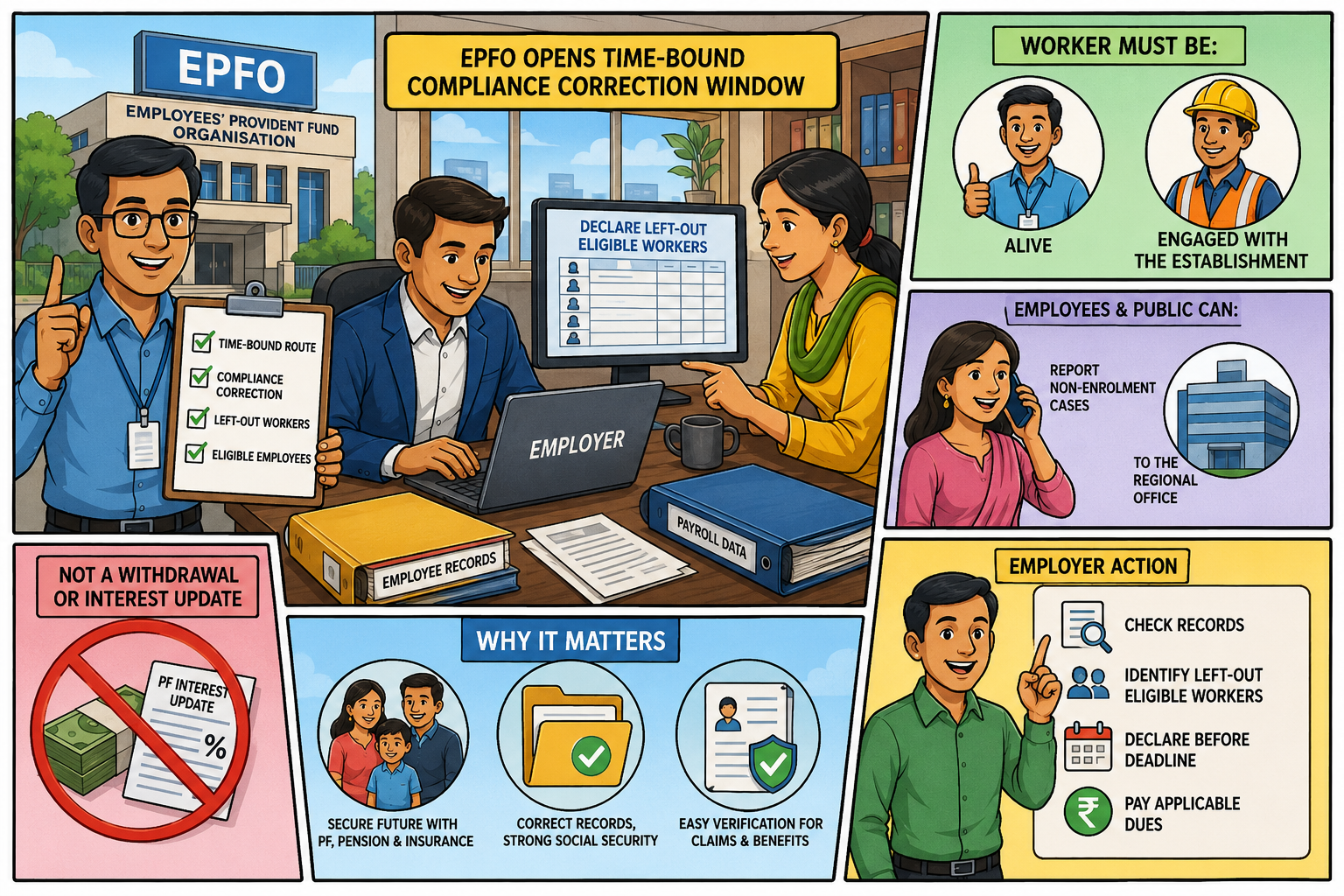
EPFO has opened a time-bound route for employers to declare eligible workers who were left out of provident fund coverage. This is not a withdrawal update or a new PF interest announcement. It is a compliance correction window for establishments that missed enrolling eligible employees earlier.
The worker must still be engaged with the establishment on the declaration date. The employee also has to be alive. That condition keeps the campaign focused on current workers who can still be verified through employer records. EPFO has also asked employees and members of the public to report non-enrolment cases to the Regional Office for verification if an eligible worker was missed.
Many workers realise their PF record is missing only after they change jobs. Some see no passbook entry. Some find that one employer never created a UAN. Others may have salary slips but no PF contribution history. For such workers, this extension can help create formal social security coverage without pushing them straight into a long dispute.
The benefit is stronger for workers in sectors where contractor changes, payroll shifts or casual hiring records often create gaps. Once the employer declares the worker, the past employee share is waived if it was not deducted from wages earlier. That is important. A worker should not be asked to pay old employee contributions from personal savings when the amount was never cut from salary.
Employers should not treat this as a last-week filing job. First, they need to compare active employee lists with PF member records. Then they should check who joined during the eligible period and who was not added to EPFO records despite being eligible.
The table below gives the core details in one place. It keeps the official update, the earlier development and the policy source together for quick reading.
After this check, employers should keep proof ready. Salary slips, attendance records, appointment letters, wage registers and contractor files may be needed during verification. Workers should also keep copies of bank salary credits, offer letters and old salary slips. A written request to HR is better than a verbal reminder.
Payroll and labour compliance professionals would read this as a low-penalty correction route, not a blanket exemption. The ₹100 penal damage per establishment lowers the fear of heavy penalties, but it does not remove the employer’s duty to pay the employer-side dues. Interest and administrative charges still apply.
A workable solution is simple. Employers should create 3 lists: all active employees, all active PF members and all eligible workers not found in PF records. Any mismatch should be checked against joining dates and wage eligibility. The LoansJagat view also fits here. Its report on the EPF Scheme 2026 said the new framework replaced the 1952 EPF scheme after 74 years and added tighter checks for exempted PF trusts, digital accounts and employer responsibility through the LoansJagat update. That points to one larger trend: EPFO wants cleaner employer records, not casual PF compliance.
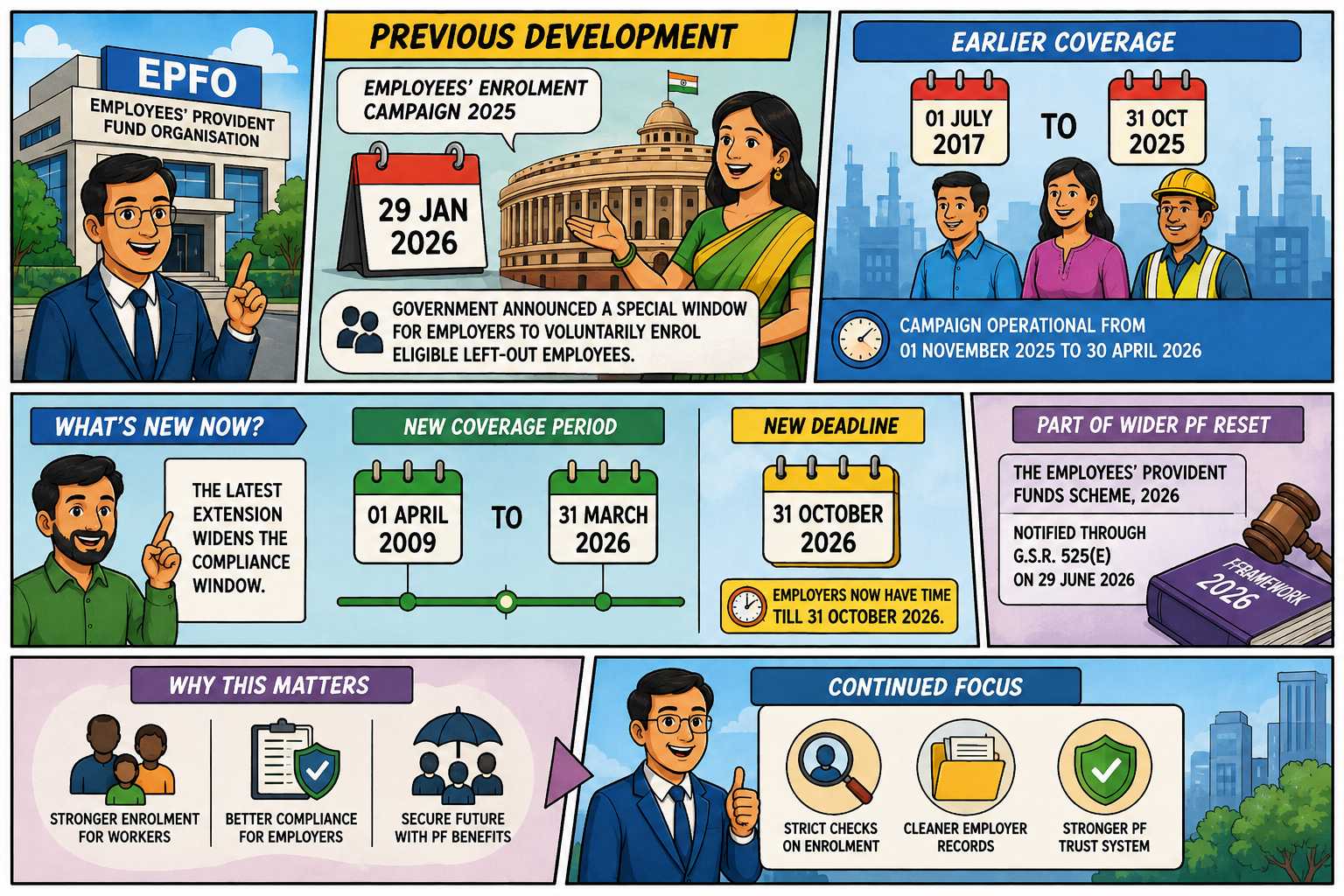
The previous development came through the Employees’ Enrolment Campaign 2025. On 29 January 2026, the government said the campaign gave employers a special window to voluntarily enrol eligible employees who were left out between 01 July 2017 and 31 October 2025. That earlier campaign was operational from 01 November 2025 to 30 April 2026.
The latest extension widens the compliance window. It now covers the period from 01 April 2009 to 31 March 2026 and gives employers time till 31 October 2026. The 2026 PF framework notified through G.S.R. 525(E) on 29 June 2026 also became part of the wider PF compliance reset. So, the new deadline is not a standalone announcement. It follows months of action around enrolment, employer records and PF trust checks.
EPFO has urged employers to use the extended campaign and declare left-out eligible employees within the deadline. It has also warned that establishments failing to act during the extended period may face normal enforcement action and prosecution under the law.
For employees, the action point is direct. Workers should check whether their UAN passbook shows contributions for the period of employment. If the record is missing, they should ask HR in writing and keep proof ready. For employers, the safer step is to correct the record before EPFO finds the gap during inspection or through a worker complaint.
EPFO’s 31 October 2026 deadline gives employers one more chance to add eligible left-out workers to the PF net. The update can help workers who were missed due to poor payroll records, contractor changes, delayed onboarding or old compliance gaps.
The best action is early filing. Employers should verify names now, not in the final week of October. Workers should check their UAN records and ask for written confirmation if PF coverage is missing. A corrected PF record can help with savings, pension and insurance support years later.
EPFO has extended the enrolment campaign till 31 October 2026 for eligible workers missed from PF coverage.
Eligible workers from 01 April 2009 to 31 March 2026 can be declared by employers.
No, the employee’s past share is waived if it was not deducted from salary earlier.
If an employer is deducting PF from salary but not depositing it, the employee should first check the EPFO passbook and keep payslips, bank salary credits and the appointment letter ready. Then ask HR or payroll for a written update. If there is no proper reply, the employee can raise a complaint on the EPFiGMS portal or visit the nearest EPFO office with proof.
That is risky. EPFO has warned of normal enforcement action and prosecution after the campaign period ends.








.png&w=3840&q=75)


