
By continuing, you agree to LoansJagat's Credit Report Terms of Use, Terms and Conditions, Privacy Policy, and authorize contact via Call, SMS, Email, or WhatsApp
Disclaimer: The information published on LoansJagat is intended for general informational and educational purposes only and should not be considered financial, legal, or investment advice. Interest rates, loan terms, statistics, and other data may change over time and may vary by lender or source. Please verify the latest information and consult a qualified financial advisor or the respective Bank/NBFC before making any financial decisions.
Subscribe Now
About the author

Arshathul Afia
Arshathul Afia is a journalism graduate and fintech content writer with 4+ years of experience in digital publishing and research-led writing. She has written 200+ articles covering personal finance, lending, banking, digital payments, credit, insurance, and major financial developments in India. At LoansJagat, she focuses on simplifying complex fintech news, RBI updates, loan-related changes, policy developments, and industry trends for everyday readers. Her journalism background helps her approach stories with research, context, and clarity, while her SEO experience ensures content remains discoverable and relevant. She aims to make financial news easier to understand, practical, and useful for readers across India.
Related Blog Post
Simplify All Your Loans Into One Affordable EMI

Customers Served

Debt Consolidated

1200+ Reviews

Locations in India
Club all Loans & Credit Card Bills into Single EMI

Quick Apply Loan
Consolidate your debts into one easy EMI.

Takes less than 2 minutes. No paperwork.

10 Lakhs+
Trusted Customers

2000 Cr+
Loans Disbursed

4.7/5
Google Reviews

50+
Banks & NBFCs Offers
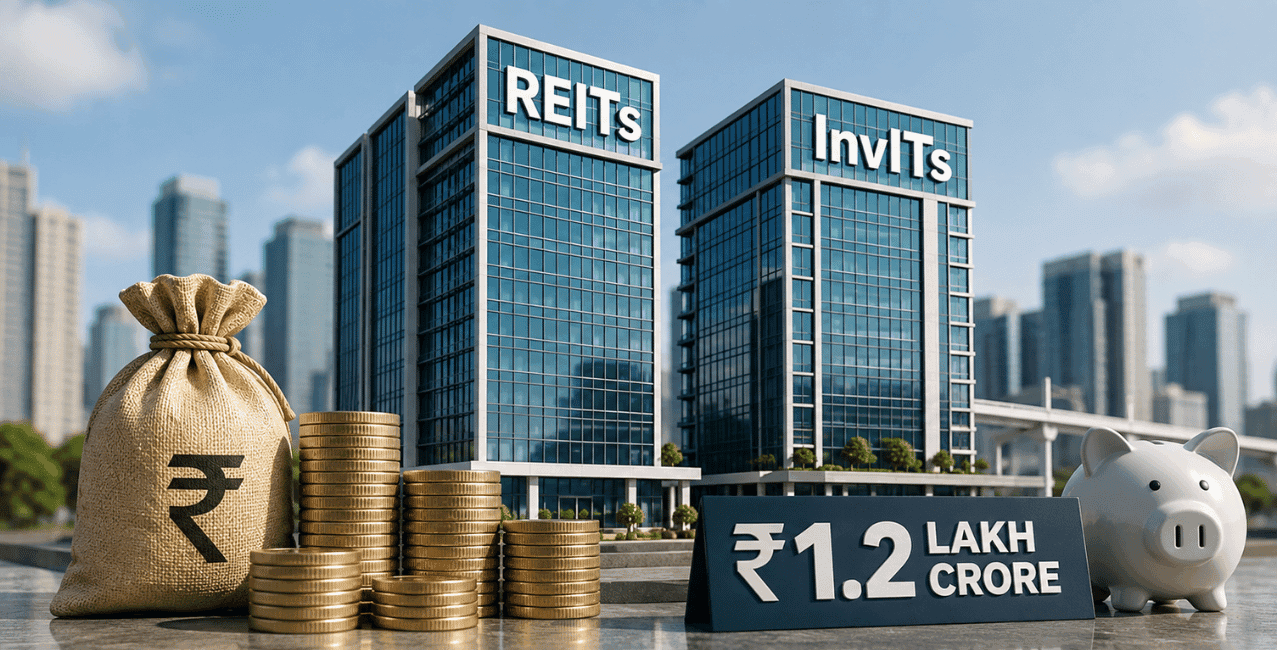
EPFO and insurers may supply ₹1.2 lakh crore to India’s REITs and InvITs, but regulatory permission and strict asset checks will decide the final outcome.
The Employees’ Provident Fund Organisation and Indian insurance companies could become major sources of long-term capital for Real Estate Investment Trusts and Infrastructure Investment Trusts. Avendus Capital made the assessment in its report, Trust the Structure: REITs, InvITs and the Real Return Imperative, released in Mumbai on June 16, 2026. The report estimates that a further 2% EPFO allocation and a 1 percentage-point rise in insurer exposure could together provide more than ₹1.2 lakh crore.
That money has not been approved. In the near term, stronger institutional demand could help new trust issues find buyers and make listed units easier to trade. Over several years, it may allow road operators, power companies and property developers to sell mature assets, repay debt and fund fresh projects. The risk is equally direct. Retirement savings and policyholder funds could face losses if a trust carries costly borrowings, weak assets or unreliable cash collections.
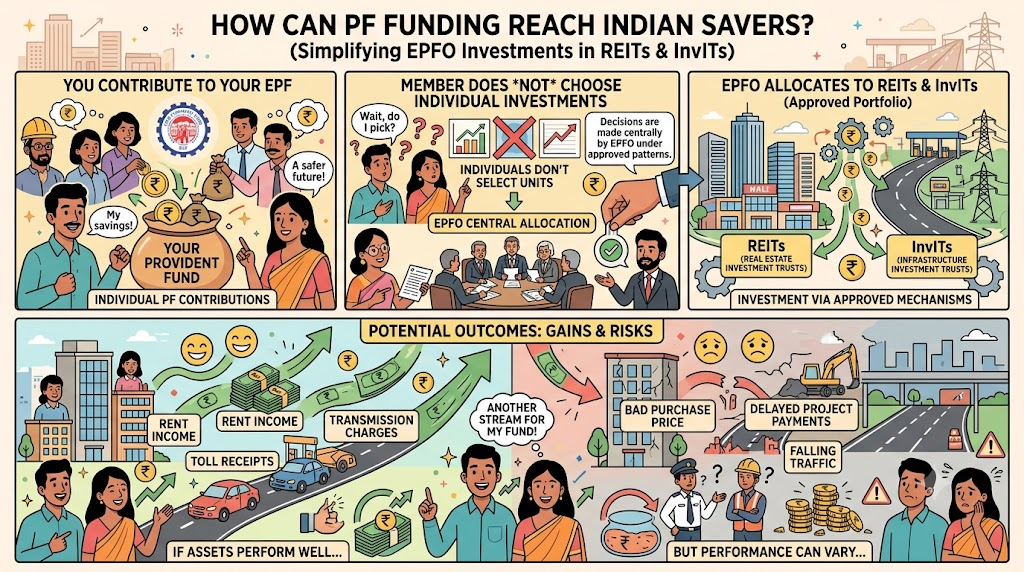
An EPFO member would not select a REIT or InvIT inside the provident fund account. EPFO would make the allocation centrally under an investment pattern approved by its Central Board of Trustees. If the assets perform as expected, rent, toll receipts or transmission charges could add another stream of income to the fund. A bad purchase price, delayed project payments or falling traffic could work in the opposite direction.
Insurance policyholders would see no immediate alteration to premiums or policy benefits either. Life insurers need assets that can generate money over long periods because many policies run for decades. Operating roads, leased offices and power networks may fit that requirement. Still, a long contract does not guarantee payment. The tenant, road user, electricity buyer and debt structure all affect the money available for distribution.
Avendus Managing Director Gaurav Sood described REITs and InvITs as “one of the most significant long-term opportunities” in Indian capital markets. Gaurav Arora, who heads Infrastructure and Real Assets Investment Banking at the firm, said these trusts could “financialize cash-generating core assets and recycle capital”. Both statements appeared in the Avendus release dated June 16, 2026.
The proposal needs a staged approach. EPFO could begin with operating assets that have several years of payment records, manageable debt and sponsors with established governance. Insurers can compare the life of each asset with the dates on which policy claims may fall due. A wider ceiling without these checks would merely enlarge the amount exposed to poor underwriting.
The report places combined REIT and InvIT assets under management near ₹10 lakh crore and expects the figure to cross ₹20 lakh crore by 2030. It also says domestic long-duration institutions use about 7.5% of their permitted capacity. Full use could release close to ₹7 lakh crore, although that is a theoretical maximum rather than a forecast of money certain to arrive.
The main position is easier to follow when the estimates and approved developments are kept apart.
Readers need this distinction. An estimated investment pool is different from cash placed in a public issue. Some future money may buy existing units from sponsors instead of financing new roads or buildings. That would increase public ownership and trading volume, but the same amount would not be added to the assets held by the trusts.
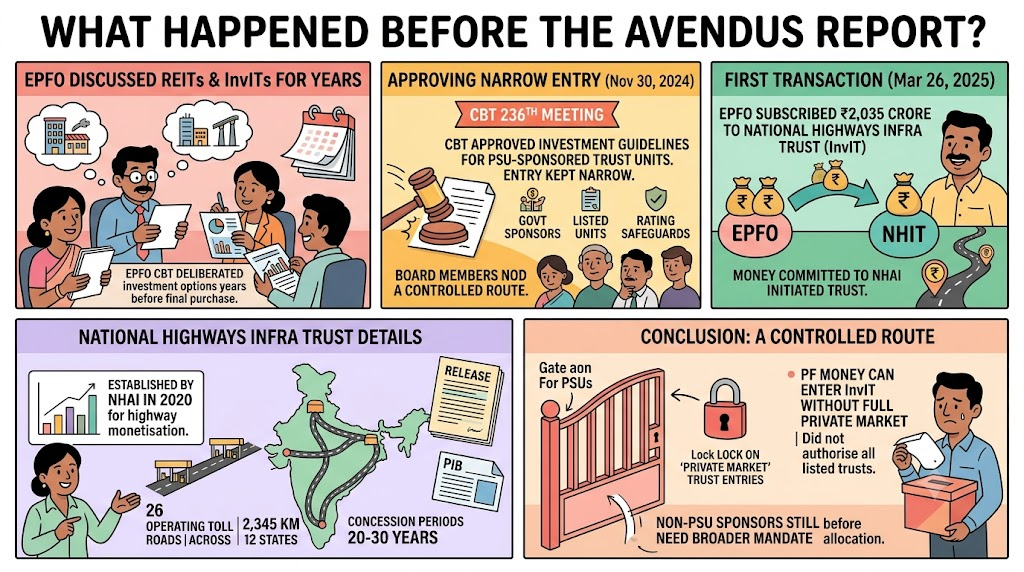
EPFO had discussed REITs and InvITs for years before making a purchase. The Central Board of Trustees approved investment guidelines for units issued by PSU-sponsored trusts at its 236th meeting on November 30, 2024. The decision kept the first entry narrow. Government-backed sponsors, listed units, and rating safeguards gave the Board a more controlled route for workers’ money.
The first transaction followed on March 26, 2025. EPFO subscribed ₹2,035 crore to the National Highways Infra Trust, established by NHAI in 2020 for highway monetisation. The trust held 26 operating toll roads covering 2,345 km across 12 states after that fundraising round. Their concession periods ranged from 20 to 30 years. Those figures came from the PIB release published on the same date.
This purchase proved that provident fund money could enter an InvIT without opening the full private market. It did not authorise investment in every listed trust. Non-PSU sponsors still need a broader EPFO mandate before they can compete for a comparable allocation.
Insurers have operated under a separate rulebook. IRDAI’s April 22, 2021 circular, reference number IRDAI/F&I/CIR/INV/098/04/2021, requires eligible debt instruments to carry at least an AA rating. It also caps cumulative unit and debt exposure at 3% of the insurer’s total fund size. A proposed 6% combined ceiling has been discussed, but it should not be described as a notified change.
LoansJagat’s reading is cautious. Larger institutional buying could improve liquidity and give infrastructure sponsors a dependable source of patient money. Yet workers and policyholders gain only when the trust’s assets keep producing cash after interest, maintenance and management costs. The headline allocation percentage says little about asset quality.
Direct retail investors face a separate issue. Trust distributions can contain rent, interest, dividends and repayment components, so the amount credited is not always taxed in one way. The LoansJagat guide to Section 194LBA, published on January 20, 2026, explains when tax is deducted and why the income component affects the investor’s final tax treatment. Chasing the highest displayed yield without checking that breakdown can produce an unpleasant result at filing time.
A higher allocation limit should follow asset testing, not lead it. For an office REIT, reviewers need occupancy data, lease expiries, tenant concentration and borrowing costs. A road InvIT needs traffic history, toll rules, concession length, and a realistic maintenance budget. Power and transmission trusts require attention to the payment record of buyers and state distribution companies.
Debt needs its own reading. A trust may report regular distributions while depending on refinancing or fresh borrowing. EPFO and insurers would need to examine when debt matures, whether interest is fixed or floating, and how much cash remains after maintenance. Sponsor transactions deserve review too, especially when the trust buys an asset from a related company.
There is also a pricing problem. Large buyers entering a limited market may push unit prices higher. Existing investors may welcome that rise, while new investors receive a lower yield for the same cash flow. Institutional demand improves liquidity, but it cannot repair an overpriced or poorly governed asset.
EPFO and insurers have enough financial weight to change the scale of India’s REIT and InvIT market. Avendus estimates the immediate opening at more than ₹1.2 lakh crore from 2 allocation changes. For now, the figure remains conditional.
The earlier ₹2,035 crore NHAI InvIT transaction gives policymakers a working case to examine. Wider access may follow if public and private trusts can show dependable collections, moderate debt and honest valuations. Workers’ savings and policyholder funds need that evidence before a larger cheque is written.
Avendus combines over ₹60,000 crore from a possible 2% EPFO allocation with another ₹60,000 crore from a 1 percentage-point insurer increase.
No. EPFO would select and manage eligible investments centrally. Members would continue to hold provident fund balances under the existing account structure.
Tax depends on whether the distribution contains rent, interest, dividend, or repayment. Investors should check the trust’s distribution statement before filing returns.
They are regulated market instruments, not guaranteed deposits. Safety depends on asset cash flow, debt, sponsor conduct, valuation, and the investor’s holding period.
A REIT offers listed property exposure and possible price appreciation. An FD offers a contracted return and deposit protection within the applicable statutory limit.








.png&w=3840&q=75)


