
By continuing, you agree to LoansJagat's Credit Report Terms of Use, Terms and Conditions, Privacy Policy, and authorize contact via Call, SMS, Email, or WhatsApp
Disclaimer: The information published on LoansJagat is intended for general informational and educational purposes only and should not be considered financial, legal, or investment advice. Interest rates, loan terms, statistics, and other data may change over time and may vary by lender or source. Please verify the latest information and consult a qualified financial advisor or the respective Bank/NBFC before making any financial decisions.
Subscribe Now
About the author

Arshathul Afia
Arshathul Afia is a journalism graduate and fintech content writer with 4+ years of experience in digital publishing and research-led writing. She has written 200+ articles covering personal finance, lending, banking, digital payments, credit, insurance, and major financial developments in India. At LoansJagat, she focuses on simplifying complex fintech news, RBI updates, loan-related changes, policy developments, and industry trends for everyday readers. Her journalism background helps her approach stories with research, context, and clarity, while her SEO experience ensures content remains discoverable and relevant. She aims to make financial news easier to understand, practical, and useful for readers across India.
Related Blog Post
Simplify All Your Loans Into One Affordable EMI

Customers Served

Debt Consolidated

1200+ Reviews

Locations in India
Club all Loans & Credit Card Bills into Single EMI

Quick Apply Loan
Consolidate your debts into one easy EMI.

Takes less than 2 minutes. No paperwork.

10 Lakhs+
Trusted Customers

2000 Cr+
Loans Disbursed

4.7/5
Google Reviews

50+
Banks & NBFCs Offers
Employers now have until October 31, 2026, to enrol eligible workers who were missed from EPF records under EPFO’s one-time nationwide campaign covering past gaps.
The Employees’ Provident Fund Organisation has asked establishments across India to use the Employees’ Enrolment Campaign 2026 before October 31. According to an Akashvani News report published on August 22, 2026, employers can declare workers who should have received EPF coverage during the eligible period but were never enrolled. The employee must be alive and working for the same establishment on the declaration date.
In the short term, employers face a difficult records exercise. Old wage registers, contractor bills, appointment letters and deduction entries may not match. Workers could gain provident fund, pension and insurance protection after enrolment, which may help their families many years later. The weak point is serious. Former employees cannot enter through this window, while current workers cannot submit the final employer declaration themselves.
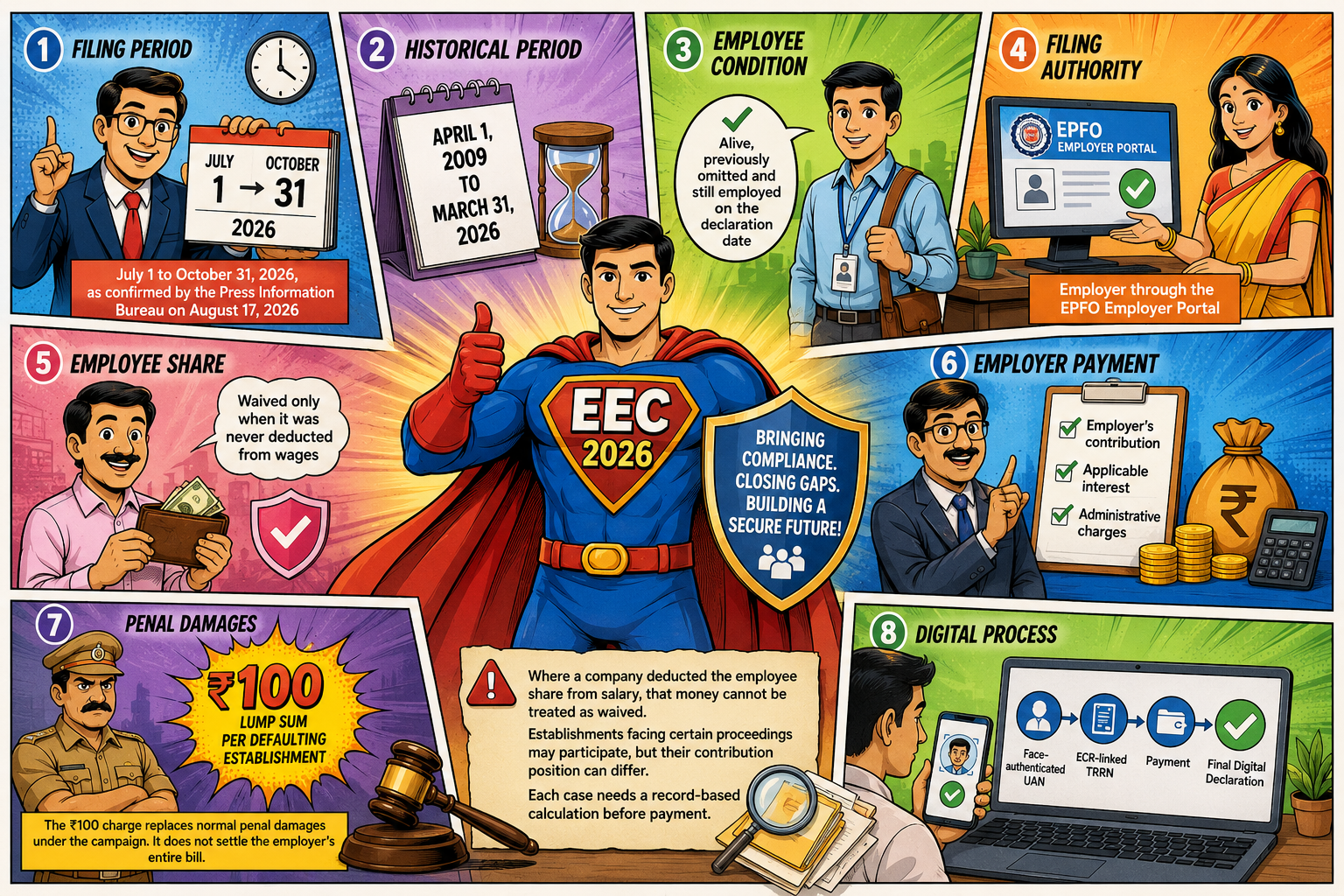
The campaign was notified on June 29, 2026 and started operating on July 1. Its terms separate the employee contribution from the employer’s unpaid liability, a detail that can easily be lost behind the widely reported ₹100 figure.
The ₹100 charge replaces normal penal damages under the campaign. It does not settle the employer’s entire bill. Where a company deducted the employee share from salary, that money cannot be treated as waived. Establishments facing certain proceedings may participate, but their contribution position can differ. Each case needs a record-based calculation before payment.
Read Also : India’s Credit Card Boom Deepens as July Spending Crosses Rs 2 Trillion for Third Straight Month
A missed EPF entry can follow a worker for years. A security guard may change work sites while remaining on one contractor’s rolls. A warehouse employee may receive wages through a bank but never obtain a UAN. Smaller factories sometimes begin with a few workers, grow later, and fail to update coverage when the legal requirement applies. EEC 2026 gives the employer a route to repair such omissions while the worker is still employed.
Successful enrolment can place the worker within EPF, EPS and EDLI protection. EPF builds retirement savings. EPS can provide pension benefits after the required service conditions are met, while EDLI supports the eligible family of a member who dies during employment. Past service and contribution records affect later claims, so the declaration period must match attendance and wage evidence. A wrong date may create another problem instead of fixing the old one.
Former workers receive no direct relief under this campaign. EPFO’s Kolkata office said on August 13, 2026, that employees who had left before the declaration were excluded. A former employee with salary slips showing PF deductions may still use the normal EPFO grievance or legal route, but EEC 2026 will not allow that person to file an employer declaration independently.
Read Also : September 1 Money Changes: LPG, Tax & Canara Bank Updates
The Regional Provident Fund Commissioner-I in Mysuru described EEC 2026 as an opportunity to regularise eligible workers and extend provident fund, pension and insurance benefits. The statement was issued through PIB Bengaluru on August 14, 2026. EPFO officials have asked employers to begin early because UAN generation, face authentication, contribution calculations and challan payment can all fail when personal or payroll details differ.
The practical solution is a worker-by-worker audit. Employers should first separate serving staff from former employees. Payroll teams then need to identify workers with an existing UAN, people who never received one, and cases where PF appeared on salary slips but not in the passbook. Contractor attendance, wage sheets and bank credits should be checked together. A company operating across several branches may need to review each establishment code separately.
LoansJagat’s editorial assessment is that EEC 2026 offers strong financial relief to compliant employers through reduced damages, but its employer-controlled design leaves workers with limited power. That is the main policy gap. The most useful step for employees is to check Aadhaar, mobile, UAN and service details before HR begins filing. This LoansJagat guide to UAN activation through UMANG explains those checks without presenting the campaign as a worker-filed application.
No fresh nationwide enrolment count had been published by August 27, 2026. That absence should be stated rather than filled with an estimate. The strongest test will be how many declarations lead to paid contributions, not how many employers open the EEC module.
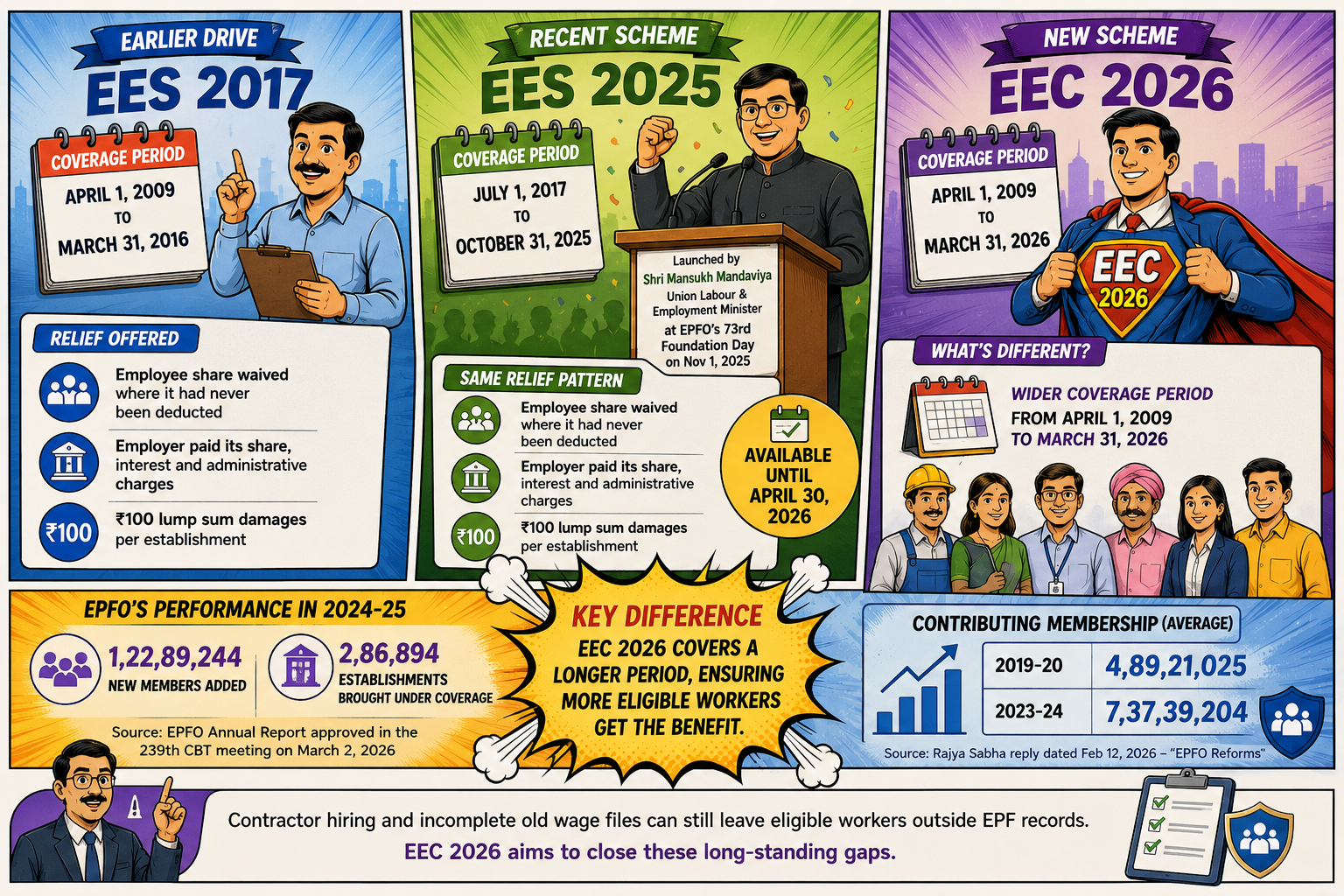
The government used a similar exercise in 2017 for eligible workers left outside EPF between 2009 and 2016. A later Employees’ Enrolment Scheme opened on November 1, 2025. It covered employees omitted between July 1, 2017 and October 31, 2025, and remained available until April 30, 2026.
EES 2025 offered the same basic type of relief. The employee share was waived where it had never been deducted, while the employer paid its share, interest, administrative charges and ₹100 in damages per establishment. Union Labour and Employment Minister Mansukh Mandaviya launched the scheme at EPFO’s 73rd Foundation Day on November 1, 2025. EEC 2026 now uses a wider period running from April 1, 2009, to March 31, 2026.
During 2024-25, EPFO added 1,22,89,244 members. It also brought 2,86,894 establishments under coverage. These numbers appeared in the Annual Report approved during the 239th CBT meeting on March 2, 2026. They cover EPFO’s full-year work, not registrations made through EEC 2026.
Rajya Sabha received another update on February 12, 2026. In its written reply, “EPFO Reforms,” the Labour Ministry listed average contributing membership at 4,89,21,025 in 2019-20 and 7,37,39,204 in 2023-24. Yet contractor hiring and incomplete old wage files can still leave eligible workers outside EPF records.
Read Also : New EPFO Portal: 8 PF Services From UAN Activation to Withdrawal
A serving employee who suspects missed coverage should write to HR or payroll and keep a copy. Useful documents include the appointment letter, salary slips, wage-credit bank statements, attendance records and any previous UAN. Where PF was deducted, the worker should compare each monthly entry with the EPF passbook rather than relying on the salary slip alone.
After the employer files under EEC 2026, the worker should ask for the member ID, UAN, declared employment period and proof of the paid challan. Face authentication only creates or verifies identity. It does not confirm that historical contributions reached EPFO. A worker noticing a wrong joining date or missing month should raise it before the October 31 cut-off.
EEC 2026 gives employers a final 4-month route to correct eligible EPF omissions covering April 2009 to March 2026. The reduced ₹100 damages can encourage voluntary filing, though employers still owe their contribution, interest and administrative charges.
For workers, the result depends on timing and employer action. Serving employees should check records now. Former employees remain outside this campaign and may need the regular grievance process. October 31 is the completion deadline, not a safe date to begin.
EEC 2026 is an EPFO compliance window allowing employers to enrol eligible current workers omitted from EPF coverage between April 1, 2009, and March 31, 2026.
No. The worker must be alive and still employed by the declaring establishment when it files the online declaration before October 31, 2026.
No. ₹100 covers penal damages. The employer must also pay its historical contribution, applicable interest and administrative charges under the campaign conditions.
The employee can collect records and approach HR, but only the employer can complete the EEC declaration. The worker may use EPFO’s grievance route if HR refuses.
No. The waiver applies only when the employee share was never deducted. Salary slips and passbook entries should be preserved before raising the non-deposit with EPFO.








.png&w=3840&q=75)


