Disclaimer: The information published on LoansJagat is intended for general informational and educational purposes only and should not be considered financial, legal, or investment advice. Interest rates, loan terms, statistics, and other data may change over time and may vary by lender or source. Please verify the latest information and consult a qualified financial advisor or the respective Bank/NBFC before making any financial decisions.
Subscribe Now
About the author

Arshathul Afia is a journalism graduate and fintech content writer with 4+ years of experience in digital publishing and research-led writing. She has written 200+ articles covering personal finance, lending, banking, digital payments, credit, insurance, and major financial developments in India. At LoansJagat, she focuses on simplifying complex fintech news, RBI updates, loan-related changes, policy developments, and industry trends for everyday readers. Her journalism background helps her approach stories with research, context, and clarity, while her SEO experience ensures content remains discoverable and relevant. She aims to make financial news easier to understand, practical, and useful for readers across India.
Related News
Simplify All Your Loans Into One Affordable EMI

Customers Served

Debt Consolidated

1200+ Reviews

Locations in India
Club all Loans & Credit Card Bills into Single EMI

Quick Apply Loan
Consolidate your debts into one easy EMI.

Takes less than 2 minutes. No paperwork.

10 Lakhs+
Trusted Customers

2000 Cr+
Loans Disbursed

4.7/5
Google Reviews

50+
Banks & NBFCs Offers
Other services mentioned in this article
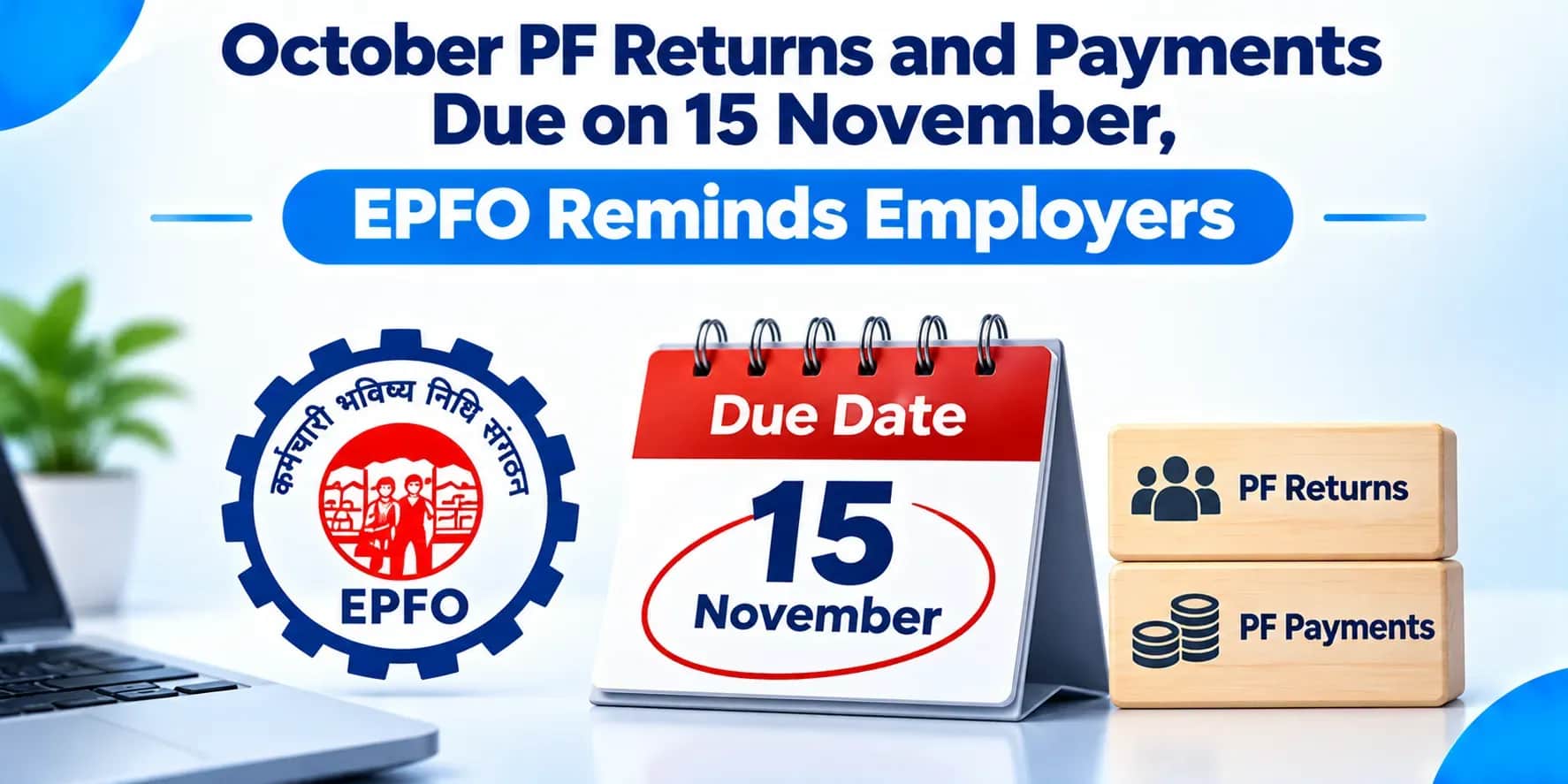
EPFO has asked employers to file the October 2026 return and pay provident fund dues by 15 November so workers’ contributions can be credited on time.
Key Highlights
Employers covered by the EPF scheme have until 15 November 2026 to submit their October return and deposit the corresponding provident fund contributions. In its 12 November reminder, EPFO asked employers to complete both steps on time so the money could be credited to workers’ accounts without delay.
A payroll team that has already uploaded the October file still has to check the payment. The return records what is due for each covered employee. The employer then uses the challan to remit the money and checks that the transaction has cleared. A payment still marked pending needs a follow-up, especially close to the deadline.
The ECR is the monthly electronic return employers use to report provident fund contributions. It records the wages used to calculate contributions and the amounts due for each employee. Under the Employees’ Provident Funds Scheme, 2026, the employer remits both its own share and the employee’s share deducted through payroll. The scheme ordinarily gives employers 15 days from the close of the month to file and pay.
A mismatch in a member record or an error in the wage figures can hold up the return. Checking those details before submission leaves time to correct the file. Once the payment clears, the employer can keep the return and payment acknowledgement together to reconcile the amounts reported and paid.
Read also: India Needs ₹12.55 Lakh Crore More to Meet Its FY27 Direct Tax Target
The monthly wage ceiling for mandatory EPF coverage rose from ₹15,000 to ₹25,000 on 17 September 2026. October was the first full wage month under the revised ceiling. Payroll teams preparing the October return need to account for workers who became eligible when the ceiling rose and check that the return lists them under the correct member IDs.
Employers reported difficulties updating payroll systems and recalculating contributions after the ceiling changed midway through September. EPFO moved the deadline for that wage month from 15 October to 31 October. Its November reminder gave employers the regular deadline for October dues. The distinction is easy to miss because the extended deadline for September fell on the last day of the October wage month.
A delay in remitting contributions can leave an employer liable for interest. EPFO may also levy damages under the applicable provisions. Damages are calculated on the arrears, and the rate varies with the length of the delay. Even if an employer files the return on time, any contribution still unpaid after the deadline remains due.
Employees will usually see the deduction first on their October payslip. The passbook records what has been credited to the member account. Comparing the two records can flag a missing entry. Employees who changed jobs can check the member ID for the employer that paid their October wages, since more than one member ID can be linked to the same Universal Account Number (UAN).
The October ECR and the corresponding EPF payment are both due on 15 November 2026. Employers can close out the month by confirming that the return was accepted and the payment cleared. Employees with a missing October entry can ask payroll to confirm the deposit and the member ID used.
Yes. Filing the return and paying the dues are separate steps on the employer portal. An employer can file first and complete the payment later, provided both steps are completed by 15 November 2026.
They can check the October payslip, confirm they have selected the member ID linked to their employer and ask payroll when the contribution was remitted. A missing entry can also reflect a delay in posting the payment to the member account.
Employees can raise the issue with payroll first. If the contribution remains missing, they can register a grievance through EPFO’s online grievance system. The wage month, payslip and relevant passbook record are useful when reporting the discrepancy.
The extension covered only the September 2026 wage month, for which the return and contributions were due by 31 October. The due date for the October return and payment is 15 November 2026.
The employer deducts the employee’s share through payroll and deposits it along with the employer’s share. The employer handles the monthly payment for both shares.
Start your journey today
Apply Now*T&C apply