

By continuing, you agree to LoansJagat's Credit Report Terms of Use, Terms and Conditions, Privacy Policy, and authorize contact via Call, SMS, Email, or WhatsApp
Disclaimer: The information published on LoansJagat is intended for general informational and educational purposes only and should not be considered financial, legal, or investment advice. Interest rates, loan terms, statistics, and other data may change over time and may vary by lender or source. Please verify the latest information and consult a qualified financial advisor or the respective Bank/NBFC before making any financial decisions.
Subscribe Now
About the author

Arshathul Afia
Arshathul Afia is a journalism graduate and fintech content writer with 4+ years of experience in digital publishing and research-led writing. She has written 200+ articles covering personal finance, lending, banking, digital payments, credit, insurance, and major financial developments in India. At LoansJagat, she focuses on simplifying complex fintech news, RBI updates, loan-related changes, policy developments, and industry trends for everyday readers. Her journalism background helps her approach stories with research, context, and clarity, while her SEO experience ensures content remains discoverable and relevant. She aims to make financial news easier to understand, practical, and useful for readers across India.
Related News
Simplify All Your Loans Into One Affordable EMI

Customers Served

Debt Consolidated

1200+ Reviews

Locations in India
Club all Loans & Credit Card Bills into Single EMI

Quick Apply Loan
Consolidate your debts into one easy EMI.

Takes less than 2 minutes. No paperwork.

10 Lakhs+
Trusted Customers

2000 Cr+
Loans Disbursed

4.7/5
Google Reviews

50+
Banks & NBFCs Offers
Other services mentioned in this article
The EPFO wage ceiling limit has been increased from ₹15,000 to ₹25,000, and it will remain unchanged from September 17, 2026, while the minimum pension amount remains at ₹1,000.
The Union Cabinet approved the higher EPFO wage ceiling on September 16, 2026, raising it from ₹15,000 to ₹25,000 a month. The new limit came into force across India from September 17. According to the Press Information Bureau release issued on September 16, more than 51 lakh additional employees are expected to come within compulsory EPFO coverage.
The change follows a long gap. The earlier ₹15,000 ceiling had remained in place since 2014, even as salaries and formal employment moved higher. The Ministry of Labour and Employment said those changes in wages and income were among the reasons for revising the threshold now.
This will have the most immediate effect on the eligible workers, who were not covered by the compulsory service because their salary exceeded ₹15,000 on joining. For some, the number of PF deductions may start or increase, and reduce the amount of money that's available. Such payments accumulate savings in the provident fund and provide pension and insurance coverage for qualified workers. This latest ruling was against a rise in the minimum EPS pension. The price of that floor, which was introduced in the month of September, 2014, will continue at ₹1,000 per month.
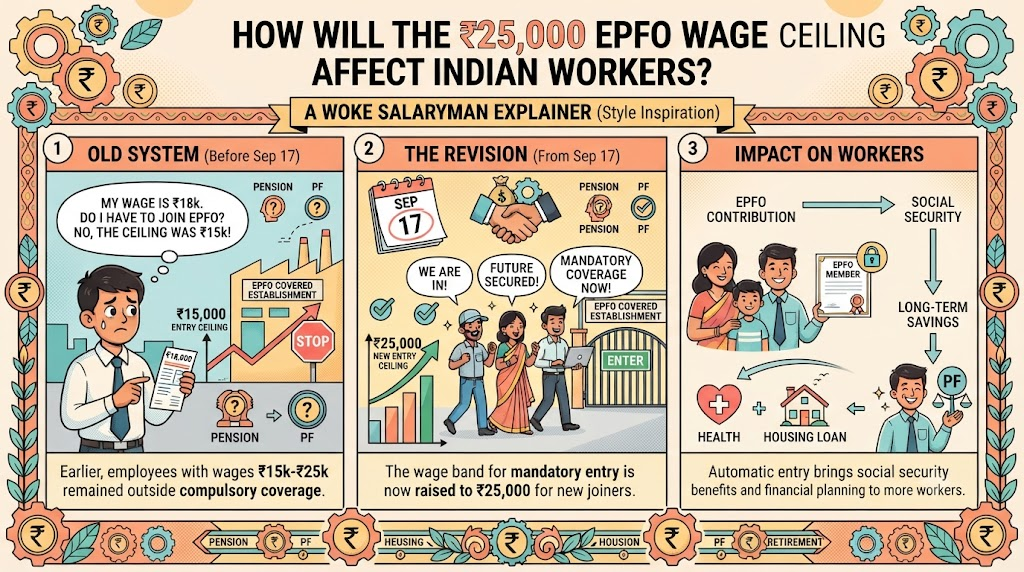
The revision mainly changes who enters the statutory system automatically. A fresh employee joining an EPFO-covered establishment with qualifying wages between ₹15,000 and ₹25,000 could earlier remain outside compulsory coverage because the entry ceiling stopped at ₹15,000. From September 17, that wage band falls within mandatory coverage, subject to scheme rules. EPF savings, EPS pension protection and EDLI insurance can therefore reach a wider group of formal workers.
There is a positive side that may not show on the 1st salary slip. A newly covered employee starts building a provident fund balance and pension service record. The UAN can carry that record across jobs when account details stay correctly linked. For workers who do not save separately for retirement, the payroll deduction creates regular savings. The drawback is monthly cash flow, especially where household budgets already run close to salary.
The change becomes easier to read when the earlier and revised positions are placed together.
₹25,000 is a statutory wage ceiling for coverage, not a universal gross-salary limit. Employees with the same CTC can still see different PF deductions because the wage components, earlier membership, and employer contribution policy may differ. Workers should compare their payslip with their EPFO record before assuming everyone will lose the same amount from take-home pay.
Labour and Employment Minister Mansukh Mandaviya described the September 16 revision as an “important step towards strengthening social security for workers”. EPFO officials have also linked wider coverage with retirement protection and worker retention. The policy argument is fairly direct. The threshold had stayed at ₹15,000 while wages moved, leaving some new employees outside compulsory PF, pension and insurance coverage.
For employees, the fix starts with the salary slip. Puneet Gupta, Partner, People Advisory Services-Tax at EY India, has flagged higher employer PF, pension and EDLI costs along with possible lower take-home pay for affected workers. Debjani Aich, Partner at CMS INDUSLAW, has pointed to the payroll and employee-document changes employers now need. LoansJagat’s September 17 analysis adds a household example: a newly enrolled worker with ₹20,000 in qualifying wages could have an employee PF contribution of ₹2,400 at 12%. It is illustrative, not a universal deduction.
The earlier major revision came in September 2014, when the wage ceiling rose from ₹6,500 to ₹15,000. It then stayed at ₹15,000 for roughly 12 years. During that period, wages increased and formal employment expanded, while a new employee joining above the ceiling could still remain outside automatic coverage. The government has cited those changes while raising the threshold to ₹25,000.
The 2026 proposal moved through the Expenditure Finance Committee on June 16 after inter-ministerial consultation. On September 16, the Cabinet approved the amendment. On 17th September, the Ministry of Labour and Employment issued Notification (S.O. 5109(E)) under the Code on Social Security, 2020, which sets the wage ceiling at ₹25,000 from 17th September onwards. Payroll teams therefore cannot treat the change as if it applied for the whole year.
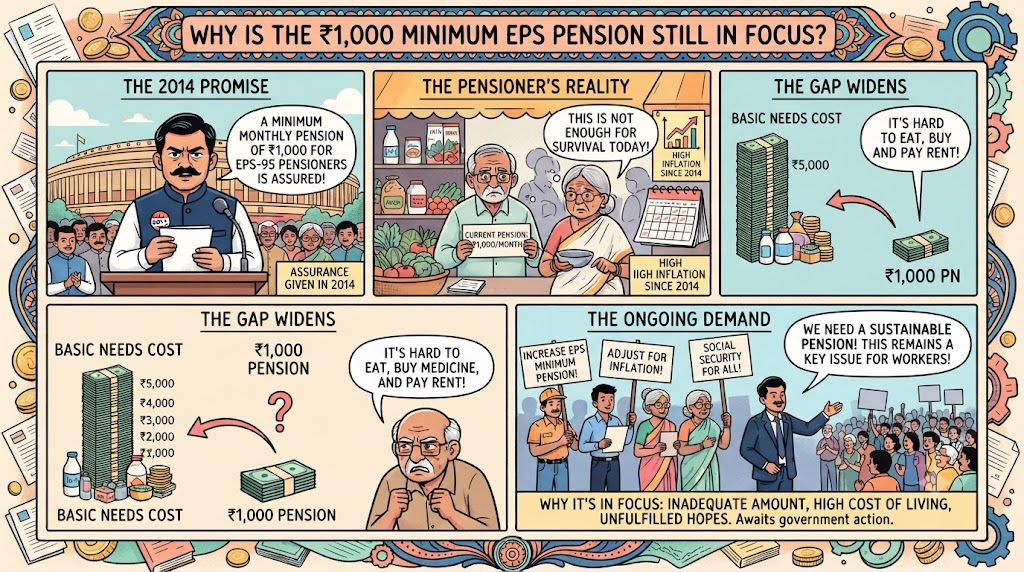
The pension question has a different track. The Lok Sabha Secretariat’s Fifteenth Report of the Standing Committee on Labour, Textiles and Skill Development records that Gazette Notification No. 593(E), dated August 19, 2014, provided a minimum monthly pension of ₹1,000 for specified EPS pensioners. Payment under the revised minimum began in September 2014. That amount has remained unchanged while the wage ceiling has now moved again.
Parliament’s labour panel returned to the pension issue in its Fifteenth Report on Demands for Grants 2026-27. The report was adopted on March 16, 2026, and placed before the Lok Sabha the following day. A major concern was the ₹1,000 minimum pension, which had stayed at the same level for years even as household and medical expenses went up. The panel asked for an early review and told the Labour Ministry to examine whether additional budget support could make a higher pension possible.
A committee recommendation does not itself change pension payments. A revision needs a separate government decision and the required legal and financial steps. The September wage-ceiling announcement did not include such a pension increase. For EPS pensioners, ₹1,000 therefore remains the notified minimum.
The government describes the higher ceiling as a way to widen formal social security. Mandaviya linked the change with access to provident fund savings, pension and insurance for a larger worker base. Regional Provident Fund Commissioner-I Shadakshara Gopala Reddy also said the measure would extend assured social security and support long-term retirement protection.
For employees, the shorter-term concern is different. A new PF deduction is visible immediately, while retirement value builds slowly. Suchita Dutta, Executive Director of the Indian Staffing Federation, has argued that wider portable social security can support formal flexi employment. Employers can reduce confusion by showing the PF wage, employee contribution, employer contribution, and UAN status. Workers should also separate CTC, basic pay, and PF wages before estimating the change in in-hand salary.
The ₹25,000 EPFO wage ceiling updates an entry threshold that had remained at ₹15,000 since September 2014. Newly covered workers may first notice a salary deduction, but that contribution also creates a formal retirement-saving record with pension and insurance protection. Employers now have to apply the new threshold correctly.
The unfinished part is the minimum EPS pension. The wage ceiling has moved after 12 years, but the ₹1,000 pension floor has not. Parliament’s Labour Standing Committee has already asked for a review. The September 2026 change only widens EPFO coverage. The minimum EPS pension stays at ₹1,000 unless the government announces a separate revision.
The maximum wage limit for the compulsory EPFO contribution is set at ₹25,000 per month. This supersedes the previous ceiling of ₹15,000, which was in effect as of September 17. Most of the changes are in the compulsory cover for eligible workers in the wage range from ₹15,000 to ₹25,000.
No. The effect depends on earlier membership, the PF wage used for contributions, and the employer’s payroll policy. A newly covered worker may see a new deduction. Someone already contributing on higher wages may see a smaller change or none in the employee contribution.
A recent Reddit discussion raised this concern after workers noticed revised deductions. Existing EPFO membership generally continues even when wages later cross the entry ceiling. Employees facing an unexpected change should check their UAN history and ask HR how the PF wage has been calculated.
For a new employee, wages above the statutory ceiling can place the person outside automatic coverage, subject to scheme rules and previous membership. An existing member does not normally stop being an EPFO member merely because wages later rise above the ceiling.
No. The latest decision did not announce an increase in the ₹1,000 minimum EPS pension. The floor dates from September 2014. A Parliamentary committee sought an urgent review in March 2026, but its recommendation has not itself changed the notified amount.









.png&w=3840&q=75)


