
By continuing, you agree to LoansJagat's Credit Report Terms of Use, Terms and Conditions, Privacy Policy, and authorize contact via Call, SMS, Email, or WhatsApp
Disclaimer: The information published on LoansJagat is intended for general informational and educational purposes only and should not be considered financial, legal, or investment advice. Interest rates, loan terms, statistics, and other data may change over time and may vary by lender or source. Please verify the latest information and consult a qualified financial advisor or the respective Bank/NBFC before making any financial decisions.
Subscribe Now
About the author

Arshathul Afia
Arshathul Afia is a journalism graduate and fintech content writer with 4+ years of experience in digital publishing and research-led writing. She has written 200+ articles covering personal finance, lending, banking, digital payments, credit, insurance, and major financial developments in India. At LoansJagat, she focuses on simplifying complex fintech news, RBI updates, loan-related changes, policy developments, and industry trends for everyday readers. Her journalism background helps her approach stories with research, context, and clarity, while her SEO experience ensures content remains discoverable and relevant. She aims to make financial news easier to understand, practical, and useful for readers across India.
Related News
Simplify All Your Loans Into One Affordable EMI

Customers Served

Debt Consolidated

1200+ Reviews

Locations in India
Club all Loans & Credit Card Bills into Single EMI

Quick Apply Loan
Consolidate your debts into one easy EMI.

Takes less than 2 minutes. No paperwork.

10 Lakhs+
Trusted Customers

2000 Cr+
Loans Disbursed

4.7/5
Google Reviews

50+
Banks & NBFCs Offers
Other services mentioned in this article
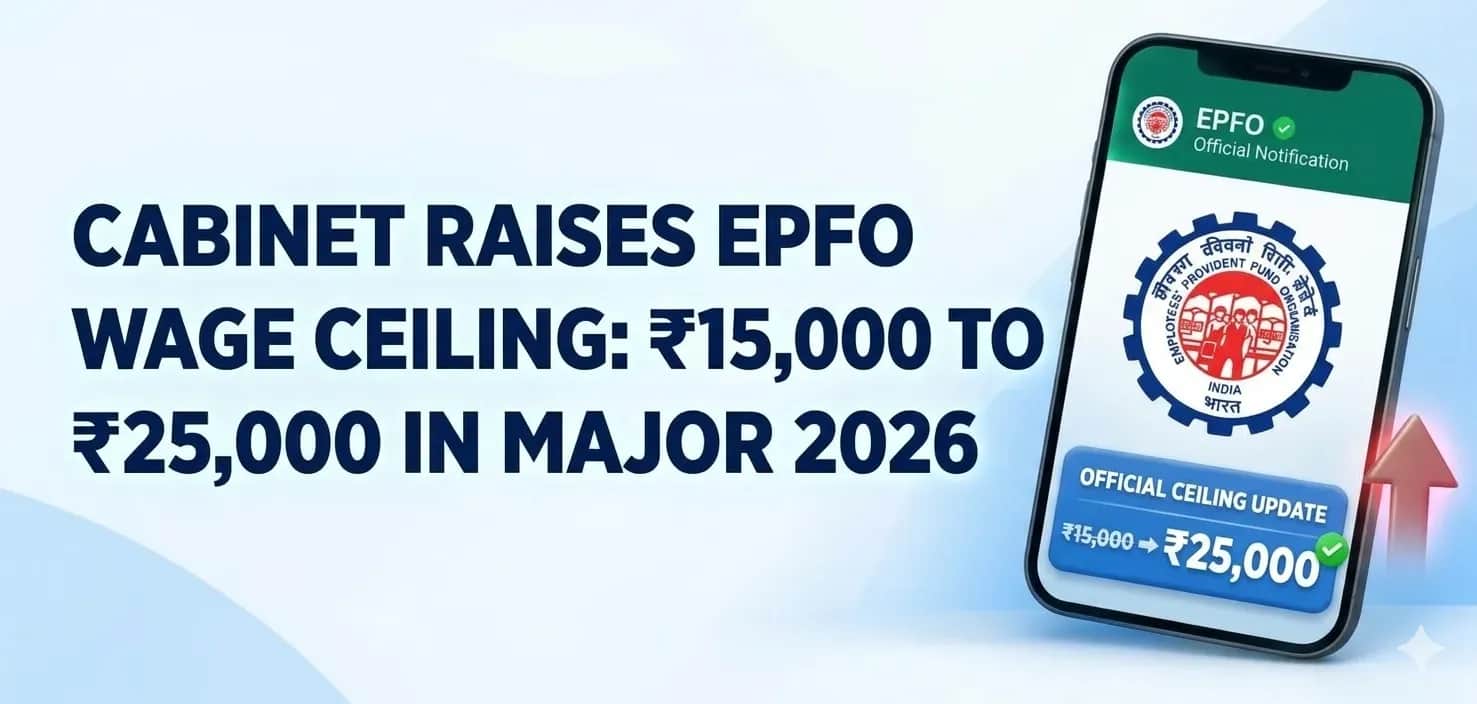
After twelve years, the wage ceiling set by the EPFO has been increased. On September sixteenth, the Cabinet raised the wage ceiling to twenty‑five thousand rupees. As a result, fifty‑one lakh workers in the sector of the country will benefit from this scheme.
Key Highlights
The Union Cabinet, chaired by Prime Minister Narendra Modi, approved the higher Employees’ Provident Fund Organisation wage ceiling in New Delhi on 16 September 2026. Information and Broadcasting Minister Ashwini Vaishnaw announced that the ₹25,000 ceiling would apply from 17 September 2026. The Cabinet said the decision would extend mandatory provident fund, pension and insurance protection to workers who had remained outside automatic coverage because their joining wages crossed ₹15,000.
For employees, the first effect may appear on the salary slip. Someone enrolled because of the revised ceiling could receive less money in hand once contributions begin. Employers may face a higher wage bill or rearrange a cost-to-company package. The longer-term gain is regular retirement savings, EPS pension eligibility and EDLI insurance. The Labour Ministry and EPFO must now complete the statutory and administrative work.

The main group affected consists of fresh employees joining an EPFO-covered establishment with qualifying monthly wages between ₹15,000 and ₹25,000. Under the earlier position, a person entering employment above ₹15,000 was not automatically covered. That worker could start a regular salaried job but remain outside compulsory EPF, EPS and EDLI protection. The revised ceiling narrows that gap and links a wider section of formal employment with portable social security.
EPF gives the worker a funded account supported by employee and employer contributions. EPS provides pension protection, while EDLI provides insurance linked to membership. The Universal Account Number can carry the employee’s record between jobs, provided the UAN, Aadhaar, bank and joining details remain correctly linked.
The wage ceiling is not the same as gross salary or total CTC. Contributions use the wage components covered by the applicable scheme, and salary structures differ. Therefore, 2 people earning the same CTC may not see an identical payslip change. The table shows the broad shift.
At the existing 12% rate, the difference between a ₹15,000 base and a ₹25,000 base can reach ₹1,200 a month. That figure will not apply in every case. Some employees already contribute above the old ceiling. Others have the employer share built into CTC. Payroll teams must use the final directions and individual records before changing deductions.
The ₹15,000 limit came into force in September 2014 and stayed unchanged for 12 years. The government said minimum wages in several states and occupations had moved closer to the old ceiling, with some crossing it. The threshold had stopped covering a sizeable group of salaried workers.
Work on the revision moved through several stages. The Expenditure Finance Committee recommended the proposal at its 16 June 2026 meeting after inter-ministerial discussions. The Union Cabinet approved it on 16 September. The government estimated an annual outlay of ₹11,339 crore, compared with existing annual budgetary support of about ₹10,250 crore. Its 5-year expenditure estimate came to ₹56,696 crore. Those figures reflect the Centre’s pension commitment as more workers enter the system.
Voluntary enrolment had not brought every worker into EPFO because a person joining above the statutory limit could remain excluded. Raising the ceiling changes that position directly. Compulsory saving may feel tight when it starts, yet a longer contribution history can produce a larger retirement balance.
Ashwini Vaishnaw said the revision had been sought for a long period and would help employees as well as employers. He linked the decision to wage increases since 2014 and said the old ceiling no longer reflected pay in several states. The government also expects wider coverage to support employee retention because PF, pension and insurance benefits travel with formal employment instead of ending with one employer.
Suchita Dutta, Executive Director of the Indian Staffing Federation, described the decision as support for formal jobs carrying portable social security. A usable UAN allows contributions to follow contract and staffing employees between workplaces, although incorrect exit dates or incomplete KYC can still cause trouble.
Puneet Gupta, Partner, People Advisory Services-Tax at EY India, said the ceiling decides mandatory coverage and influences EPS and EDLI contributions. He warned that employer costs would rise and affected workers could receive less take-home pay. Debjani Aich, Partner at CMS INDUSLAW, said companies would need to revise payroll systems, employee documents and electronic filings.
Employers can show the previous and revised contributions in a payslip note instead of letting workers guess why salary fell. Stating the wage base and treatment of the employer share may prevent avoidable complaints.
The editorial view from LoansJagat is that the ceiling revision should be judged through both monthly cash flow and retirement protection. A worker earning ₹20,000 in qualifying wages may see an employee contribution of ₹2,400 at a 12% rate if newly enrolled. That can pinch a household running close to its monthly budget. The same payment, joined by the applicable employer contribution, builds an asset that would not exist if the entire wage continued arriving as spendable salary.
Employees often use “salary”, “basic pay”, “PF wages” and “CTC” as if they mean the same figure. They do not. LoansJagat’s reading is that employers should identify the wage base, both contributions, effective payroll month and UAN status so workers can trace the change.

Employees should confirm whether they already hold active EPFO membership. Existing members generally continue after wages cross an entry ceiling. Employees who recently became covered employees should confirm their UAN, Aadhaar, PAN, bank account details and their date of joining, since disparities may result in delay in settlement of future dues/claims.
Employers need a person-by-person review. HR teams should identify excluded employees in the revised wage band, check relevant wage components and follow the detailed directions before finalising payroll. Workers must also know whether the employer contribution is added outside CTC or absorbed within it.
The Cabinet’s decision brings the EPFO wage ceiling closer to present salary levels after a 12-year gap. More than 51 lakh additional employees are expected to enter mandatory coverage, gaining provident fund savings, pension protection and insurance linked to employment. That is the lasting benefit.
Many households are still adjusting to having income taxes withheld from their pay. For employees, pay periods become stressful as they wait to see how much of their pay will be deducted for rent and other expenses. Employers have new costs and compliance burdens. The withholding and payroll treatment rules have to be followed. Employees should not have to worry about their take-home pay changing because of the employer’s decision to offer social security. Both should be done correctly by the employer.
The Union Cabinet raised the monthly ceiling for mandatory EPFO coverage from ₹15,000 to ₹25,000 on 16 September 2026. The revised limit was announced from 17 September 2026, subject to the applicable scheme provisions and implementation directions.
No. The calculation depends on applicable PF wages, existing membership, salary components and the employer’s contribution policy. ₹25,000 is the statutory ceiling for mandatory coverage, not a universal description of gross salary or CTC.
It may reduce take-home pay for a worker newly brought into mandatory coverage because the employee contribution starts being deducted. The actual amount depends on qualifying wages and payroll treatment. Existing contributors may see a smaller change or none.
Crossing the entry ceiling does not normally end membership for an existing EPFO member. The employer should continue contributions under the applicable rules. Employees should ask for a written explanation if a PF deduction suddenly disappears.
No. Coverage and withdrawal are separate issues. EPFO rules decide when a member can make a partial claim, unemployment withdrawal or final settlement. The higher wage ceiling expands mandatory entry; it does not turn the balance into an unrestricted savings account.









.png&w=3840&q=75)


