.png&w=3840&q=65)
By continuing, you agree to LoansJagat's Credit Report Terms of Use, Terms and Conditions, Privacy Policy, and authorize contact via Call, SMS, Email, or WhatsApp
Disclaimer: The information published on LoansJagat is intended for general informational and educational purposes only and should not be considered financial, legal, or investment advice. Interest rates, loan terms, statistics, and other data may change over time and may vary by lender or source. Please verify the latest information and consult a qualified financial advisor or the respective Bank/NBFC before making any financial decisions.
Subscribe Now
About the author

Arshathul Afia
Arshathul Afia is a journalism graduate and fintech content writer with 4+ years of experience in digital publishing and research-led writing. She has written 200+ articles covering personal finance, lending, banking, digital payments, credit, insurance, and major financial developments in India. At LoansJagat, she focuses on simplifying complex fintech news, RBI updates, loan-related changes, policy developments, and industry trends for everyday readers. Her journalism background helps her approach stories with research, context, and clarity, while her SEO experience ensures content remains discoverable and relevant. She aims to make financial news easier to understand, practical, and useful for readers across India.
Related News
Simplify All Your Loans Into One Affordable EMI

Customers Served

Debt Consolidated

1200+ Reviews

Locations in India
Club all Loans & Credit Card Bills into Single EMI

Quick Apply Loan
Consolidate your debts into one easy EMI.

Takes less than 2 minutes. No paperwork.

10 Lakhs+
Trusted Customers

2000 Cr+
Loans Disbursed

4.7/5
Google Reviews

50+
Banks & NBFCs Offers
Other services mentioned in this article
The Finance Ministry gave its nod to raising EPFO's wage ceiling to ₹25,000. Cabinet clearance and the formal notification haven't landed. Your payslip stays unchanged for now. Hold off on assumptions.
The wage ceiling of ₹ 25,000 has not yet been effected. The latest economic news was reported on 3 August 2022, in Livemint, quoting amenable official sources from the finance ministry. The report stated the final ceiling will be fixed after the Union Cabinet's approval. Therefore, a substantial change in employees' salary slips can not be expected prior to the government
In the short term, the proposal can reduce take-home pay for some workers if the PF deduction rises on a higher wage base. That can hurt monthly cash flow, especially for employees working with tight rent, food, transport and loan budgets. Over the long term, the same change can help a larger section of salaried workers build a bigger retirement corpus and gain pension-linked cover through EPFO.
The issue is about the salary limit used for compulsory EPF and EPS coverage. At present, the official wage ceiling is ₹15,000 per month. If the Cabinet approves the proposed ₹25,000 ceiling and the labor ministry notifies it, more workers earning above the present limit may come under mandatory provident fund coverage.
The live rule still comes from the Ministry of Labour and Employment. In the Gazette Notification dated 29 May 2026, S.O. 2702(E), 15,000 rupees monthly was notified as the wage ceiling for Chapter III of the Code on Social Security, 2020. Therefore, the news is not that the ceiling has been altered. The news is that the proposed ceiling has taken one more step closer to the Cabinet.
A worker with basic wages of ₹20,000 may currently fall outside compulsory coverage if the person joined at wages above the statutory ceiling and the employer follows the cap. If the ceiling becomes ₹25,000, that employee may enter mandatory EPF and EPS coverage, depending on the final wording of the rule.
There is a cash-flow trade-off. At the present 12% rate, employee contribution on ₹15,000 is ₹1,800 per month. If the notified ceiling becomes ₹25,000, the same 12% calculation becomes ₹3,000 per month. For some workers, that extra ₹1,200 will mean a lower in-hand salary. For others, it will mean forced long-term saving at a stage when voluntary saving often gets delayed.
The table below separates the reported proposal from the official position. This is needed because several employees are reading the ₹25,000 figure as if it has already started.
This is why HR teams should not revise statutory PF treatment only on media reports. Employees should also wait for the cabinet decision, the effective date and the final notification before assuming any new deduction.
Payroll specialists usually read this change in 2 parts. The first part is social security. More workers may get compulsory PF and pension-linked coverage. The second part is monthly salary. If a company works on fixed CTC, higher PF can reduce the employee’s take-home pay unless the employer absorbs the extra cost.
The labour ministry has already acknowledged this concern in Parliament. In Lok Sabha Starred Question No. 7, answered on 1 December 2025, Labour and Employment Minister Dr. Mansukh Mandaviya said raising the wage ceiling requires consultations with trade unions and industry associations because it affects employee take-home salary and employer hiring cost. That official reply explains why the final step needs more than one internal approval.
LoansJagat’s view also fits the salary-slip concern. In its EPF contribution explainer, LoansJagat noted that the current ₹1,800 monthly cap is tied to the ₹15,000 wage ceiling. That makes the present rule easier for employees to check. If the ceiling rises, employees will need to review whether their company deducts PF only on the statutory ceiling, on full basic wages, or as part of a fixed CTC arrangement.
The practical solution is boring but necessary. Employers should issue a plain salary note once the notification arrives. It should show the old PF amount, the new PF amount, the employer share and the net take-home change. Without that, workers may only see a lower credit in the bank account and assume a pay cut.
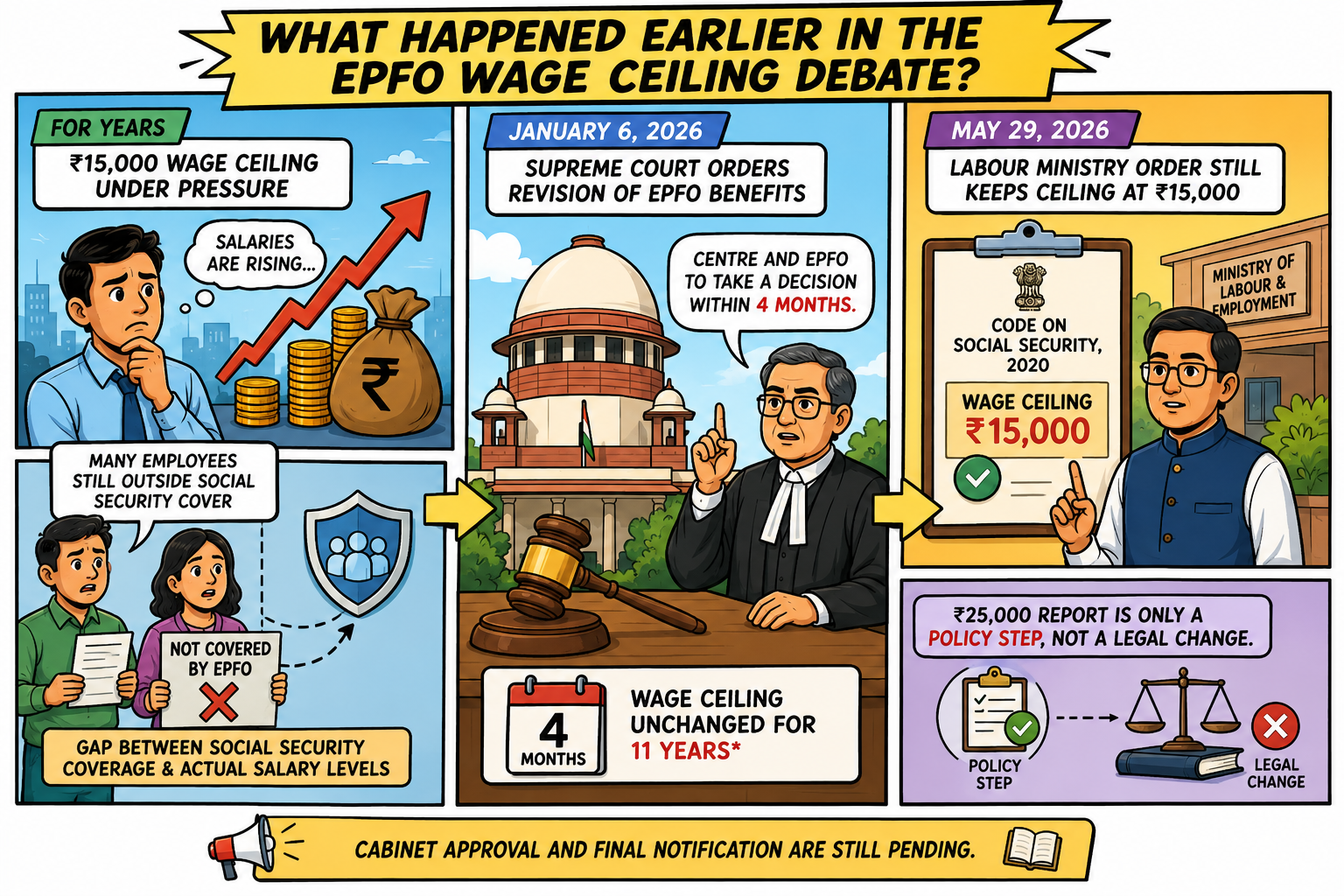
The ₹15,000 wage ceiling has been under pressure for years. The current figure has remained linked to compulsory EPFO coverage for a long period, while wages in formal jobs have moved up in many sectors. That has created a gap between social security coverage and actual salary levels in organised employment.
The Supreme Court ordered the revision of EPFO benefits, and Akashvani News reported the order on January 6, 2026. They ordered the Union government and EPFO to make a decision within four months. The Order cited the wage ceiling standing for 11 years, and many employees remain uncovered for social security benefits as a result.
Late in the year, on May 29, the Labour ministry order still kept the wage ceiling at Rs. 15,000 for the Code on Social Security, 2020. Thus, the report of Rs. 25,000 should be seen as a policy step and not as a completed legal change.
The government has not issued a final notification raising the EPFO wage ceiling to ₹25,000. That is the first stakeholder position employees should rely on. The Ministry of labour and Employment’s official notification still carries the ₹15,000 figure.
The Supreme Court’s January 2026 direction gave urgency to the issue. It pushed the centre and EPFO to take a decision on revision instead of letting the ceiling stay untouched. For workers and trade unions, the main argument is wider social security. For employers, the first concern is payroll cost.
Employees have a narrower question: how much salary will actually come into the bank account every month? That answer depends on the final notification and company salary structure. A worker contributing only ₹1,800 today may see the deduction rise if the statutory wage base is revised. A worker already contributing on full basic pay may not see the same change.
Officials say that the EPFO wage limit may rise to ₹25,000 following a Cabinet decision; however, this is not yet official. For now, the wage limit is ₹15,000 as stated in the Ministry of Labour and Employment notification of 29 May 2026.
When this proposal takes effect, the number of employees subject to mandatory provident fund and pension contributions is likely to increase, thereby improving employees’ retirement savings. The employees may, however, have a lower take-home pay during the first month as employers will have to offset the higher statutory costs resulting from this proposal. For now ₹25,000 is a proposal and ₹15,000 is the limit in force until a notification to this effect is issued.
No. Reports say the proposal moved forward, but Cabinet approval and final notification are still pending.
The current notified EPFO wage ceiling is ₹15,000 per month under the 29 May 2026 notification.
It may reduce for some employees if PF deduction rises within a fixed CTC salary structure.
Employees should not panic. They should wait for the official notification and then check salary structure.
Yes, if PF is being calculated only on the current ₹15,000 statutory wage ceiling. Some employers may deduct PF on higher basic pay, depending on company policy or employee consent.










.png&w=3840&q=75)


