
.png&w=3840&q=65)
By continuing, you agree to LoansJagat's Credit Report Terms of Use, Terms and Conditions, Privacy Policy, and authorize contact via Call, SMS, Email, or WhatsApp
Disclaimer: The information published on LoansJagat is intended for general informational and educational purposes only and should not be considered financial, legal, or investment advice. Interest rates, loan terms, statistics, and other data may change over time and may vary by lender or source. Please verify the latest information and consult a qualified financial advisor or the respective Bank/NBFC before making any financial decisions.
Subscribe Now
About the author

Arshathul Afia
Arshathul Afia is a journalism graduate and fintech content writer with 4+ years of experience in digital publishing and research-led writing. She has written 200+ articles covering personal finance, lending, banking, digital payments, credit, insurance, and major financial developments in India. At LoansJagat, she focuses on simplifying complex fintech news, RBI updates, loan-related changes, policy developments, and industry trends for everyday readers. Her journalism background helps her approach stories with research, context, and clarity, while her SEO experience ensures content remains discoverable and relevant. She aims to make financial news easier to understand, practical, and useful for readers across India.
Related Blog Post
Simplify All Your Loans Into One Affordable EMI

Customers Served

Debt Consolidated

1200+ Reviews

Locations in India
Club all Loans & Credit Card Bills into Single EMI

Quick Apply Loan
Consolidate your debts into one easy EMI.

Takes less than 2 minutes. No paperwork.

10 Lakhs+
Trusted Customers

2000 Cr+
Loans Disbursed

4.7/5
Google Reviews

50+
Banks & NBFCs Offers
Other services mentioned in this article
Sitharaman’s bill brings cloud records, electronic files and digital signatures into India’s banking evidence law after 135 years of paper-ledger wording.
Finance Minister Nirmala Sitharaman introduced the Bankers’ Books Evidence Bill, 2026, in the Lok Sabha on August 3, 2026, according to the Bill listing on Digital Sansad. The Bill seeks to replace the Bankers’ Books Evidence Act, 1891, which governs how certified bank records are accepted as evidence in court. The change has arrived at a time when loan accounts, repayment trails, fraud complaints and transaction histories are often stored in digital systems rather than physical branch books.
The short-term impact will be seen by banks, courts, police teams, debt recovery forums, lawyers and borrowers stuck in financial disputes. The long-term impact could be wider. A customer fighting a wrong loan entry, a small business proving a payment, or a family tracing account records after a death may get faster access to certified digital proof. There is a downside too. Digital records carry private financial details, and weaker safeguards could expose customers to careless data sharing.
Also Read: Zomato And Blinkit Enable ₹18 Crore Income Tax Refunds For Delivery Partners Across 905 Cities
How Will The Bill Affect Bank Customers In India?
For most account holders, nothing will change at the counter tomorrow. Savings account rules, fixed deposit rates, UPI payments, cheque use and ATM charges are not part of this Bill. The change starts when a bank record becomes proof. That may happen during a cyber fraud complaint, a disputed EMI, a bounced cheque case, a family inheritance claim, a business payment fight or a recovery case.
This may help ordinary customers in 2 ways. First, courts may find it easier to accept certified electronic records instead of waiting for paper-heavy branch processes. Second, borrowers and depositors may have a better route to prove what happened in their account if the bank’s digital trail is produced in a certified format. The law will still need strong checks. A bank statement is not just a number sheet. It can reveal salaries, medical payments, loan defaults, business receipts and personal transfers.
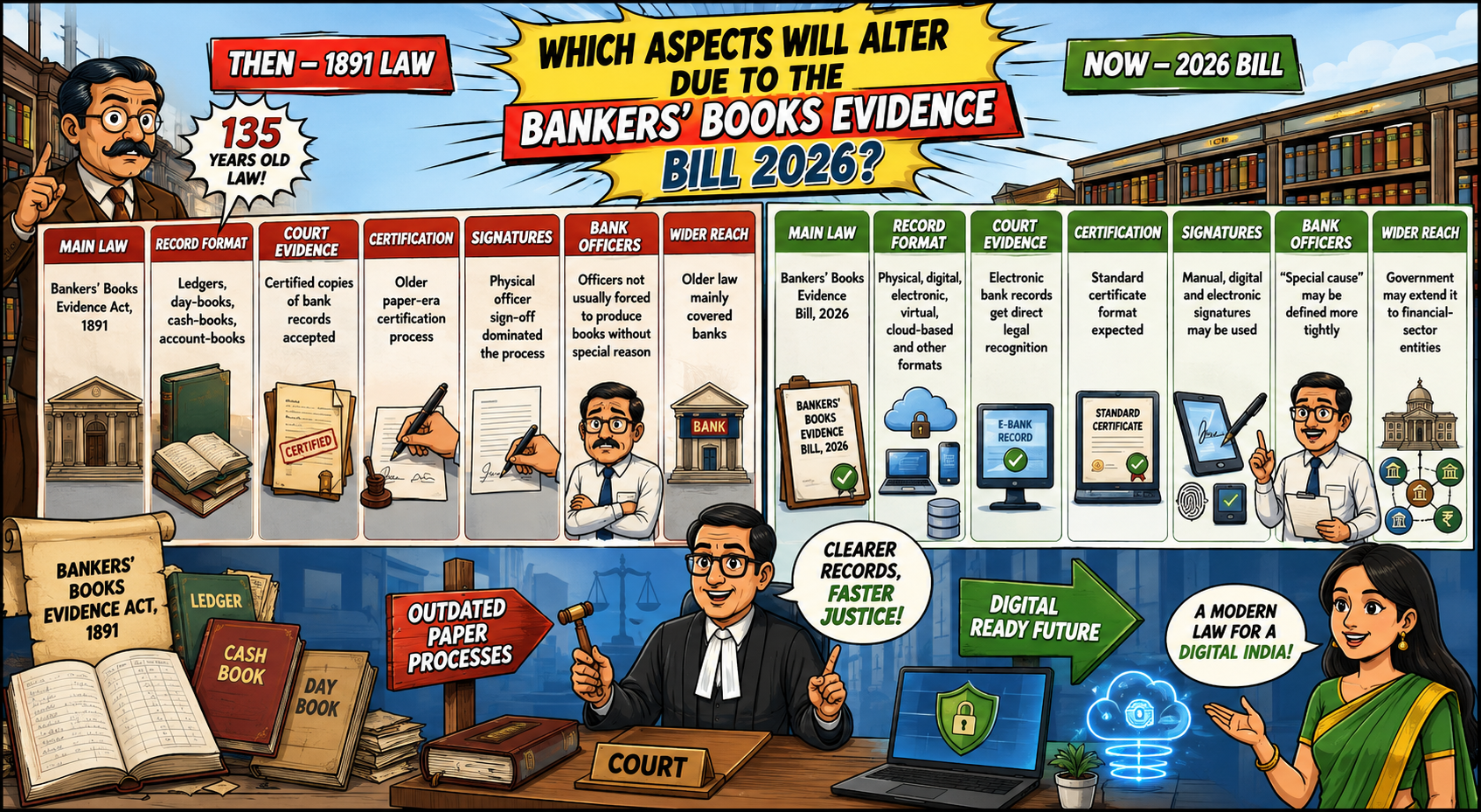
The Bankers’ Books Evidence Act, 1891, predates the digital record-keeping for banks. With the India Code, it is listed as Act No. 18 of 1891, and its long title is "An Act to amend the Law of Evidence with respect to Bankers’ Books.” Its current version is antiquated and refers to ledgers, daybooks, cashbooks, and account books, which are no longer commonly used in the regular operations of a bank.
The 2026 Bill updates that frame for a banking system where records are stored across core banking systems, electronic logs, cloud backups and digital archives. The table below explains the main shift without treating the bill as a change in daily banking services.
After this change, the legal fight may move from “Can this digital record be accepted?” to “Was this digital record properly certified?” That is a better question for courts, banks and customers. It puts attention on authenticity rather than old paperwork habits.
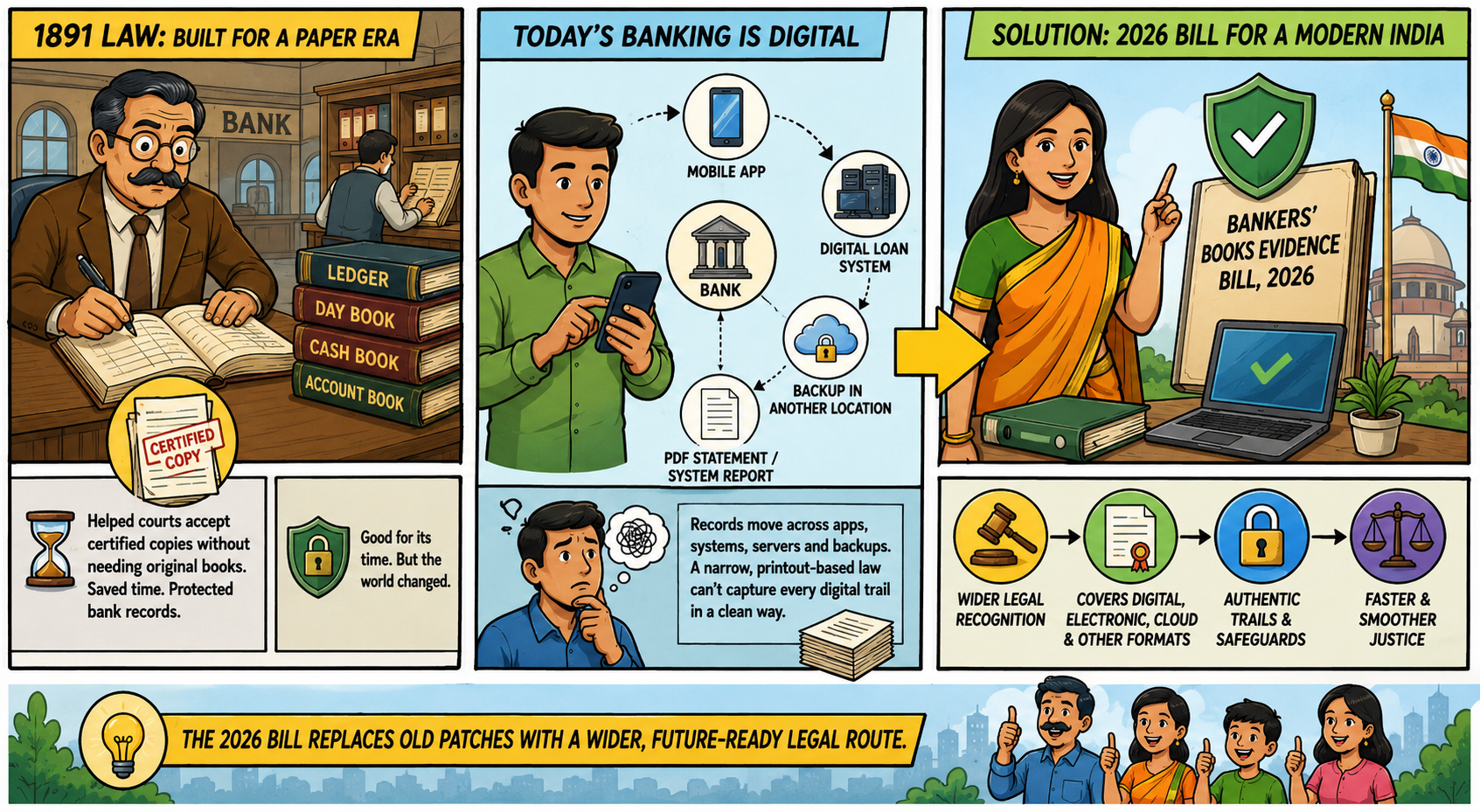
The Bankers’ Books Evidence Act, 1891 was useful for its time. It helped courts accept certified copies of bank entries without forcing banks to bring original books in every routine case. That saved time and protected bank records from being pulled into every proceeding.
The law did receive later updates for printouts and electronically retrieved records, but the language still carries traces of another era. Today’s banking record can start from a mobile app, move through a digital loan system, get backed up in another location and appear later as a PDF statement or system report. A narrow printout-based approach cannot handle every such trail cleanly. The 2026 Bill tries to replace those old patches with a wider legal route.
The government’s reason is technology. Bank records are now created, stored and retrieved through modern systems, so the law has to recognise those systems in court. Banks will likely prefer this because legal departments deal with summons, police notices, loan recovery files and arbitration requests almost every working day. A standard digital certification process can cut repeated paperwork and reduce routine officer appearances.
For borrowers, the editorial reading is simple. A stronger evidence law can help only if certification is strict and challenge rights remain open. If a customer says a bank entry is wrong, the certified record should not end the discussion blindly. The system trail, date stamp, officer certificate and audit record should support it. LoansJagat’s banking explainer on the Banking Regulation Act, 1949 gives useful background on the separate law that governs bank licensing, management and supervision. The new Bill is different. It deals with proof of bank records in legal proceedings.
Also Read: Samsung Offers 30-Month Zero-Cost EMI on Galaxy Z Fold 8 Series
Customers should keep their own records even after the law changes. Loan sanction letters, repayment receipts, closure certificates, bank emails, complaint numbers, passbook scans and monthly statements can help when a dispute starts. Digital banking is convenient, but screenshots alone may not be enough in a formal case.
Banks should also prepare early. Branch staff, legal teams and compliance officers will need training on certification formats, digital signatures, storage trails and customer data limits. Courts will expect clean documents, not random downloads from a bank system. That is where the real test will arrive.
FM Sitharaman’s Bankers’ Books Evidence Bill, 2026, is a legal update with a narrow purpose and a large courtroom impact. It does not change how people use their bank accounts every day. It changes how bank records can be proved when a dispute reaches a court, tribunal, police file or recovery forum.
If passed, the bill can help India move from paper-ledger proof to certified digital evidence. That should help borrowers, lenders, businesses and families when financial records decide a case. The final benefit will depend on 1 thing: digital records must become easier to prove, not easier to misuse.
It is a bill to update how certified bank records are accepted as evidence in Indian courts.
No. It deals with bank records in legal proceedings, not deposits, interest rates or charges.
Yes, if the final law allows certified electronic records and the bank follows the required format.
The risk exists if safeguards are weak. Certification, audit trails and customer challenge rights will be important.
It was written for physical books. Indian banking now runs on digital, electronic and cloud-based records.








.png&w=3840&q=75)


