

By continuing, you agree to LoansJagat's Credit Report Terms of Use, Terms and Conditions, Privacy Policy, and authorize contact via Call, SMS, Email, or WhatsApp
Disclaimer: The information published on LoansJagat is intended for general informational and educational purposes only and should not be considered financial, legal, or investment advice. Interest rates, loan terms, statistics, and other data may change over time and may vary by lender or source. Please verify the latest information and consult a qualified financial advisor or the respective Bank/NBFC before making any financial decisions.
Subscribe Now
About the author

Arshathul Afia
Arshathul Afia is a journalism graduate and fintech content writer with 4+ years of experience in digital publishing and research-led writing. She has written 200+ articles covering personal finance, lending, banking, digital payments, credit, insurance, and major financial developments in India. At LoansJagat, she focuses on simplifying complex fintech news, RBI updates, loan-related changes, policy developments, and industry trends for everyday readers. Her journalism background helps her approach stories with research, context, and clarity, while her SEO experience ensures content remains discoverable and relevant. She aims to make financial news easier to understand, practical, and useful for readers across India.
Related Blog Post
Simplify All Your Loans Into One Affordable EMI

Customers Served

Debt Consolidated

1200+ Reviews

Locations in India
Club all Loans & Credit Card Bills into Single EMI

Quick Apply Loan
Consolidate your debts into one easy EMI.

Takes less than 2 minutes. No paperwork.

10 Lakhs+
Trusted Customers

2000 Cr+
Loans Disbursed

4.7/5
Google Reviews

50+
Banks & NBFCs Offers
India’s gold-loan rules changed from 1 April 2026, allowing up to 85% LTV on smaller consumption loans while tightening valuation, auctions and jewellery-return rules for borrowers.
The new framework for gold loan in India for commercial banks, cooperative banks and NBFCs, has been implemented from 1 April 2026. For the maximum loan to value ratio with respect to a household borrower, the major difference is the 85% LTV offered in consumption loans of up to ₹2.5 lakh. It was confirmed in a reply to Lok Sabha on 9 March 2026 that the roll-out date will be confirmed, the upper limit for small borrowers will be raised, checks on the ability to repay loans exceeding ₹2.5 lakh, auction safeguards, and compensation for the failure of the lender to return jewelry pledged after closure.
The higher limit can be of assistance to a family needing to arrange money for a hospital bill, college fee, seasonal farm expense or a temporary business deficit. Extra cash can be collected without the need for an outright sale of an ornament. However, when interest rates increase, income is delayed or repayment is delayed, there is a risk of getting into a situation where there is less credit available near the maximum limit. According to the Press Information Bureau, personal loans increased by 16.2% during FY 2025-26, and loans against gold jewellery remained strong.
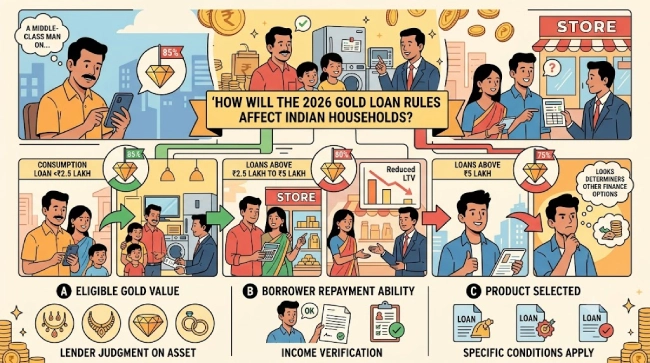
The 85% figure does not apply to every gold loan. For consumption loans up to ₹2.5 lakh, the maximum LTV is 85%. It falls to 80% for loans above ₹2.5 lakh and up to ₹5 lakh, then to 75% above ₹5 lakh. A lender can approve less after looking at the eligible gold value, the borrower’s repayment ability and the product selected.
That difference is easy to miss at a branch counter. Suppose a family needs ₹1.8 lakh for a medical expense and owns enough eligible gold to support a higher sanction. Taking only ₹1.8 lakh may still be the better call. Extra borrowing looks harmless when gold prices are high. Repayment day can tell a different story.
Before handing over jewellery, borrowers should check these 8 points.
The ₹5,000 figure needs careful wording. For the borrower, it is compensation for a lender-caused delay after the permitted return period, not a routine fine in every late-return case. The closure receipt and valuation record should be kept until every pledged item is back.
Families also need to separate purchase price from loan value. A necklace bought for ₹3 lakh may include stones, workmanship and non-gold fittings. Those parts do not raise the eligible gold value. Someone walking into a branch with only the old bill in mind may therefore expect more than the lender can sanction.
Read Also : ITR Refund Delayed After Filing? Check Your Status Online in Minutes
Borrower-focused commentary keeps coming back to one weak spot: higher LTV gives access to more cash, but income does not rise with it. LoansJagat, in its 4 July 2026 explainer, advised first-time borrowers to check valuation, documentation and repayment terms before pledging jewellery. That advice goes to the heart of the decision. The useful figure is often the amount due on repayment day, not the sanction shown at the start.
A practical test is to write down the repayment source before signing. Salary credited next month, a confirmed customer payment, crop proceeds after harvest or a fixed maturity receipt gives the loan an exit. If the borrower cannot name that source, the amount probably needs to come down. For a bullet loan, the household should compare the full maturity amount with the cash expected on that date.
Renewal needs the same caution. Rolling over a gold loan can appear convenient because the jewellery stays with the lender and the borrower avoids an immediate sale. Yet repeated renewals can turn a short-term facility into a costly cycle. Interest keeps getting paid, the gold remains locked away, and the original cash problem may still be there months later.
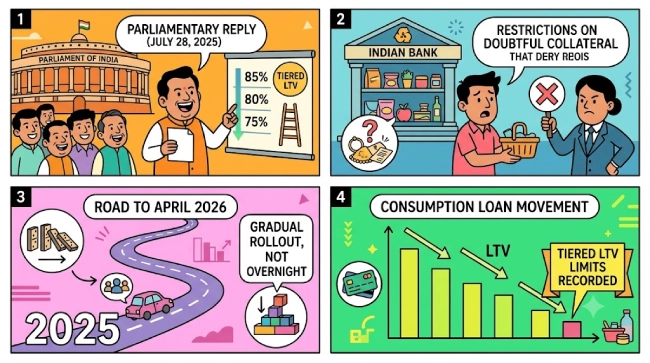
The 2026 rules were not introduced overnight. During 2025, the government had already recorded the move towards tiered LTV limits for consumption loans. A parliamentary reply dated 28 July 2025 listed the 85%, 80% and 75% slabs and referred to restrictions where ownership of pledged collateral appeared doubtful.
On 1 December 2025, Minister of State for Finance Pankaj Chaudhary told Lok Sabha that concerns raised during the draft stage had been examined, including repayment-capacity requirements and ownership documentation. The final framework kept lighter treatment for smaller loans while requiring a detailed assessment once borrowing crossed ₹2.5 lakh.
Government data placed before Parliament in July 2025 showed bank loans against gold jewellery at ₹2,51,369 crore in May 2025, compared with ₹1,16,777 crore in May 2024. The sharp rise helps explain why valuation, recovery and return of ornaments received closer policy attention.
The government’s 9 March 2026 reply described the 85% ceiling as a financial-inclusion step for small borrowers because eligible households can raise more money against the same gold. The reply also highlighted regional-language communication, upfront disclosure of charges, prior auction notice, the reserve-price floor and return of auction surplus.
For lenders, the structure creates room to offer more credit in the smallest slab, but it also raises the paperwork burden. For borrowers, that paperwork can be useful later. The valuation sheet, purity record, photographs of pledged items, repayment schedule and closure proof can help if a dispute arises.
There is a household angle policy papers cannot fully capture. Gold kept at home may have been bought for a daughter’s wedding, inherited from a parent or held as emergency savings. Once pledged, it becomes security for a debt. A borrower expecting repayment money in 3 or 6 months may use the loan well. Someone already planning another loan to repay this one is taking a much harder route.\
Gold Loan Rules 2026 give smaller borrowers more room to raise cash and stronger protection around valuation, auctions and return of pledged jewellery. The 85% LTV headline is useful, but it remains a ceiling.
Before pledging family gold, the borrower should know the exact amount required, final repayment amount, due date, auction process and source of repayment. Those checks are more useful than chasing the highest sanction available. A well-sized loan can cover a temporary shortage. A loan taken without a workable repayment source can put an irreplaceable family asset at risk.
For consumption loans up to ₹2.5 lakh, the maximum LTV is 85%. It falls to 80% above ₹2.5 lakh and up to ₹5 lakh, then to 75% above ₹5 lakh. A lender may sanction less.
The lender checks purity and net eligible gold content. Stones, making charges and non-gold fittings do not increase collateral value. The old purchase invoice does not decide the loan amount.
Yes. A lender can move towards auction after following the recovery process and giving prior notice. Reserve-price safeguards apply, and any eligible surplus left after dues are adjusted should return to the borrower.
The borrower should contact the lender early, ask for the exact dues, and check repayment or restructuring options before the account moves towards auction proceedings
That depends on repayment ability and whether the family wants the jewellery back. A short gold loan can work where money is expected soon. Selling may be financially safer where repayment is doubtful because it avoids interest and auction risk.








.png&w=3840&q=75)


