
By continuing, you agree to LoansJagat's Credit Report Terms of Use, Terms and Conditions, Privacy Policy, and authorize contact via Call, SMS, Email, or WhatsApp
Disclaimer: The information published on LoansJagat is intended for general informational and educational purposes only and should not be considered financial, legal, or investment advice. Interest rates, loan terms, statistics, and other data may change over time and may vary by lender or source. Please verify the latest information and consult a qualified financial advisor or the respective Bank/NBFC before making any financial decisions.
Subscribe Now
About the author

Arshathul Afia
Arshathul Afia is a journalism graduate and fintech content writer with 4+ years of experience in digital publishing and research-led writing. She has written 200+ articles covering personal finance, lending, banking, digital payments, credit, insurance, and major financial developments in India. At LoansJagat, she focuses on simplifying complex fintech news, RBI updates, loan-related changes, policy developments, and industry trends for everyday readers. Her journalism background helps her approach stories with research, context, and clarity, while her SEO experience ensures content remains discoverable and relevant. She aims to make financial news easier to understand, practical, and useful for readers across India.
Related Blog Post
Simplify All Your Loans Into One Affordable EMI

Customers Served

Debt Consolidated

1200+ Reviews

Locations in India
Club all Loans & Credit Card Bills into Single EMI

Quick Apply Loan
Consolidate your debts into one easy EMI.

Takes less than 2 minutes. No paperwork.

10 Lakhs+
Trusted Customers

2000 Cr+
Loans Disbursed

4.7/5
Google Reviews

50+
Banks & NBFCs Offers
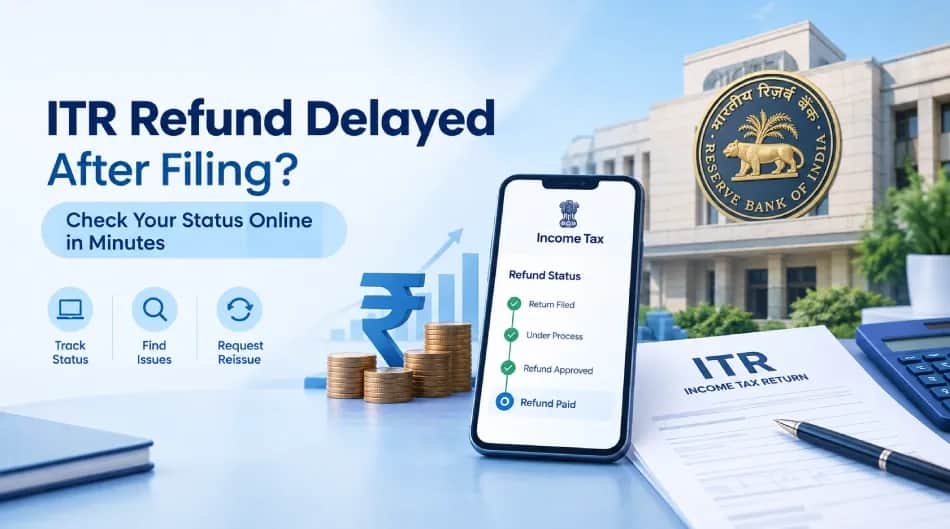
Taxpayers awaiting an ITR refund can track its progress online, spot verification or bank errors, and request reissue when a transfer has failed after processing.
Income-tax refunds for Assessment Year 2026–27 have not reached every eligible taxpayer yet, even after returns were filed and verified. The issue concerns individual taxpayers across India who claimed excess TDS, advance tax or self-assessment tax for income earned in FY 2025–26. The Income Tax Department says refund processing starts after verification and usually takes 4 to 5 weeks. A DD India report published on September 1, 2026, recorded over 7.8 crore filings by August 31.
The short-term effect is fairly direct. A person expecting ₹20,000 or ₹50,000 back may have planned an insurance payment, school expense, loan instalment or festive purchase around it. A longer delay can expose an incomplete verification, a wrong bank entry, an unread notice or an earlier tax demand. Over time, repeated delays can weaken confidence in the filing process, although a pending status alone does not mean CPC has rejected the claim.
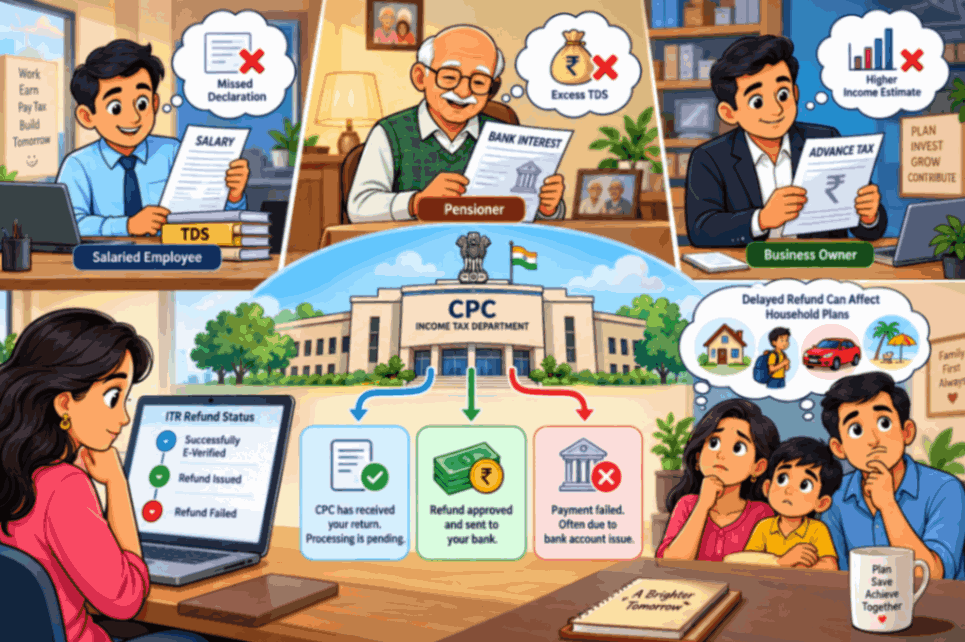
A refund becomes due when tax already paid exceeds the liability accepted after processing. Salaried employees may have excess TDS because an employer missed a declaration. Pensioners can face the same issue on bank interest. Business owners may have paid advance tax against an income estimate that later proved too high.
The useful part is that the taxpayer can identify the stage online. “Successfully E-Verified” means CPC has received a valid return but has not finished processing it. “Refund Issued” shows that CPC approved the payment and sent the instruction. “Refund Failed” points to a transfer problem, often involving the bank account. Each label calls for a different response, so sending repeated grievances before reading the status may achieve little.
Abhishek Soni, CEO of Tax2win, told The Economic Times in a July 15, 2026 report that most correctly filed and verified refunds are processed within 2 to 6 weeks. A payment within a few days can occur, but taxpayers should not treat that as the standard. Nikita Seth, Legal Associate at Jotwani Associates, advised taxpayers to examine the nominated account when the portal says “Refund Issued” but no money appears.
The practical solution begins with 3 checks: verification, CPC status and bank validation. LoansJagat’s tax refund status guide also separates a return under process from a failed refund. For borrowers, that distinction has a real use. A pending refund should not be treated as cash available for the next EMI until a credit date appears.
The Income Tax e-Filing portal provides the return lifecycle for every assessment year. Taxpayers should use it directly and ignore messages that promise faster release.
The portal wording should guide the taxpayer’s next move. The table below condenses the common messages without treating every delay as a failed payment.
The official Income Tax Department Refund Status User Manual identifies missing pre-validation, a name difference between bank and PAN records, an invalid IFSC and a closed account as refund-failure causes. An inoperative PAN may also stop the transfer. These are account-level faults. They do not erase a refund already accepted by CPC.
Read Also : AI Enters India’s Payment Core as Razorpay and Cashfree Put Agents to Work
Verification permits processing, but it does not approve the claimed amount. CPC still compares the return with available tax information. Differences involving Form 26AS, AIS or TIS can hold up the calculation. An incorrect ITR form or a large claim may also invite another check.
An earlier demand creates another possibility. The department can propose an adjustment against the current refund. The taxpayer should read the communication before accepting or disputing it. If the calculation appears wrong, the response should include supporting records.
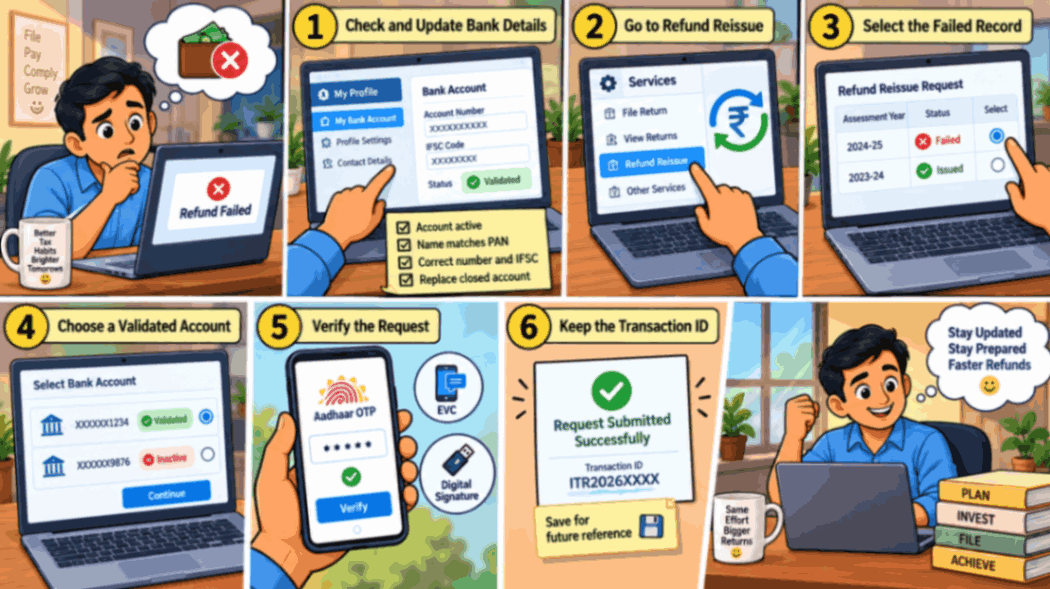
First, the taxpayer should open My Profile and My Bank Account. The selected account must remain active and pre-validated. Its name should agree with PAN records, and the number and IFSC must be correct. A closed account should be replaced with an active one.
After the portal records a failure, the taxpayer can open Services, choose Refund Reissue and create a request. Select the failed record and a validated account, complete verification through Aadhaar OTP, EVC or digital signature, and retain the transaction ID.
The filing season produced a heavy volume of returns. More than 5.9 crore ITR-1 and ITR-2 forms were filed by July 31, 2026. After filings from eligible non-audit business and professional taxpayers were included, the total crossed 7.8 crore by August 31. The Income Tax Department called it a record and thanked taxpayers and tax professionals for completing their filings on time.
Notification No. 02 of 2024, dated March 31, 2024 and effective from April 1, 2024, provides 30 days for e-verification or submission of ITR-V. CPC Bengaluru must receive a physical form within that period. An unverified return can become invalid, while late verification can shift the recognised filing date.
Read Also : Gold Price Prediction: 5 Triggers That Could Push Rates to ₹1.60 Lakh
The Income Tax Department’s published guidance asks taxpayers to check portal status and departmental messages when the refund does not arrive within the usual 4-to-5-week period. It also places responsibility on the filer to provide a working, validated bank account. The department’s September 1 filing update thanked taxpayers and professionals, but the record number also indicates why returns may move through CPC at different speeds.
Tax professionals separate routine waiting from a case requiring action. Soni gives a 2-to-6-week range for correctly prepared returns. Seth advises reviewing the Section 143(1) intimation when CPC creates a demand or adjusts a refund. Households should leave the expected amount outside their repayment plan until CPC issues it.
A delayed ITR refund needs diagnosis before action. Taxpayers should confirm verification, read the exact portal message and inspect the nominated bank account. A return under processing usually calls for more time. A failed payment requires corrected bank details and a reissue request, while an adjustment needs a review of the earlier demand.
Passwords, OTPs and bank credentials should never be shared with anyone offering faster release. The e-Filing portal, CPC intimation and registered departmental messages provide the valid route. Until the refund reaches the bank, households should also avoid committing that expected amount to a dated loan or bill payment.
The Income Tax Department says it usually takes 4 to 5 weeks. Some straightforward returns may move faster, while discrepancies, demands or bank problems can extend the wait.
Yes. CPC can adjust all or part of a refund against an outstanding tax demand after following the prescribed process. The taxpayer should read the communication and check whether the demand is accurate.
The bank will normally reject the transfer. After the portal marks it as failed, the taxpayer should validate an active account and submit a refund reissue request.
Verification only allows CPC to begin processing. The return may remain queued, require data reconciliation or await a response. Check the portal before raising a grievance.
Not immediately. A month can fall within the usual range. Confirm verification, inspect the bank status and respond if CPC has posted a notice.








.png&w=3840&q=75)


