
By continuing, you agree to LoansJagat's Credit Report Terms of Use, Terms and Conditions, Privacy Policy, and authorize contact via Call, SMS, Email, or WhatsApp
Disclaimer: The information published on LoansJagat is intended for general informational and educational purposes only and should not be considered financial, legal, or investment advice. Interest rates, loan terms, statistics, and other data may change over time and may vary by lender or source. Please verify the latest information and consult a qualified financial advisor or the respective Bank/NBFC before making any financial decisions.
Subscribe Now
About the author

Arshathul Afia
Arshathul Afia is a journalism graduate and fintech content writer with 4+ years of experience in digital publishing and research-led writing. She has written 200+ articles covering personal finance, lending, banking, digital payments, credit, insurance, and major financial developments in India. At LoansJagat, she focuses on simplifying complex fintech news, RBI updates, loan-related changes, policy developments, and industry trends for everyday readers. Her journalism background helps her approach stories with research, context, and clarity, while her SEO experience ensures content remains discoverable and relevant. She aims to make financial news easier to understand, practical, and useful for readers across India.
Related News
Simplify All Your Loans Into One Affordable EMI

Customers Served

Debt Consolidated

1200+ Reviews

Locations in India
Club all Loans & Credit Card Bills into Single EMI

Quick Apply Loan
Consolidate your debts into one easy EMI.

Takes less than 2 minutes. No paperwork.

10 Lakhs+
Trusted Customers

2000 Cr+
Loans Disbursed

4.7/5
Google Reviews

50+
Banks & NBFCs Offers
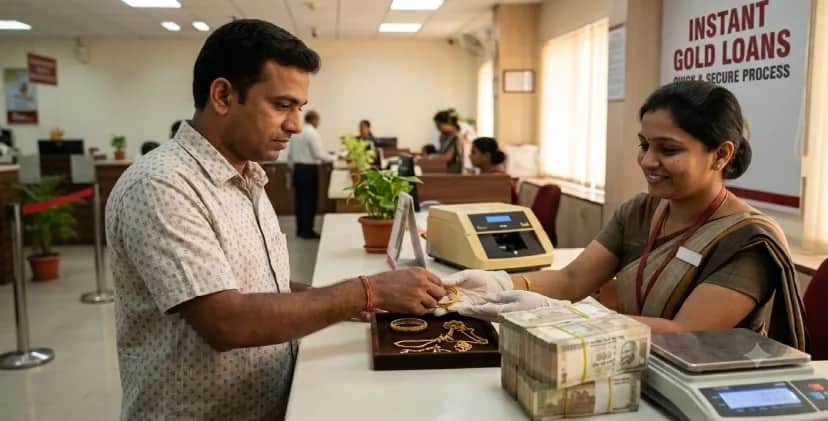
SBI says some personal-loan customers are pledging gold instead, as lower rates reshape how Indian households raise a few lakhs for urgent expenses and bills.
Lower rates can reduce borrowing costs, but missed repayments put pledged jewellery at risk.
State Bank of India said during its Q1 FY27 earnings call on August 7, 2026, that some customers who normally use its Xpress Credit personal loan are moving to gold-backed borrowing. Chairman Challa Sreenivasulu Setty attributed the switch to an interest rate advantage of almost 3%. The change is visible among customers seeking around Rs 2.5 lakh to Rs 3 lakh for medical treatment, education or home repairs.
In the short term, a cheaper secured loan can reduce the interest paid by a household and provide money faster. The longer-term risk is harder to ignore. A personal loan leaves family assets untouched, while a gold loan places jewellery with the lender until every due amount is paid. Continued default may lead to an auction, turning a cash shortage into the permanent loss of an asset.
Price is the main pull. SBI’s published personal-loan range is 10.00% to 15.00%, effective from August 15, 2025. Its 12-month bullet gold loan carried a 9.15% rate as of June 16, 2026, while the EMI and overdraft variants were listed at 10.10%. A customer offering a personal loan near the upper end of the range may therefore find a gold-backed option noticeably cheaper.
Approval can also be more direct. The lender checks the jewellery’s purity and net gold weight, applies its valuation method and fixes the eligible amount. Salary slips and a strong credit history may carry less weight than they do in an unsecured application. That helps pensioners, traders, freelancers and small business owners whose income does not arrive in the same amount every month.
Families facing an urgent hospital bill or college payment may get faster access to formal credit. A borrower can raise money without selling jewellery and recover it after repayment.
Women borrowers are likely to remain an important part of this change. A NITI Aayog report released on April 7, 2026, said personal and gold loans were among the most widely accessed credit products for women. That access can support household expenses or a small enterprise. Yet jewellery may belong to the wider family, so consent and repayment planning should come before the pledge.
The basic differences are easier to see side by side. Rates shown below use SBI’s published position, while processing fees and final offers can vary by customer and scheme.
| Comparison Point | Gold Loan | Personal Loan |
| Security | Gold jewellery is pledged | No physical collateral |
| SBI Published Rate | 9.15% for 12-month bullet; 10.10% for EMI or overdraft | 10.00% to 15.00% |
| Approval Basis | Purity, net weight and gold valuation | Income, employment and credit profile |
| Typical Use | Short cash requirement with a known repayment source | Larger need or a longer repayment period |
| Main Risk | Jewellery may be auctioned after continued default | Higher interest and damage to the credit record after default |
The lower displayed rate does not settle the choice. A bullet loan can leave principal and interest due together at maturity. Someone waiting for a confirmed business payment may handle that structure. A household depending on an uncertain bonus may struggle when the final date arrives.
Setty told analysts, “We have seen that many of our normal Xpress Credit customers are opting to take a gold loan.” He said the movement was keeping Xpress Credit growth below double digits despite healthy sourcing and disbursals. SBI’s average gold-loan ticket, around Rs 2.5 lakh to Rs 3 lakh, overlaps directly with small personal loans. That explains why the 2 products are now competing for the same borrower.
SBI’s gold-backed portfolio had crossed Rs 3.1 lakh crore by June 2026, including roughly Rs 1.25 lakh crore in personal gold loans and Rs 1.85 lakh crore in agricultural gold loans. Management described these borrowers as price-sensitive. It also said gold loans were an opportunistic area rather than the bank’s central retail product, so the pace may ease if the pricing advantage narrows.
From a borrower-side view, the cheapest rate works only when the repayment date matches dependable cash flow. LoansJagat’s gold-loan guide published on February 26, 2026 explains that net weight, purity and lender valuation decide how much money is sanctioned. LoansJagat’s reading is practical: compare the rupee outgo and the recovery date for the jewellery, not the headline rate alone.
The shift had been developing for several quarters. During SBI’s November 4, 2025 earnings call, Setty said some unsecured personal-loan customers were moving towards secured gold loans because rising gold values supported larger loan amounts. The latest August 2026 remarks show that the behaviour continued into FY27 and was strong enough to affect growth in Xpress Credit.
Government figures had also pointed to wider demand. A Press Information Bureau note from the Ministry of Finance published on May 5, 2026, said personal loans expanded by 16.2% in FY 2025-26, compared with 11.7% a year earlier. The release named vehicle finance and loans against gold jewellery among the segments showing strong momentum.
Punjab National Bank offered another example during its Q1 FY27 earnings call on July 18, 2026. Managing Director and Chief Executive Officer Ashok Chandra said PNB’s gold-loan exposure had risen from Rs 15,694 crore in June 2025 to Rs 31,888 crore in June 2026. The bank had also added 3,400 branches to its gold-loan network. That expansion took the product deeper into smaller cities and rural districts.
The first step is to calculate the complete repayment amount. Interest, processing fees, valuation costs and late charges should appear on one sheet. A rate difference of 2% or 3% may save money, though a short tenure can create a heavy monthly or final payment. The borrower should ask for both figures before signing.
Repayment style comes next. An EMI gold loan suits regular monthly income. A bullet facility may fit a trader expecting payment against a completed order. An overdraft can work when funds are needed in parts, provided interest is serviced as agreed. Choosing the wrong structure can erase the original saving.
The jewellery itself needs a family conversation. Wedding ornaments, inherited pieces and items kept for a child’s future often carry value beyond their market price. Pledging them for routine consumption can create conflict if income later falls. Borrowing against such gold is safer when the expense is necessary and the repayment source is already identified.
Gold loans are gaining ground because they can put a few lakhs into a borrower’s account at a lower rate than many personal-loan offers. SBI’s August 2026 disclosure adds a useful detail: part of that growth is coming from existing personal-loan customers who are actively changing products.
The cheaper route is not automatically the safer route. A borrower with stable income and a short repayment plan may benefit from pledging gold. Someone needing several years to repay, or relying on uncertain income, may be better served by an unsecured loan despite the higher cost. The right choice protects both cash flow and the jewellery.
A gold loan may cost less for short borrowing. A personal loan avoids putting jewellery at risk and may offer more time to repay.
The cheapest option varies by collateral and borrower profile. Gold loans can be cheaper than unsecured personal loans, but fees and tenure must be compared.
SBI linked the movement to a rate advantage of nearly 3% and overlapping loan tickets of around Rs 2.5 lakh to Rs 3 lakh.
Yes. Continued default can lead to an auction after the lender follows the notice and recovery terms stated in the loan agreement.
EMIs suit regular income, while bullet repayment suits a confirmed future payment. Borrowers should avoid a structure based on uncertain cash.









.png&w=3840&q=75)


