
By continuing, you agree to LoansJagat's Credit Report Terms of Use, Terms and Conditions, Privacy Policy, and authorize contact via Call, SMS, Email, or WhatsApp
Disclaimer: The information published on LoansJagat is intended for general informational and educational purposes only and should not be considered financial, legal, or investment advice. Interest rates, loan terms, statistics, and other data may change over time and may vary by lender or source. Please verify the latest information and consult a qualified financial advisor or the respective Bank/NBFC before making any financial decisions.
Subscribe Now
About the author

Arshathul Afia
Arshathul Afia is a journalism graduate and fintech content writer with 4+ years of experience in digital publishing and research-led writing. She has written 200+ articles covering personal finance, lending, banking, digital payments, credit, insurance, and major financial developments in India. At LoansJagat, she focuses on simplifying complex fintech news, RBI updates, loan-related changes, policy developments, and industry trends for everyday readers. Her journalism background helps her approach stories with research, context, and clarity, while her SEO experience ensures content remains discoverable and relevant. She aims to make financial news easier to understand, practical, and useful for readers across India.
Related News
Simplify All Your Loans Into One Affordable EMI

Customers Served

Debt Consolidated

1200+ Reviews

Locations in India
Club all Loans & Credit Card Bills into Single EMI

Quick Apply Loan
Consolidate your debts into one easy EMI.

Takes less than 2 minutes. No paperwork.

10 Lakhs+
Trusted Customers

2000 Cr+
Loans Disbursed

4.7/5
Google Reviews

50+
Banks & NBFCs Offers
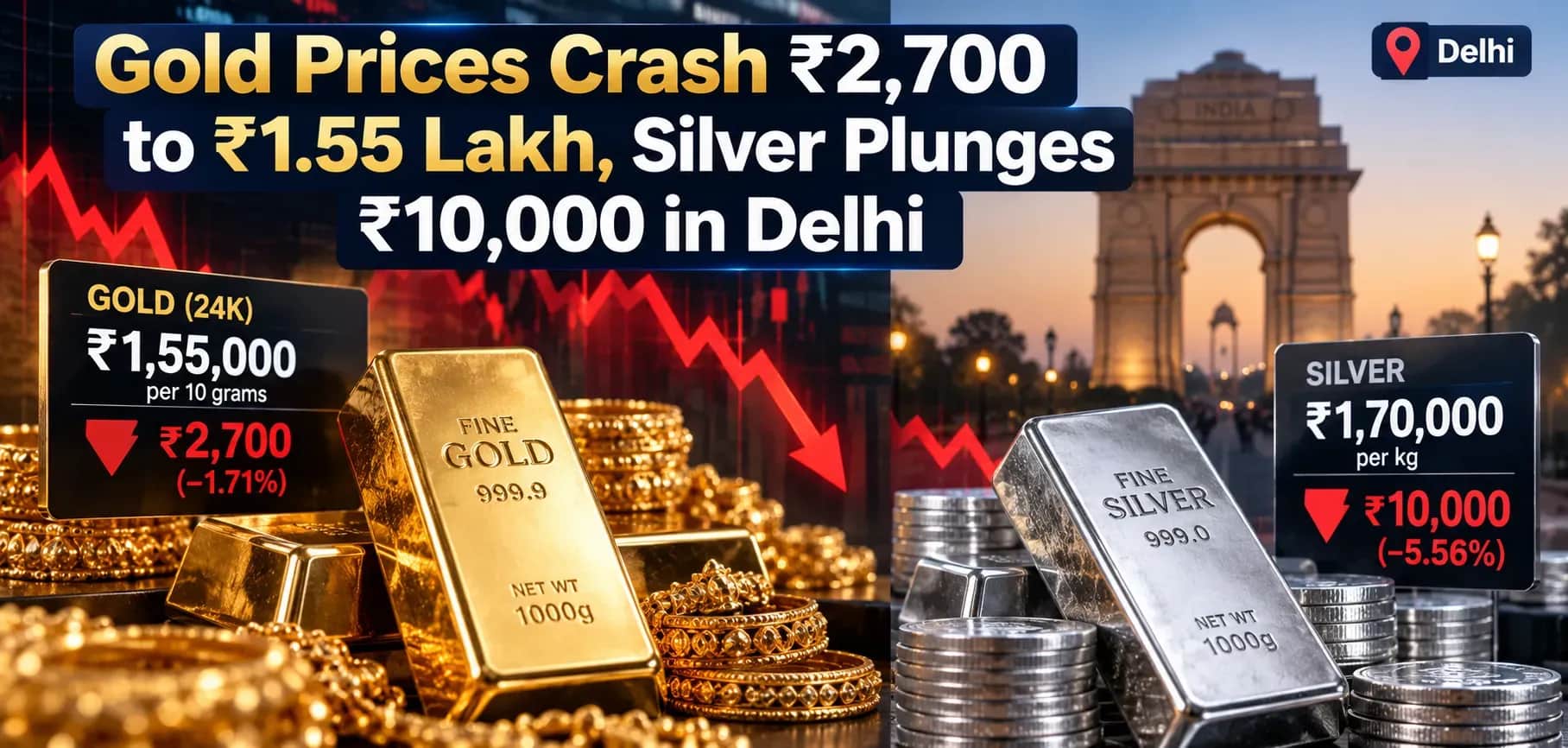
Delhi’s bullion counters turned cheaper after heavy selling pulled gold and silver lower, bringing buyers some relief before the next US policy decision this week.
Gold buyers in Delhi saw a smaller number on the price board that Friday. The rate for 99.9% pure gold came down to ₹1,55,900 per 10g from Thursday’s ₹1,58,600. So, the difference was ₹2,700 in a day. Silver had a tougher session. A kilogram was quoted at ₹2,34,600, compared with ₹2,44,600 earlier. The update issued on 12 September said traders had started selling after the recent rise. The quoted rates already included taxes.
For families waiting to buy wedding jewellery, the cheaper rate brings some relief, at least for now. The shop bill may not fall by the full amount because purity, making charges and design costs remain part of the calculation. Investors face a less comfortable situation. Frequent price swings make entry decisions difficult, while a lower valuation may also affect people planning to pledge gold for funds. The next move will depend heavily on US interest rates, bond yields, crude oil, the rupee and buying activity in Indian markets.
Traders described Friday’s move as a local correction after the recent rise. Some holders booked gains, while buyers stayed cautious after several abrupt price changes. That combination pushed physical-market quotations lower. Silver suffered the larger fall, which showed how quickly the white metal can move when traders reduce positions together.
The domestic fall appeared unusual because international bullion recovered during part of the same session. Spot gold rose by $49.82 to $4,366.58 per ounce, and silver gained 2% to $64.77 per ounce. Timing explains much of the gap. Indian sellers reacted to weakness seen earlier in global trade, while overseas investors later bought after the decline. Local demand, currency movement and dealer activity can also make Delhi quotations differ from global spot prices.
The table below separates the Delhi physical-market rate from the international price snapshot. Both describe Friday’s trade, but they represent different markets and trading windows.
The table does not show a jewellery-shop rate. A retail invoice can be higher because the jeweller calculates purity, net weight, making charges, design costs and applicable tax. Futures prices and benchmark bullion rates may show another figure because those quotations cover different transactions.

A lower bullion quotation can reduce the metal portion of a jewellery bill. Based on Friday’s Delhi movement, 99.9% pure gold became about ₹270 cheaper per gram than on Thursday. A family buying a 22-carat chain will not automatically save the same amount per gram, however. Most jewellery contains less pure gold than the 99.9% reference, and making charges may remain unchanged even when the bullion rate falls.
Practical checking helps. Buyers should ask the jeweller to show the purity, net gold weight, rate used, making charge and tax separately. They can verify the HUID through the official BIS Care facility before taking delivery. A person considering a pledge should not use the showroom bill as an estimate of borrowing capacity. The borrower-side view from LoansJagat is straightforward: lenders focus on assessed purity and eligible gold content when calculating a gold loan. A lower market price may reduce the amount available on a new pledge or leave less room for a top-up, but it does not rewrite an existing repayment schedule. Borrowers still owe the agreed amount.
Saumil Gandhi, Senior Analyst for Commodities at HDFC Securities, took a cautious view. Gold had picked up slightly in overseas trade, he said, yet it was still heading towards a 3rd straight weekly loss. Costlier crude oil, firmer US Treasury yields and talk of tighter monetary policy were weighing on the metal. The yield link is fairly direct. When bonds pay more interest, some investors move money away from gold because it provides no regular income.
Then came the inflation numbers. On 10 September 2026, the US Bureau of Labor Statistics published Producer Price Indexes, August 2026, under identification number USDL-26-1495. Producer prices rose 0.4% during the month and were 5.4% higher than 12 months earlier. Those figures left the Federal Reserve with less room to lower borrowing costs. Another rate increase also remained possible.
Independent metals trader Tai Wong saw Friday’s overseas recovery as evidence that some investors were buying after the fall. That view suggests a short-term floor may be forming, but it does not promise a lasting rebound. Gold still ended the week about 1.5% lower in international trade. Buyers who have a fixed wedding deadline may split their purchase into smaller lots. Investors without an immediate need can wait for the policy announcement and watch whether prices hold for several sessions.
Gold had barely broken out of a 6-session slide when prices changed direction again. On 4 September, the Delhi rate climbed ₹3,400 and reached ₹1.59 lakh per 10g. Silver moved up ₹5,000 to ₹2,40,500 per kg. Firmer overseas trade brought buyers back after the earlier dip. That relief did not last long.
That recovery weakened within days. A market update dated 9 September 2026 recorded a ₹2,150 fall in gold to around ₹1.58 lakh per 10g. Gold then closed at ₹1,58,600 on Thursday before Friday’s selling took it to ₹1,55,900. The sequence shows a market reacting quickly to overseas data, oil prices and shifting expectations rather than following a steady downward path.
Published benchmark rates also moved lower on 11 September. Those rates exclude 3% GST and making charges, so they should not be compared directly with the tax-inclusive Delhi quote. The distinction is useful for readers who see different numbers on a trading screen, a news report and a jewellery counter on the same morning.

The next major event is the Federal Reserve policy meeting scheduled for 15 and 16 September 2026. The official meeting calendar confirms the dates. A rate increase or a firm warning about inflation could keep pressure on gold. A pause, softer guidance or lower Treasury yields could bring buyers back.
Indian demand will play its part too. Wedding purchases and festival orders can support physical prices, while a weak rupee can make imported bullion more expensive even when overseas gold falls. Silver may keep showing wider changes because investment demand and industrial buying both influence its price. A ₹10,000 daily fall is attractive to a buyer, but it also shows the risk of entering without checking the latest quotation.
Delhi’s ₹2,700 gold-price fall gives buyers a lower reference point after several unstable sessions. Silver offered a larger reduction, though its ₹10,000 decline also exposed its sharper daily risk. Families should compare the complete jewellery bill instead of looking only at the 24-carat headline rate.
For investors and borrowers, Friday’s drop needs context. Local traders sold after a rally, while overseas buyers entered later and lifted international prices. The next Federal Reserve decision may decide whether gold remains near ₹1.55 lakh or reverses again. Until then, careful price comparison and staggered buying offer a practical response.
Local traders attributed the decline to selling after the recent rally. Higher bond yields, expensive crude oil and expectations of tighter US monetary policy also kept pressure on precious metals.
No. The figure covered 99.9% pure gold in Delhi’s physical bullion market and included taxes. City rates, purity levels and jewellery-shop quotations can differ.
A buyer with a fixed deadline may purchase in smaller lots instead of trying to predict the lowest price. The final decision should compare 22-carat rates, making charges, tax and HUID details.
No. A market-price decline does not change the repayment terms already written into the loan agreement. It may influence a fresh valuation or the room available for an additional loan.
The Federal Reserve meeting on 15 and 16 September is the nearest major trigger. Bond yields, crude oil, the rupee and Indian physical demand can also change domestic prices.









.png&w=3840&q=75)


