
.png&w=3840&q=65)
By continuing, you agree to LoansJagat's Credit Report Terms of Use, Terms and Conditions, Privacy Policy, and authorize contact via Call, SMS, Email, or WhatsApp
Disclaimer: The information published on LoansJagat is intended for general informational and educational purposes only and should not be considered financial, legal, or investment advice. Interest rates, loan terms, statistics, and other data may change over time and may vary by lender or source. Please verify the latest information and consult a qualified financial advisor or the respective Bank/NBFC before making any financial decisions.
Subscribe Now
About the author

Arshathul Afia
Arshathul Afia is a journalism graduate and fintech content writer with 4+ years of experience in digital publishing and research-led writing. She has written 200+ articles covering personal finance, lending, banking, digital payments, credit, insurance, and major financial developments in India. At LoansJagat, she focuses on simplifying complex fintech news, RBI updates, loan-related changes, policy developments, and industry trends for everyday readers. Her journalism background helps her approach stories with research, context, and clarity, while her SEO experience ensures content remains discoverable and relevant. She aims to make financial news easier to understand, practical, and useful for readers across India.
Related Blog Post
Simplify All Your Loans Into One Affordable EMI

Customers Served

Debt Consolidated

1200+ Reviews

Locations in India
Club all Loans & Credit Card Bills into Single EMI

Quick Apply Loan
Consolidate your debts into one easy EMI.

Takes less than 2 minutes. No paperwork.

10 Lakhs+
Trusted Customers

2000 Cr+
Loans Disbursed

4.7/5
Google Reviews

50+
Banks & NBFCs Offers
Other services mentioned in this article
CGST officers have found 30,162 fake input tax credit cases worth ₹74,782 crore in FY26. The sharp rise has put companies on alert, especially those that claim GST credit through long supplier chains.
CGST officials assessed that fraudulent ITC claims in FY26 stood at ₹74,782 crore, with 30,162 cases all over the country. MoS Finance Pankaj Chaudhary placed the details in the Rajya Sabha on July 28, 2026. It was alleged that the cases almost doubled in FY25, where the officials stated 15,283 cases were reported, with claims of ₹58,773 crore.
The 5Ws are basic here. What? A spike in fraudulent ITC cases. Who? CGST formations, the suspected fake firms, the beneficiaries, and the various businesses in the invoice chains. When? FY26, with the detailed update being provided to Parliament on the cited date. Where? Across the country, with cases from Maharashtra and Gujarat being among the significant ones. Why? Because fake credit leads to a rise in tax collection difficulties and prolonged clean claims, and leaves genuine firms to defend themselves by proving the validity of their purchases along with the invoices and suppliers.
Input tax credit lets a registered business reduce GST payable on sales by claiming credit for GST paid on purchases. A trader buying goods, paying GST and selling them further can use that tax credit if the purchase is genuine and properly recorded. LoansJagat’s explainer on Input Tax Credit also explains ITC as a way to reduce tax liability when eligible purchases are used for business.
Fraud begins when invoices are created without any real supply. A fake firm raises an invoice, another firm claims credit, and the chain moves ahead through more GSTINs. By the time officers trace the first link, the firm may have shut down, changed address or used borrowed documents. That is why a fake invoice can become a wider tax trail very quickly.
Also Read: Income Tax Notice To Deceased Person Can Be Void Under Section 148, Legal Heirs Must Act Fast
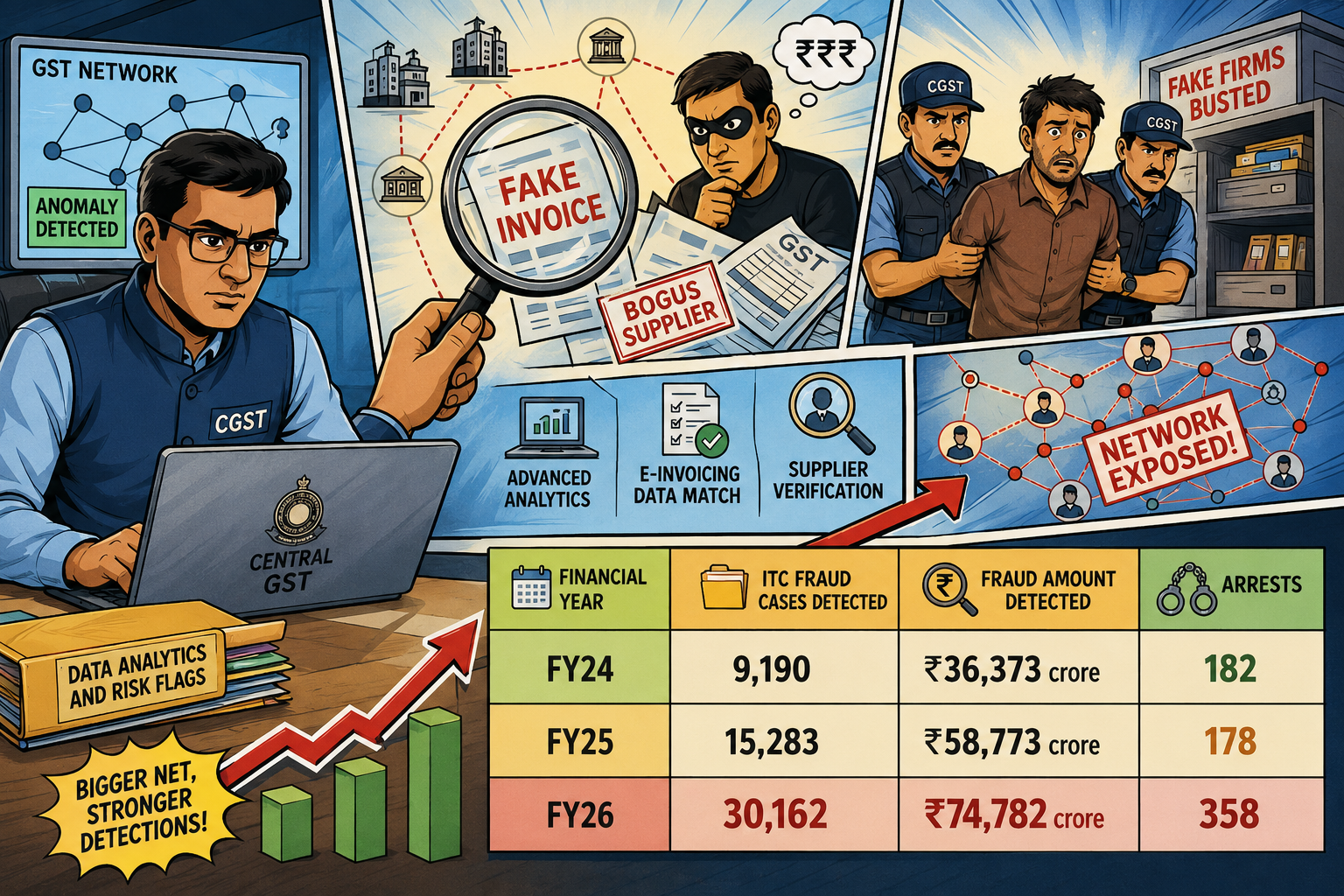
The FY26 number shows a wider tax enforcement drive, not only bigger individual fraud cases. The reported detection rose to 30,162 cases, compared with 15,283 cases in FY25 and 9,190 cases in FY24. The detected amount also moved from ₹36,373 crore in FY24 to ₹58,773 crore in FY25, then to ₹74,782 crore in FY26.
Before the table, the point to note is this. The case count has moved faster than the fraud value. That means officers are not only chasing large rackets. They are also catching smaller links, suspicious credit trails and beneficiaries spread across long supplier chains.
After this table, the business warning is direct. A company cannot treat GST invoices as routine paperwork anymore. If a supplier has a weak filing history, mismatched invoices, no delivery proof or repeated address changes, the buyer may also get dragged into questions later.
The latest fraud figure follows earlier GST enforcement drives. On January 7, 2024, the Press Information Bureau said GST formations had detected 29,273 bogus firms involved in suspected ITC evasion of ₹44,015 crore since the special drive began in mid-May 2023. The same update said ₹4,646 crore had been protected through ITC blocking and recovery, with 121 arrests.
Another official record from Parliament also showed how fake registrations became a repeated concern. A Lok Sabha reply available on Sansad referred to action against bogus firms and suspected fake ITC evasion under the special drive. These earlier updates explain why FY26 detections did not come out of nowhere. The GST system had already been looking at fake firms, forged documents and invoice chains.
Also Read: FY 2025-26 ITR Filed but Not Verified? Tax Return May Be Treated as Unfiled
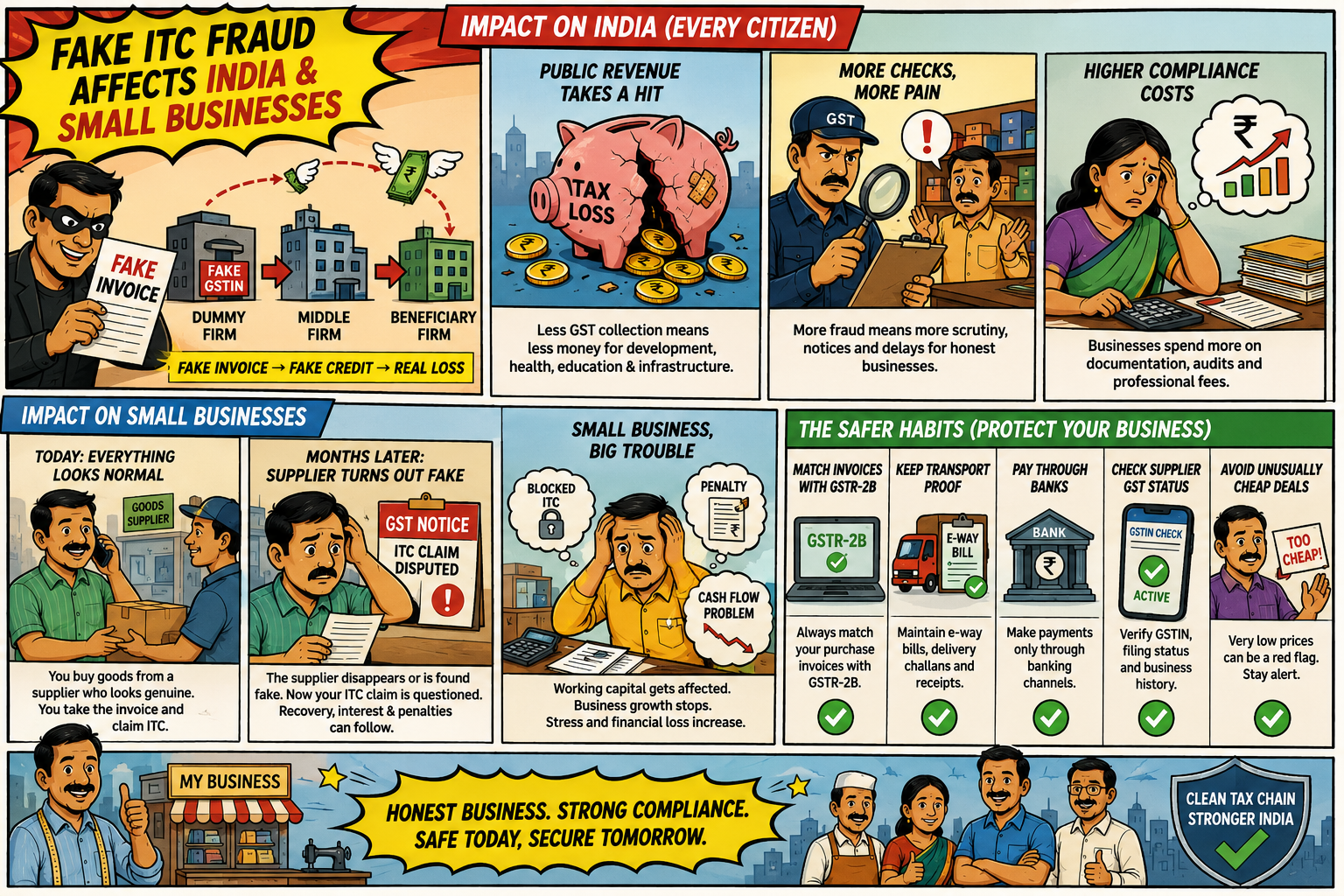
For ordinary Indians, fake ITC fraud hits public revenue. GST collection supports government spending, and fake credit reduces the tax that should have reached the exchequer. The loss may not be visible at a shop counter, but it travels through the system. More fraud also means more checking, more notices and higher compliance costs for honest firms.
Small businesses face the sharpest pain. A manufacturer in Rajkot, a contractor in Pune or a textile trader in Surat may buy from a supplier that looks normal today. Months later, if that supplier turns out to be fake or non-compliant, the buyer can face questions over credit claims. The safer habit is boring but useful, match invoices with GSTR-2B, keep transport proof, pay through banks and avoid casual dealings with vendors who offer unusually cheap billing.
Tax experts quoted in business reports have said the rise in detections also reflects better use of data tools, e-invoicing trails and automated matching by GST systems. Their wider reading is reasonable. Fraud may have grown, yes, but detection has also become sharper. Officers now have more digital trails than they had in the first few years of GST.
The solution needs work from both sides. Government teams need faster cancellation of dummy GSTINs, stronger checks on repeated beneficiaries and quicker action on identity misuse. Businesses need tougher vendor onboarding. They should not claim ITC only because an invoice has arrived in the inbox. If goods did not move, if payment did not match, or if the supplier’s returns look irregular, the credit claim can become a future liability.
Minister of State for Finance Pankaj Chaudhary told the Rajya Sabha on July 28, 2026 that CGST officers detected fake ITC claims worth ₹74,782 crore in FY26. The statement placed the issue directly in Parliament and gave the current year’s fraud numbers official weight.
Earlier government communication also shows the policy direction. The Finance Ministry, through PIB, had already called out fake registrations, bogus firms and invoice fraud during the 2023 drive. The official line has been to target masterminds and beneficiaries, not only paper firms that disappear after passing credit. That part is important because many dummy GSTINs are only front doors. The real gain often reaches someone further down the chain.
LoansJagat’s view fits naturally here because ITC is not only a tax term for accountants. It affects working capital, supplier trust and loan files too. Lenders often look at GST returns, revenue flow and tax compliance when studying a business. A disputed ITC claim can weaken a borrower’s profile, especially for SMEs that depend on clean records for overdrafts, invoice finance or business loans.
The FY26 GST ITC fraud figure is a hard warning for India’s tax chain. Fake credit has moved beyond isolated billing tricks. It now runs through dummy firms, weak KYC checks, forged documents and long supplier networks.
For the government, the next task is recovery and prosecution. Detection alone will not repair revenue loss. For businesses, the safer route is simple. Verify every supplier before claiming credit. Keep proof of movement. Match returns. Do not share PAN, Aadhaar or bank details with unknown agents. In GST, one careless invoice can now create a much larger problem later.
ITC fraud happens when a business claims GST credit using fake invoices without real goods or services.
CGST officers detected ₹74,782 crore worth of fake ITC claims across 30,162 cases in FY26.
Minister of State for Finance Pankaj Chaudhary shared the data in the Rajya Sabha on July 28, 2026.
Fraud networks use fake GST registrations to create invoices, pass credit and hide the actual beneficiary.
They should verify GSTINs, match GSTR-2B, keep delivery records and avoid suppliers with suspicious billing.








.png&w=3840&q=75)


