.png&w=3840&q=65)
By continuing, you agree to LoansJagat's Credit Report Terms of Use, Terms and Conditions, Privacy Policy, and authorize contact via Call, SMS, Email, or WhatsApp
Disclaimer: The information published on LoansJagat is intended for general informational and educational purposes only and should not be considered financial, legal, or investment advice. Interest rates, loan terms, statistics, and other data may change over time and may vary by lender or source. Please verify the latest information and consult a qualified financial advisor or the respective Bank/NBFC before making any financial decisions.
Subscribe Now
About the author

Arshathul Afia
Arshathul Afia is a journalism graduate and fintech content writer with 4+ years of experience in digital publishing and research-led writing. She has written 200+ articles covering personal finance, lending, banking, digital payments, credit, insurance, and major financial developments in India. At LoansJagat, she focuses on simplifying complex fintech news, RBI updates, loan-related changes, policy developments, and industry trends for everyday readers. Her journalism background helps her approach stories with research, context, and clarity, while her SEO experience ensures content remains discoverable and relevant. She aims to make financial news easier to understand, practical, and useful for readers across India.
Related News
Simplify All Your Loans Into One Affordable EMI

Customers Served

Debt Consolidated

1200+ Reviews

Locations in India
Club all Loans & Credit Card Bills into Single EMI

Quick Apply Loan
Consolidate your debts into one easy EMI.

Takes less than 2 minutes. No paperwork.

10 Lakhs+
Trusted Customers

2000 Cr+
Loans Disbursed

4.7/5
Google Reviews

50+
Banks & NBFCs Offers
Other services mentioned in this article
A tax notice sent after death can be challenged, but heirs must record the death, protect the estate, and respond through proper channels.
The Allahabad High Court has quashed an income tax reassessment case where the Income Tax Department issued a Section 148 notice in the name of Sanjay Dubey on March 28, 2025, even though he had died on January 7, 2024. The case involved his legal heir, Asha Dubey, and became important for families who receive old tax notices after a taxpayer’s death.
The issue is simple, but the legal effect is heavy. Can the tax department reopen a case by sending a fresh Section 148 notice to a person who no longer exists in law? In this case, the court said no. The notice itself failed because it was addressed to a deceased taxpayer, not to the legal representative.
According to the Income Tax Department’s Section 148 page, the assessing officer must issue a notice before making a reassessment or recomputation where income is believed to have escaped assessment. That power exists, but it has to be used against the correct person. A dead taxpayer cannot file a return, defend the case, produce documents, or appoint someone in response to that notice.
This is why legal heirs should not begin with a detailed reply about income, bank entries or property papers. Their first point should be the death. The date of death, the name on the notice and the date of issue are the 3 details that decide the first response.
Many families in India do not close tax loose ends immediately after a death. A bank account may remain open for a few months. A property sale may be completed later. TDS may appear in Form 26AS. A pension entry, interest income or refund claim may also stay linked with the deceased person’s PAN. Then one day, a notice lands in the inbox or by post. Most families panic.
The positive part is that heirs now have stronger ground to push back if a fresh notice is wrongly issued in the name of the deceased person. They should inform the assessing officer, attach the death certificate, and state that the notice is void because the addressee had died before the notice date. At the same time, families must remember that tax dues do not vanish after death. The law allows valid dues to be recovered from the estate in the hands of legal representatives.
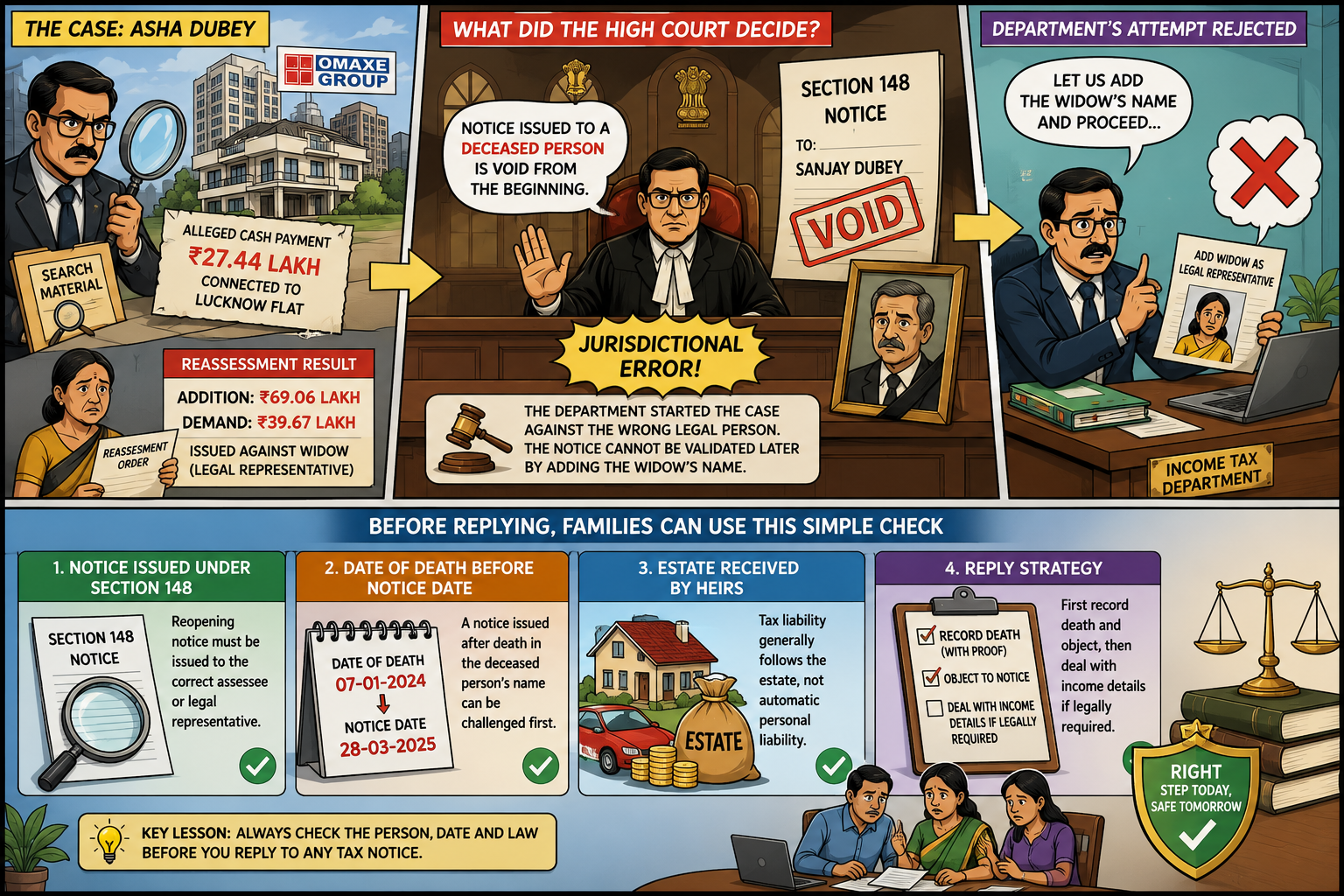
The reassessment notice in the Asha Dubey case was linked to material from a search involving the Omaxe Group. LoansJagat reported on July 24, 2026, that the department referred to an alleged ₹27.44 lakh cash payment connected with a Lucknow flat. The reassessment later led to an addition of ₹69.06 lakh and a demand of ₹39.67 lakh against the widow as legal representative.
The High Court did not accept the department’s attempt to save the proceedings by adding the widow later. The court treated the defect as a jurisdictional error. In simple words, the department had started the case against the wrong legal person. Since the taxpayer was already dead, the notice could not become valid by replacing the name later.
Before replying, families can use this simple check.
This table matters for ordinary households because most errors happen in the first reply. A son may write emotionally. A widow may upload documents without raising objection. A daughter may pay a demand just to avoid a visit to the tax office. That can create fresh problems. A short, direct reply with death proof is usually the better first step.
Section 159 of the Income-tax Act already deals with legal representatives. The Income Tax Department’s Section 159 page says that when a person dies, the legal representative is liable to pay any sum that the deceased would have been liable to pay if alive. It also treats the legal representative as an assessee for such tax work.
The same provision also gives protection. The liability of the legal representative is limited to the estate capable of meeting the tax dues. If an heir receives property worth a certain value, the department can pursue valid tax dues against that estate. It cannot blindly treat every heir’s personal income or savings as open for recovery. There is one warning here. If heirs dispose of estate assets while tax dues remain unpaid, personal exposure can arise up to the value of assets handled.
This older legal position explains why the latest ruling does not cancel tax law after death. It only says the department must follow the correct route. If a proper notice goes to a legal representative within the allowed time, the heir has to deal with it. If the notice goes to a dead person first, that first defect can break the reassessment.

Tax experts quoted in the Business Standard reference said heirs should not ignore the notice and should not act as if a defective notice is valid. That is the thin line. Silence can lead to an ex parte order. A careless reply can weaken the legal objection. The first response should record the death and challenge the validity of the notice.
The solution is fairly direct. The legal heir should log in through their own income tax account, register as a representative assessee for the deceased taxpayer, upload the death certificate, legal heir proof and PAN details, then wait for approval. After that, the heir can access pending notices and respond through the official route. Using the deceased person’s old login, Aadhaar OTP or digital signature after death should be avoided.
There is also a borrower-facing angle here. LoansJagat’s view fits naturally into this case because many families discover tax, loan or property-linked liabilities only after death. The safer approach is to list the deceased person’s tax filings, home loans, property papers, bank accounts and pending notices before dividing assets. It sounds boring. It saves trouble later.
The court took a firm view that tax laws operate against living persons or legally recognised representatives, not against a dead individual. Reports on the judgment said the High Court held the Section 148 notice void from the beginning and not curable through a later name change.
The department argued that it did not know about the death when it issued the notice. That argument did not save the reassessment. At the same time, the court did not ignore another concern. If a return was filed after death using the deceased person’s name or Aadhaar OTP, that action may be examined separately under law. Families should take that warning seriously.
For taxpayers, the larger message is practical. Keep the death certificate, PAN, bank details, last filed ITR, Form 26AS and property papers in one file. If there is a notice, do not delay. If there is inherited property, do not rush into sale or transfer before checking tax status.
The ruling gives legal heirs an important first defence when an income tax notice to a deceased person is issued under Section 148 after death. The family should not panic, and it should not reply casually. The first response should state that the taxpayer had died before the notice date and attach proof.
The tax department can still recover valid dues through Section 159 when the law allows it. But it must address the correct legal person and follow the proper process. For Indian families, the safest path is simple. Check the date. Check the name. Register as a legal heir. Then respond, not emotionally, but properly.
The heir should inform the assessing officer about the death and attach the death certificate.
A notice issued to a dead person after death can be challenged as void.
Yes, but liability is generally limited to the estate received from the deceased person.
They should avoid it and register as legal heirs through their own e-filing account.
A death certificate, PAN, legal heir proof, last ITR, bank papers and tax notices should be kept ready.










.png&w=3840&q=75)


