By continuing, you agree to LoansJagat's Credit Report Terms of Use, Terms and Conditions, Privacy Policy, and authorize contact via Call, SMS, Email, or WhatsApp
Disclaimer: The information published on LoansJagat is intended for general informational and educational purposes only and should not be considered financial, legal, or investment advice. Interest rates, loan terms, statistics, and other data may change over time and may vary by lender or source. Please verify the latest information and consult a qualified financial advisor or the respective Bank/NBFC before making any financial decisions.
Subscribe Now
About the author

Arshathul Afia is a journalism graduate and fintech content writer with 4+ years of experience in digital publishing and research-led writing. She has written 200+ articles covering personal finance, lending, banking, digital payments, credit, insurance, and major financial developments in India. At LoansJagat, she focuses on simplifying complex fintech news, RBI updates, loan-related changes, policy developments, and industry trends for everyday readers. Her journalism background helps her approach stories with research, context, and clarity, while her SEO experience ensures content remains discoverable and relevant. She aims to make financial news easier to understand, practical, and useful for readers across India.
Related News
Simplify All Your Loans Into One Affordable EMI

Customers Served

Debt Consolidated

1200+ Reviews

Locations in India
Club all Loans & Credit Card Bills into Single EMI

Quick Apply Loan
Consolidate your debts into one easy EMI.

Takes less than 2 minutes. No paperwork.

10 Lakhs+
Trusted Customers

2000 Cr+
Loans Disbursed

4.7/5
Google Reviews

50+
Banks & NBFCs Offers
Other services mentioned in this article
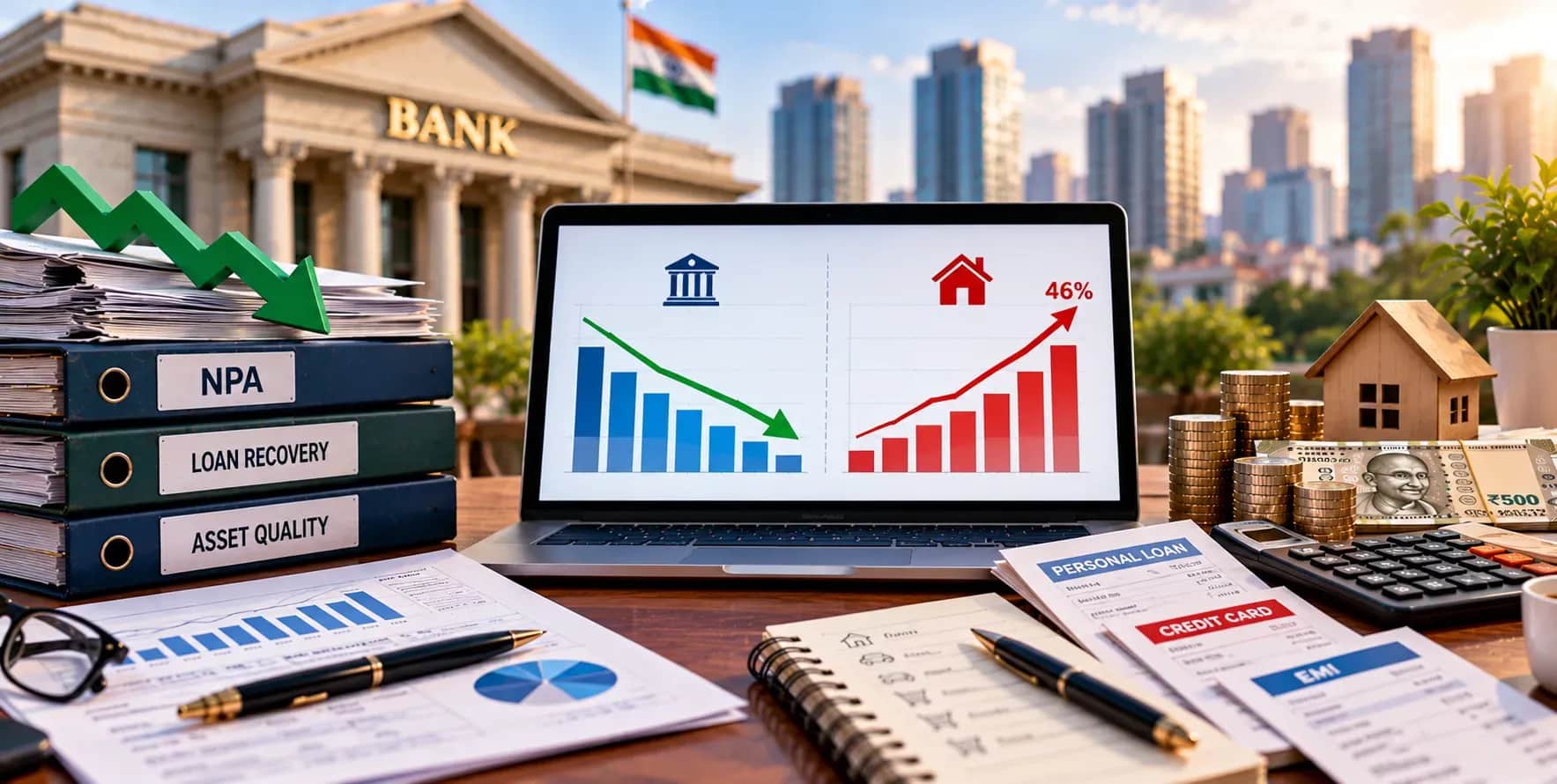
India’s household debt reached 46% of GDP as bad loans declined, prompting fresh scrutiny of borrowers taking additional credit despite keeping up with monthly repayments.
Research highlighted on 10 October 2026 has brought attention to a growing concern in India’s banking sector. A Bank of America Global Research analysis found that household borrowing has expanded considerably even as banks report better loan repayment figures. For banks and non-banking financial companies (NBFCs), the concern is whether customers taking additional loans have sufficient income to support their existing repayment commitments.
The concern extends beyond missed EMIs. Some borrowers are meeting every monthly instalment and taking fresh loans at the same time. Their accounts remain regular, yet more of their earnings go towards repayments. Less income is then available for household needs. A gap in earnings would not reduce the EMI. The borrower would still owe the same amount each month, even with less money coming in.
While purchasing a vehicle on finance, it’s not mandatory to pay the full amount on that day itself. The buyer pays through monthly instalments instead. Credit cards and personal loans also let people delay payments, though their repayment terms differ. But an existing EMI does not disappear when another loan begins. What comes out of the household budget each month is the total repayment bill, not just the newest EMI.
Not every increase in borrowing indicates financial trouble. Formal lenders provide an alternative to borrowing money through informal arrangements. Still, the amount remaining after EMI deductions deserves attention. Someone who has paid every instalment without delay may find the next loan difficult to manage, particularly if earnings have not increased.
Bank of America Global Research examined household leverage during FY19-FY26. India’s leverage intensity ratio stood at 2.1 during the period, compared with China’s 2.0. The measure tracks changes in household borrowing relative to changes in per capita GDP. Researchers have questioned whether expanding retail credit reflects lending to more customers or greater borrowing by existing customers.
The assessment of the October 2026 findings is that timely repayments tell only part of the story. Banks also need to examine how much income borrowers retain after meeting existing EMIs. Earlier coverage of small-ticket personal loan defaults, published on 21 July 2026, examined repayment difficulties in fintech lending. These findings concern a particular lending segment and should not be treated as the default rate for all personal loans.
The improvement in banking performance was visible before the October 2026 research.
Parliament received a Ministry of Finance update on 9 February 2026. Scheduled commercial banks had brought their gross non-performing asset (NPA) ratio for domestic operations down to 2.15% by September 2025. It was a provisional historic low.
The government attributed the decline to banking reforms, improved recovery procedures and earlier identification of stressed accounts.
The available figures show how falling bank defaults have coincided with increasing household borrowing.
The figures measure different aspects of lending. The NPA ratio records loans classified as non-performing, whereas household debt relative to GDP measures outstanding borrowing against the country’s economic output.
Banks may report fewer NPAs even when individual households are spending a growing share of their income on loan repayments.
In a written Lok Sabha reply dated 9 February 2026, Minister of State for Finance Pankaj Chaudhary detailed the government’s measures for reducing bad loans. These included recovery mechanisms and automated early warning systems introduced in public sector banks. Lower NPAs have reduced provisioning requirements and supported bank profitability, the government stated.
Chapter 3 of the Economic Survey 2025-26, addressed a problem in microfinance lending. Lenders did not always have accurate information about how much a borrowing household earned. Information about debts held with other lenders was also difficult to obtain. Better assessments of repayment capacity and responsible lending were among the measures discussed in the survey. The discussion concerned microfinance specifically, although the challenge of measuring total repayment obligations is relevant to the broader household debt debate.
India’s falling bad loans indicate improving banking performance, but household borrowing remains a concern.
The October 2026 research highlights the difference between customers repaying loans today and their capacity to handle growing debt over time.
There is no evidence in these figures of an immediate banking crisis. The concern is whether household incomes can support additional borrowing without creating repayment difficulties.
The October 2026 research highlighted rising non-housing borrowing, particularly among existing borrowers taking additional credit. Household debt stood at approximately 46% of GDP in September 2025.
Falling bad loans indicate improved asset quality. However, this measure does not establish whether households have sufficient income to repay additional borrowing.
Yes. Borrowers may qualify for another personal loan depending on their income, existing EMI commitments, credit history and the lender’s eligibility requirements.
Regular repayments indicate that existing obligations are being met. However, additional loans increase monthly commitments and can leave less income available for essential expenses.
No. The figure measures household borrowing relative to GDP. It does not establish an ongoing banking crisis or indicate that 46% of borrowers have defaulted.