
By continuing, you agree to LoansJagat's Credit Report Terms of Use, Terms and Conditions, Privacy Policy, and authorize contact via Call, SMS, Email, or WhatsApp
Disclaimer: The information published on LoansJagat is intended for general informational and educational purposes only and should not be considered financial, legal, or investment advice. Interest rates, loan terms, statistics, and other data may change over time and may vary by lender or source. Please verify the latest information and consult a qualified financial advisor or the respective Bank/NBFC before making any financial decisions.
Subscribe Now
About the author

Arshathul Afia is a journalism graduate and fintech content writer with 4+ years of experience in digital publishing and research-led writing. She has written 200+ articles covering personal finance, lending, banking, digital payments, credit, insurance, and major financial developments in India. At LoansJagat, she focuses on simplifying complex fintech news, RBI updates, loan-related changes, policy developments, and industry trends for everyday readers. Her journalism background helps her approach stories with research, context, and clarity, while her SEO experience ensures content remains discoverable and relevant. She aims to make financial news easier to understand, practical, and useful for readers across India.
Related News
Simplify All Your Loans Into One Affordable EMI

Customers Served

Debt Consolidated

1200+ Reviews

Locations in India
Club all Loans & Credit Card Bills into Single EMI

Quick Apply Loan
Consolidate your debts into one easy EMI.

Takes less than 2 minutes. No paperwork.

10 Lakhs+
Trusted Customers

2000 Cr+
Loans Disbursed

4.7/5
Google Reviews

50+
Banks & NBFCs Offers
Piyush Goyal rejected claims that India’s 7.8% Q1 GDP growth was inflated, saying critics compared figures prepared under 2 different statistical series during Wednesday’s address.
Piyush Goyal pushed back against criticism of India’s 7.8% real GDP growth figure at an automobile industry event in New Delhi on September 2, 2026. The Commerce and Industry Minister claimed Opposition leaders and former Finance Secretary Subhash Chandra Garg were putting together numbers from 2 separate Gross Domestic Product (GDP) series. The original series made 2011–12 its base year, whereas the new calculation makes 2022–23 its base year.
What began as an argument over calculation methods has now become a political fight. That could leave people unsure about which figure to trust, particularly when the growth they hear about has not shown up in their pay packets or employment prospects. The 2.6% claim does rely on figures that cannot be directly compared. Even so, the sharp reduction in last year’s nominal GDP estimate needs a detailed public explanation.
A GDP estimate does not change a family’s salary or monthly bills on release day. Its effect arrives through business orders, construction activity, investment and hiring. The April to June data shows expansion in manufacturing, construction and services. If that pace continues, a factory supplier in Pune, a textile worker in Tiruppur or a truck operator serving a building site may receive more work. Such gains usually appear unevenly and with a delay.
Borrowers should also avoid reading 7.8% growth as a promise of cheaper loans or immediate income relief. LoansJagat’s borrower-focused reading of the Q1 GDP release notes that business activity can strengthen before household finances improve. Better production may support future hiring, but repayments still depend on personal income, existing debt and job continuity. A strong headline cannot protect a family whose employer has not raised pay.
The dispute begins with 2 nominal GDP values. Garg compared ₹88.27 lakh crore for Q1 FY2026–27 under the new series with ₹86.05 lakh crore, an estimate for Q1 FY2025–26 published under the old series. That calculation produces approximately 2.6%. The comparison fails because the figures use different coverage, methods and statistical frameworks. It also places nominal growth against the government’s 7.8% real growth figure, although the 2 measures are not interchangeable.
Economists seeking a useful review should use the same series for both periods, then inspect the price adjustments and source data separately. MoSPI can help by releasing detailed sector revision sheets and machine-readable historical tables. That would allow independent economists to recreate the results. Public discussion would then focus on the new methodology’s strengths and weaknesses, rather than an incompatible calculation that cannot prove the official rate false.
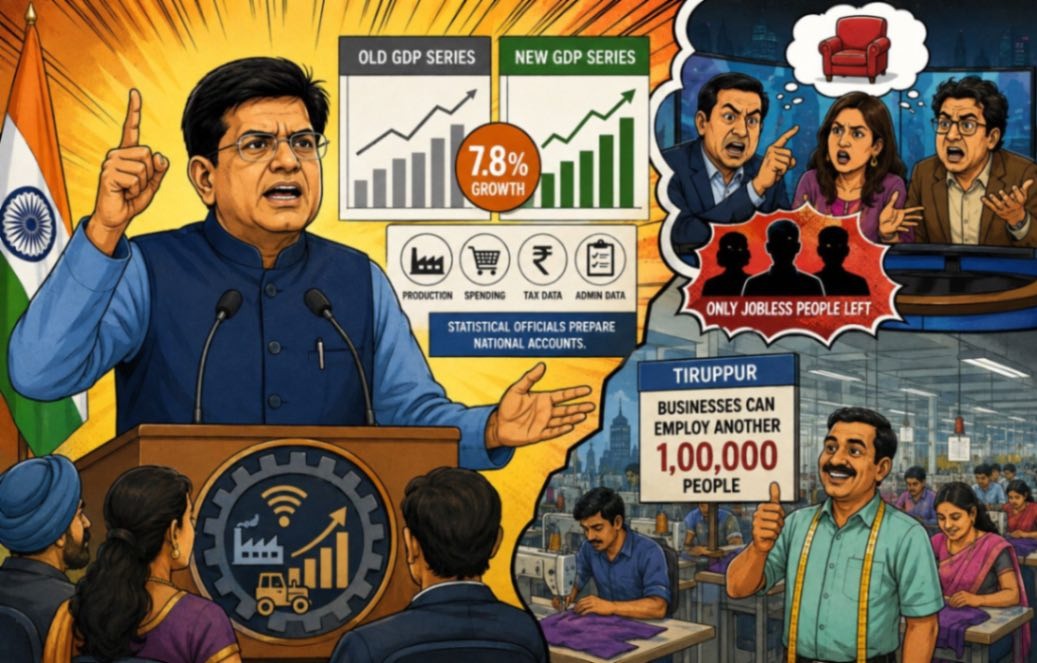
Goyal told the industry gathering that 7.8% growth was a reality and said Opposition leaders were trying to misguide people. He argued that they had compared an old GDP series with the new series even though the base year and the calculation process had changed. Politicians and Members of Parliament do not manufacture the national accounts, he added. Statistical officials prepare them from production, spending, tax and administrative information.
His language soon became sharper. Goyal described critics appearing on television as the “only jobless people left” and accused them of diminishing the work of Indian citizens. He also referred to labour demand in Tiruppur, saying businesses there could employ another 1,00,000 people. That is a regional example, not a national employment survey. Still, it formed part of his answer to claims that rapid output growth had failed to generate work.
The National Statistics Office released its quarterly estimate on August 31, 2026. Real GDP rose to ₹81.36 lakh crore from a comparable ₹75.46 lakh crore in Q1 FY2025–26. Nominal GDP reached ₹88.27 lakh crore against ₹80 lakh crore under the same new series. Those comparisons produce 7.8% real growth and 10.3% nominal growth.
The table below keeps the data selective. Every entry comes from the Ministry of Statistics and Programme Implementation’s Q1 press note dated August 31, 2026.
Services provided the largest push among the broad sectors, while manufacturing and construction also advanced. Investment grew faster than private consumption. Mining moved in the opposite direction. The result therefore came from several expanding activities, but the quarter did not deliver equal progress across every part of the economy.
India introduced the 2022–23 GDP series on February 27, 2026, replacing the 2011–12 framework. The update changed the base year and brought revised coverage, newer administrative records, different sector weights and improved price measures. The new method also adopted double deflation for manufacturing, which adjusts the prices of factory output and intermediate inputs separately before calculating real value added.
The politically sensitive change appeared in the previous year’s nominal GDP. The original Q1 FY2025–26 estimate under the old series was ₹86.05 lakh crore. After the February revision, the comparable new-series estimate became ₹80.32 lakh crore. A June update moved it to ₹80.44 lakh crore. Updated industrial production, producer price and administrative data later took the figure to ₹80 lakh crore.
On September 2, 2026, the Press Information Bureau’s official GDP note rejected the charge that officials had lowered the earlier value merely to lift current growth. It said the reduction resulted from successive changes in data, coverage and methodology. The note also stated that ₹86.05 lakh crore from the superseded series cannot be compared directly with ₹88.27 lakh crore from the new one.
That reply addresses the 2.6% arithmetic. It does not remove the need for public examination of a reduction of about ₹6 lakh crore in an earlier nominal estimate. Large revisions deserve a detailed trail showing where values moved and why. Such disclosure would strengthen the defence of the new system without asking readers to accept it on authority alone.
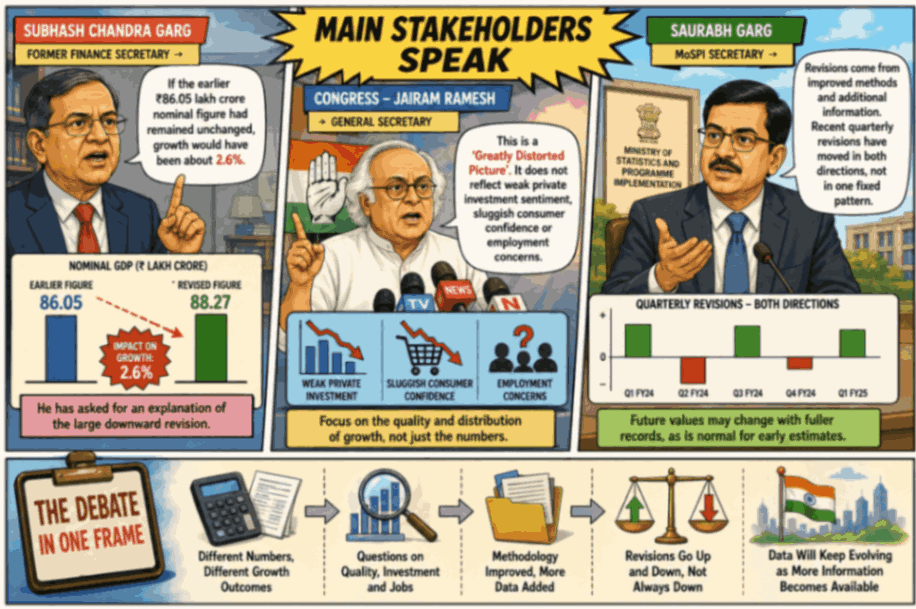
Subhash Chandra Garg argued that growth would have been about 2.6% if the earlier ₹86.05 lakh crore nominal figure had remained unchanged. His broader request was for an explanation of the large downward revision. Congress then amplified the claim and accused the Union government of lowering the previous year’s base to present a stronger current result.
Congress general secretary Jairam Ramesh described the release as a “Greatly Distorted Picture”. He said it did not reflect weak private investment sentiment, sluggish consumer confidence or employment concerns. Those claims address the quality and distribution of growth. They do not establish that Garg’s cross-series calculation is statistically valid.
MoSPI Secretary Saurabh Garg, who is not related to Subhash Chandra Garg, said the revisions came from improved methods and additional information. He also said recent quarterly revisions had moved in both directions, rather than following a fixed pattern that always lowered the previous base. Future quarterly values may change when fuller records arrive, as happens with early national account estimates.
India’s official Q1 FY2026–27 real GDP growth remains 7.8% under the 2022–23 series. Subhash Chandra Garg’s 2.6% result combines an old-series nominal estimate with a new-series nominal figure and cannot replace the official real growth calculation.
The Union government holds the stronger statistical position on that narrow point. Its next task is openness. Detailed revision records would help economists test the new method and show readers why the previous nominal estimate fell by about ₹6 lakh crore. Families will judge the growth story differently. They will look for regular work, better pay and greater room in monthly budgets.
The government has estimated the growth to be at 7.8% based on the real figures. The 2.6% estimate is based on 2 different statistical series and hence is not comparable.
Growth in the economy should not be understood necessarily in the public's sense. The GDP counts the economy's total output and not the quality of the jobs or the household income. Growth that happens in an economy may not reflect in better jobs for the people.
In the case of GDP, real GDP is adjusted for inflation, whereas nominal GDP is not adjusted.
The revision updates sector weights, data sources and price measures so the accounts better represent the present economy.
Yes. Quarterly estimates can change when the National Statistics Office receives fuller production, company and government records.









.png&w=3840&q=75)


