

By continuing, you agree to LoansJagat's Credit Report Terms of Use, Terms and Conditions, Privacy Policy, and authorize contact via Call, SMS, Email, or WhatsApp
Disclaimer: The information published on LoansJagat is intended for general informational and educational purposes only and should not be considered financial, legal, or investment advice. Interest rates, loan terms, statistics, and other data may change over time and may vary by lender or source. Please verify the latest information and consult a qualified financial advisor or the respective Bank/NBFC before making any financial decisions.
Subscribe Now
About the author

Arshathul Afia is a journalism graduate and fintech content writer with 4+ years of experience in digital publishing and research-led writing. She has written 200+ articles covering personal finance, lending, banking, digital payments, credit, insurance, and major financial developments in India. At LoansJagat, she focuses on simplifying complex fintech news, RBI updates, loan-related changes, policy developments, and industry trends for everyday readers. Her journalism background helps her approach stories with research, context, and clarity, while her SEO experience ensures content remains discoverable and relevant. She aims to make financial news easier to understand, practical, and useful for readers across India.
Related News
Simplify All Your Loans Into One Affordable EMI

Customers Served

Debt Consolidated

1200+ Reviews

Locations in India
Club all Loans & Credit Card Bills into Single EMI

Quick Apply Loan
Consolidate your debts into one easy EMI.

Takes less than 2 minutes. No paperwork.

10 Lakhs+
Trusted Customers

2000 Cr+
Loans Disbursed

4.7/5
Google Reviews

50+
Banks & NBFCs Offers
Home loan rates can differ within one bank because the final price includes loan-specific spreads, product rules, property risk and a borrower’s repayment profile too.
Home loan borrowers in India may receive different interest rates from the same bank despite having the same CIBIL score and external benchmark. Moneycontrol reported the issue on September 2, 2026, after lending executives explained how banks add a separate spread. Each loan is priced using income, repayment capacity, property profile, product and the bank’s policy on the sanction date.
The short-term result can be a higher EMI or a longer repayment period. Over several years, the extra interest may become expensive, especially for families already using a large share of monthly income for housing. A lower spread can help a strong applicant, but older customers may lose out when fresh borrowers receive better offers. The difference is not automatically an error. It still needs an explanation.

A floating home loan rate has 2 working parts. The first is the benchmark, which moves with the rate specified in the loan agreement. The second is the spread added by the bank. Borrowers often notice the benchmark because policy changes receive wide coverage. The spread receives far less attention, although it can decide whether the final rate is competitive or expensive.
Credit history remains important, but a CIBIL score does not show the entire loan file. A bank also checks salary continuity, business cash flow, current EMIs, age, proposed tenure and the borrower’s contribution to the property price. It reviews the property as security too. Legal approvals, construction stage, location and resale prospects can influence the lender’s internal risk grade even when the applicant’s CIBIL score has not moved.
The impact begins with the monthly budget. If the lender keeps the tenure unchanged, a higher rate raises the EMI. If the EMI remains fixed, the loan may run for longer and principal repayment can slow. That hurts borrowers who planned school fees, medical expenses or retirement savings around the original closure date. The strain is usually harder on a single-income household.
Official bank pages show why an advertised starting rate cannot be treated as the final offer. The State Bank of India listed home loans at 7.25% a year with effect from April 1, 2026, subject to terms and conditions. Union Bank of India listed a starting rate of 8.60% and stated that the final rate depends on factors such as the CIBIL score, loan amount and monthly income. Both pages were accessed on September 3, 2026.
The pricing inputs usually work in the following way:
There is a positive side for applicants with a stronger file. A bigger down payment, stable earnings and fewer outstanding debts may support a lower spread. Adding an earning co-applicant can improve repayment capacity in some cases. None of these steps guarantees the lowest rate, but they give the bank better reasons to price the loan competitively.
Read Also : India’s Q1 GDP Beats RBI Forecast at 7.8%, Here Are 5 Reasons It Stands Out
Santosh Agarwal, CEO of Paisabazaar, told Moneycontrol that the benchmark is only the base and that the lender’s spread reflects policy, borrower risk and product type. Adhil Shetty, CEO of BankBazaar, pointed to timing. Banks revise the spreads offered on new loans as their business strategy and market conditions change. A loan sanctioned in 2022 can therefore remain priced differently from another account opened in 2026.
Sarika Grover, co-founder of LoansJagat, said product-specific and borrower-specific inputs also enter the calculation. Matching scores do not create matching loan files. A borrower-side reading points to the hidden risk: customers compare the visible rate while the costliest variation can remain buried in spread and reset terms. An affected borrower should seek a written breakup of the benchmark, spread, risk premium, reset date and conversion fee. The bank should explain what changed and when, preferably through email or an updated loan document.
During 2025 and 2026, lenders revised home loan rate cards and promoted lower starting offers to selected applicants. The updates helped new borrowers with strong credit and income profiles. They also exposed a gap. Some existing customers discovered that their rate remained above the figure displayed for a new application at the same bank.
Those older accounts were priced under the policy available on their sanction dates. A later reduction in the new-customer spread did not always flow into them automatically. Some banks offered an internal conversion after collecting a fee. Others considered repricing only after the customer made a written request or showed a competing balance-transfer offer.
Product variations added another layer. A standard loan used to buy a first home can have different pricing from a top-up taken for renovation or personal expenses. An overdraft-linked housing product may also carry a separate premium because the borrower can deposit and withdraw surplus funds. The same customer name and CIBIL score do not make these facilities identical.
Reset timing can briefly produce another difference. Separate loans may update their benchmark on different scheduled dates. One account may reflect a benchmark change earlier, while the second changes later. If the gap continues after both reset dates have passed, the borrower should compare the spreads recorded in the sanction letters.
Read Also : EPFO Releases Kerala Pension Before Month-End, UMANG Checking Steps Inside
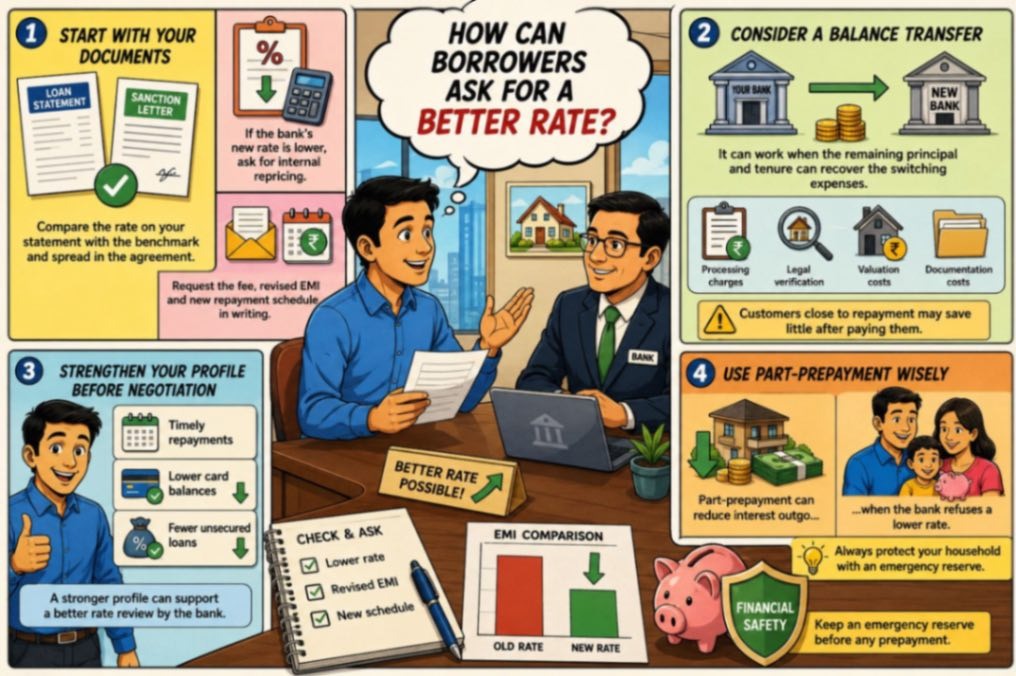
The borrower should begin with the current loan statement and sanction letter. The rate shown on the statement can be matched with the benchmark and spread in the agreement. If the bank’s new rate is lower, the customer can request internal repricing and ask for the fee, revised EMI and new repayment schedule in writing.
A balance transfer may work when the remaining principal and tenure can recover the switching expenses. Processing charges, legal verification, valuation and documentation costs must be counted. Customers close to repayment may save little after paying them.
Before negotiating, timely repayments, lower card balances and fewer unsecured loans may support a stronger review. Part-prepayment can reduce interest outgo when the bank refuses a lower rate, provided the household keeps an emergency reserve.
Home loan interest rates can differ inside the same bank because the benchmark is only the starting point. The spread carries the details that separate 1 loan from another, including property risk, income, product type, down payment and sanction-date policy.
Borrowers who spot a gap should ask for the rate formula before assuming unfair treatment. The bank’s written response will show whether the difference comes from reset timing, a separate product or an older spread. That information also gives the customer a firmer base for repricing, part-prepayment or a balance transfer.
Each loan can carry a different spread based on its product, sanction date, loan amount, property and repayment assessment. The common benchmark does not require an identical final rate.
No. The score is only 1 pricing input. Income stability, existing debt, loan-to-value ratio, property records and customer category can change the bank’s internal risk grade.
The existing loan may have an older, higher spread. New offers can use revised pricing or a temporary campaign. The borrower can ask for internal conversion and compare the fee with expected savings.
It depends on the outstanding principal, remaining tenure and transfer costs. A small gap can still help on a large, long-running loan, but fees may cancel the benefit near closure.
The borrower can request a review, but approval depends on the bank’s policy. A better score, lower debt and regular repayment record can support the request without guaranteeing acceptance.









.png&w=3840&q=75)


