
By continuing, you agree to LoansJagat's Credit Report Terms of Use, Terms and Conditions, Privacy Policy, and authorize contact via Call, SMS, Email, or WhatsApp
Disclaimer: The information published on LoansJagat is intended for general informational and educational purposes only and should not be considered financial, legal, or investment advice. Interest rates, loan terms, statistics, and other data may change over time and may vary by lender or source. Please verify the latest information and consult a qualified financial advisor or the respective Bank/NBFC before making any financial decisions.
Subscribe Now
About the author

Arshathul Afia is a journalism graduate and fintech content writer with 4+ years of experience in digital publishing and research-led writing. She has written 200+ articles covering personal finance, lending, banking, digital payments, credit, insurance, and major financial developments in India. At LoansJagat, she focuses on simplifying complex fintech news, RBI updates, loan-related changes, policy developments, and industry trends for everyday readers. Her journalism background helps her approach stories with research, context, and clarity, while her SEO experience ensures content remains discoverable and relevant. She aims to make financial news easier to understand, practical, and useful for readers across India.
Related News
Simplify All Your Loans Into One Affordable EMI

Customers Served

Debt Consolidated

1200+ Reviews

Locations in India
Club all Loans & Credit Card Bills into Single EMI

Quick Apply Loan
Consolidate your debts into one easy EMI.

Takes less than 2 minutes. No paperwork.

10 Lakhs+
Trusted Customers

2000 Cr+
Loans Disbursed

4.7/5
Google Reviews

50+
Banks & NBFCs Offers
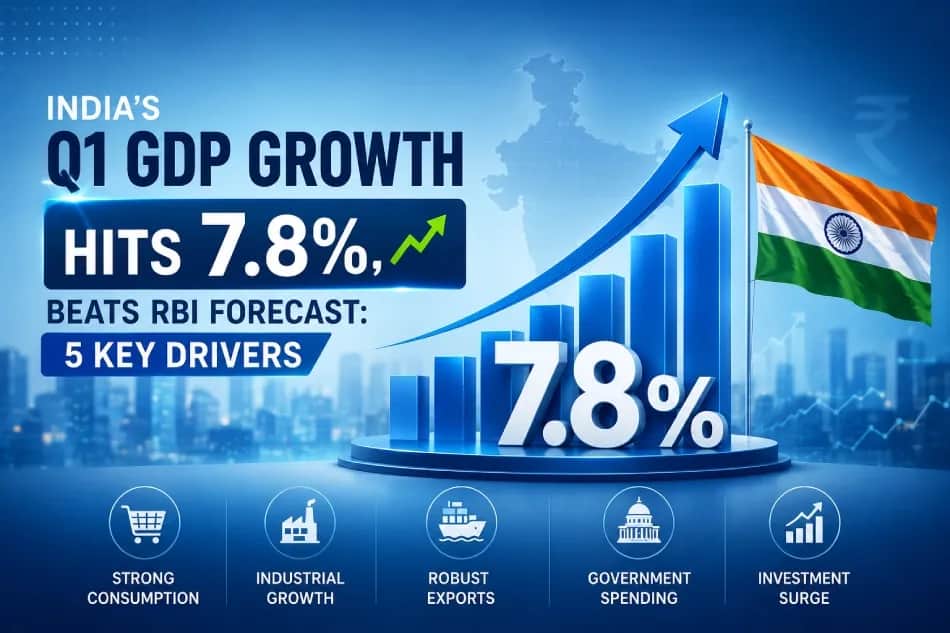
India’s economy expanded 7.8% in Q1 FY27, beating forecasts as investment, factories, services and exports held firm through a difficult quarter for global trade conditions.
In Q1 FY2026-27 (3 months from April 2026 to June 2026), India's real GDP growth rate was 7.8%. The estimate was released on 31st August 2026 by the Ministry of Statistics and Programme Implementation in New Delhi. The real output grew to ₹81.36 lakh crore from ₹75.46 lakh crore in the corresponding quarter last year. The reading crossed the RBI’s 7.0% forecast and came during a quarter disturbed by expensive oil, uncertain trade and shipping problems linked to the West Asia conflict.
For businesses, the immediate benefit could come through larger factory orders, more freight movement and continuing construction work. A longer run of investment would add factories, roads, warehouses and digital capacity. Households may take longer to notice any improvement. Agriculture lost pace and mining contracted, while fuel and food prices remain capable of eating into wages. The headline is strong. The household experience may still be uneven.
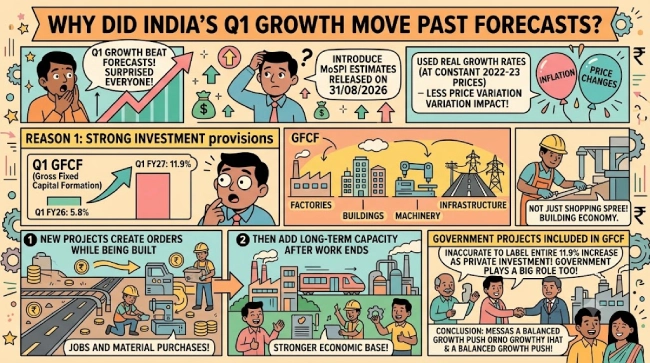
For example, spending is going up as production is going up, so this was unanticipated for many reasons. The Q1 estimates were released by the Ministry of Statistics and Programme Implementation on 31/08/2026. It used real growth rates (at constant 2022-23 prices), which lessened the impacts of price variations.
The first reason was investment and its provisions. Growth in gross fixed capital formation stood at 11.9% for the quarter compared to a rise of 5.8% in Q1 FY26. The category comprises the expenditures made on machines, factories, buildings and infrastructure. The jump tells a different story from a temporary burst in shopping. A new plant or rail project creates orders while it is being built, then adds capacity after work ends. Government projects form part of the number, so it would be inaccurate to label the entire 11.9% increase as private investment.
Manufacturing was the second driver. It expanded 9.2%, improving from 8.3% a year earlier. Construction also gathered speed. Electricity and utility output recovered after shrinking during the comparable quarter of FY26. These sectors connect with suppliers far beyond a large project site. A cement order supports a plant, truck operator and dealer. Electrical equipment, steel fabrication, packaging and repair workshops often join the same chain.
Services provided the third push, growing 10.0%. Financial, property, IT and professional services led this part of the economy. Household consumption was fourth, with spending rising 7.1%. Families continued buying goods and services despite pressure from essentials. Exports were the fifth driver. Real exports climbed 12.0%, while real imports declined 1.1%, improving the trade contribution used in the GDP calculation.
A short group of indicators captures the change without turning the story into a spreadsheet. Investment accelerated most sharply, while manufacturing and services kept the production side active.
There were weak pockets. Agriculture slowed to 3.6% from 4.4%. Mining declined 2.4%, and government consumption rose by a modest 4.3%. Much of the stronger performance therefore came from urban services, industrial output, capital spending and trade. Rural India may not have experienced the quarter in quite the same way.
GDP growth reaches a family through work, wages, shop sales and better public revenue. It does not arrive as a direct payment. Construction activity may create work for drivers, labourers and machine operators. When a factory expands, nearby workshops can receive fabrication jobs, while warehouses, caterers and security agencies pick up smaller contracts. A growing services company may hire graduates or rent another floor. None of this happens everywhere at once.
The result also needs careful reading from a borrower’s side. Strong business activity can encourage lending, but it does not guarantee cheaper home loans or personal loans. Funding costs, inflation and monetary policy still shape rates. Before MoSPI released the figure, LoansJagat examined 18.3% growth in non-food bank credit and placed likely Q1 growth near 8.0%. The final 7.8% reading was close. The practical question now is where that credit went. Loans used for machinery, stock and productive expansion have a different effect from borrowing that leaves families with heavier monthly repayments.
Dhiraj Nim of ANZ Research viewed investment and exports as signs that domestic and overseas demand both contributed. DBS Bank economist Radhika Rao pointed to consumption, government capital spending and manufacturing. Her warning concerned high oil prices, a weaker rupee and tighter financial conditions abroad. Aditi Nayar of ICRA said the number beat her organisation’s 7.0% estimate even though the West Asia conflict and uneven rainfall hurt parts of the economy.
Policy work now becomes less glamorous and more practical. Projects for roads and rails must be completed on time if there is funding. India could mitigate its vulnerability to a disruption in oil supply by increasing its suppliers, though there is little that can be done at a moment's notice to address the constraints on transport capacity or the ability of its refineries to process a greater diversity of suppliers. Poor rains can cause fluctuations in food stocks and prompt food imports if they are conducted in time. Companies need dependable electricity, trained workers, and working freight routes before announced investment turns into output. Q1 has bought some room. It has not removed these challenges.
Read Also : Startup Business Loan 2026: Get Up to ₹20 Lakh Without Collateral Under PM MUDRA Yojana
The comparison itself changed during 2026. MoSPI introduced a national accounts series with 2022-23 as the new base year on February 27, 2026. It brought in newer price indices and additional administrative records, then revised older estimates. Under that series, Q1 FY26 growth now stands at 6.9%. Reports written before the revision may show another figure. They are not necessarily referring to the same statistical series.
Activity indicators available before August 31 had already suggested a decent quarter. Vehicle sales, factory production, bank credit and central capital spending were moving up. Forecasts remained restrained because crude prices had jumped and trade routes were under pressure. Rainfall was patchy too. What surprised analysts was the amount of domestic activity that survived those disruptions through June.
The performance led Prime Minister Narendra Modi to call it “a herculean feat”. He explained that the performance of India has been possible because of its resilience to deal with interruptions in supply, volatility in oil prices and uncertainties in functionality on the global stage. His response was published by the Press Information Bureau under Release ID 2305033, dated 31st Aug. 2026.
Chief Economic Adviser V. Anantha Nageswaran turned attention towards the coming quarters. He called for the provision of greater access to trade and energy supplies and ensured the competitiveness of India's exports. The economists took the investment hike with them, but did not believe the 1 quarter to be a definitive sign of the trend. There's a case to be made for that caution. Generally, a company wouldn't hire hundreds when they are busy working on a short project. However, families also evaluate the economy by means other than GDP, such as paychecks, groceries, and employment prospects.
India’s Q1 performance stood out because 5 parts of the economy contributed together. Investment rose quickly, manufacturing expanded, services stayed active, households spent more, and exports helped. That happened during an uncomfortable period for oil-importing countries and global trade.
The tougher work starts after the headline. Projects need completion, factories need orders, and workers need jobs with dependable pay. Agriculture, mining, oil prices and rainfall could still weaken the year. If Q1 investment becomes operating capacity rather than delayed construction, the 7.8% figure will carry weight beyond a single release.
In real terms, sector GDP growth was higher in April to June 2026, as compared to April to June 2025, with India producing 7.8% more. The estimate adjusts for price changes and uses 2022-23 as the base year.
Investment spending increased, and manufacturing and services grew. Household purchases continued to rise. Real exports also grew faster, giving the expenditure calculation added support.
Not by itself. Banks consider policy rates, deposit costs, borrower risk, and competition while pricing loans. Strong growth may lift credit demand, while higher inflation can delay any reduction in rates.
How Does GDP Growth Benefit An Ordinary Indian Family?
Jobs and income provide the main route. A family may benefit when a parent finds work, a small shop gains customers, or wages rise. High food, rent, and fuel costs can offset that improvement.
It is a strong quarterly result, although 3 more quarters remain in FY27. Investment must continue, agriculture needs support, and new activity has to create paid work before the gains spread widely.









.png&w=3840&q=75)


