

By continuing, you agree to LoansJagat's Credit Report Terms of Use, Terms and Conditions, Privacy Policy, and authorize contact via Call, SMS, Email, or WhatsApp
Disclaimer: The information published on LoansJagat is intended for general informational and educational purposes only and should not be considered financial, legal, or investment advice. Interest rates, loan terms, statistics, and other data may change over time and may vary by lender or source. Please verify the latest information and consult a qualified financial advisor or the respective Bank/NBFC before making any financial decisions.
Subscribe Now
About the author

Arshathul Afia is a journalism graduate and fintech content writer with 4+ years of experience in digital publishing and research-led writing. She has written 200+ articles covering personal finance, lending, banking, digital payments, credit, insurance, and major financial developments in India. At LoansJagat, she focuses on simplifying complex fintech news, RBI updates, loan-related changes, policy developments, and industry trends for everyday readers. Her journalism background helps her approach stories with research, context, and clarity, while her SEO experience ensures content remains discoverable and relevant. She aims to make financial news easier to understand, practical, and useful for readers across India.
Related News
Simplify All Your Loans Into One Affordable EMI

Customers Served

Debt Consolidated

1200+ Reviews

Locations in India
Club all Loans & Credit Card Bills into Single EMI

Quick Apply Loan
Consolidate your debts into one easy EMI.

Takes less than 2 minutes. No paperwork.

10 Lakhs+
Trusted Customers

2000 Cr+
Loans Disbursed

4.7/5
Google Reviews

50+
Banks & NBFCs Offers
PM MUDRA offers eligible repeat borrowers collateral-free business loans up to ₹20 lakh through Tarun Plus, helping established micro-enterprises pay for their next expansion.
Under the Tarun Plus scheme of Pradhan Mantri MUDRA Yojana, small business owners who meet the eligibility criteria can avail loans up to ₹20 lakh without offering any collateral. A Press Information Bureau backgrounder dated 8th April 2026 (Release ID- 2249942) states that the facility is for entrepreneurs who have borrowed under Tarun and successfully repaid the loan. These loans are offered by participating banks, RRBs, small finance banks, NBFCs and MFIs all throughout India.
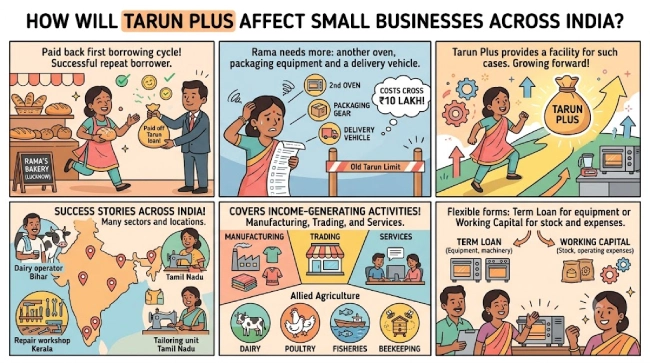
The upper limit is most useful for micro-enterprises that have moved past their first borrowing cycle. A small bakery in Lucknow, for example, may have used a Tarun loan to buy an oven and refrigerator. After repaying it, the owner may want another oven, packaging equipment and a delivery vehicle. Those expenses can cross ₹10 lakh. Tarun Plus provides a route for such a case.
The same position may arise for a dairy operator in Bihar, a tailoring unit in Tamil Nadu or a repair workshop in Kerala. PMMY covers income-generating activities in manufacturing, trading and services. Certain activities allied to agriculture, including poultry, dairy, fisheries and beekeeping, also qualify. The facility may take the form of a term loan for equipment or working capital for stock and operating expenses.
PMMY divides applicants according to their funding requirement and business stage. The highest amount carries an additional eligibility condition.
A new borrower cannot move directly into Tarun Plus. The person may apply under Shishu, Kishor or Tarun, depending on the amount required and the lender’s assessment. For the upper slab, the old Tarun account and its repayment record become part of the eligibility test.
This changes how the ₹20 lakh offer should be presented to the public. It is an expansion loan route for a proven MUDRA borrower. Calling it a starter loan without mentioning the Tarun condition would leave many first-time applicants with the wrong expectation.
A collateral-free facility removes the requirement to pledge an additional asset such as a house, plot or commercial property. It does not remove the bank’s duty to assess the borrower. Credit officers still examine account activity, existing debts, delayed payments, expected income, and the proposed use of the money.
A ₹15 lakh request from a workshop cannot rest on a 2-page description saying sales will rise. The owner should show the machine quotation, current production, confirmed orders, monthly expenses, and expected revenue after installation. Rough figures cause delays. Sometimes they lead to rejection.
The LoansJagat assessment of the ₹20 lakh MUDRA facility points to the part that short summaries often miss: Tarun Plus rewards an established repayment record. From a borrower’s viewpoint, that changes the application strategy. A first-time founder should request the amount required for the opening stage. An eligible repeat borrower should submit the earlier loan closure proof along with current business figures.
Banks may also approve less than the amount requested. Suppose a trader asks for ₹18 lakh, while recorded sales support an instalment linked to ₹11 lakh. The lender may reduce the sanction. That is still a collateral-free loan, only smaller. The advertised ceiling does not override repayment capacity.
A workable project report needs specific costs. If a food-processing unit requires ₹13 lakh, the proposal should separate machinery, electrical work, packaging equipment, raw material and initial wages. Each large expense should have a quotation or another supporting record. Expected sales should follow the unit’s actual production capacity, not a rounded figure chosen to fit the loan request.
Existing businesses need consistency across bank statements, GST returns and income-tax records. A sudden jump between declared turnover and projected revenue will invite questions. For Tarun Plus, the applicant should also carry records showing that the earlier Tarun loan was closed through successful repayment.
Banks may ask for different papers based on the borrower and activity. A usual file can contain:
Paperwork should be checked before submission. A name written differently across PAN, bank records, and registration papers can hold up verification. An expired licence creates another avoidable problem. Small errors often take longer to repair than the business proposal itself.
PMMY does not offer a single interest rate to every applicant. The participating bank, NBFC or MFI sets the rate under its lending policy after reviewing the borrower and proposed activity. Tenure, processing charges, promoter contribution, and guarantee-related costs may also differ.
A borrower should ask for the complete repayment schedule before signing. The useful figure is the total amount payable over the chosen tenure, not only the rate printed at the top of the sanction letter. A longer tenure may lower the monthly instalment but increase the total interest paid.
The repayment date should also follow the cash cycle of the business. A retailer with daily sales may handle a monthly instalment differently from a seasonal unit that earns most of its money during festivals. Borrowers need room for rent, salaries, and supplier bills after paying the EMI. Otherwise, fresh working-capital pressure can appear within a few months.
Credit guarantee coverage protects part of the lender’s exposure. It does not waive the borrower’s dues after business losses. The borrower remains liable for the principal, interest, and applicable charges until the account is closed.
.webp)
PMMY was started by the government on 8 April 2015 for non-corporate, non-farm micro-enterprises that want to get business credit. It was originally made with a limit of ₹ 5 lakh. It included amounts of more than ₹5 lakh but less than ₹10 lakh.
The higher limit was announced by the finance minister Nirmala Sitharaman during the Union Budget 2024-25 on 23 July 2024. It was a specific announcement. The new higher amount would be available to entrepreneurs who had availed Tarun loans and successfully repaid them.
Tarun Plus will come into effect from 24 October 2024. The government also expanded the CGMU coverage to eligible PMMY loans of up to ₹20 lakh. That support can provide the participating lenders with some protection in case of a covered loss, and the loan does not require the applicant to place any collateral.
As per a PIB backgrounder on 8 April 2026, PMMY had reached 57 crore loan accounts and disbursed ₹40.07 lakh crore by 27 March 2026. Over 12 crore accounts had been given to new entrepreneurs! In FY 2024-25, 59.81% of the accounts belonged to women, and 21% were new entrepreneurs.
The figures show wide use of PMMY, though the largest slab remains restricted. Many first-time entrepreneurs begin with Shishu or Kishor. Tarun Plus serves a smaller pool because every applicant needs a completed Tarun repayment cycle.
Tarun Plus gives successful MUDRA borrowers access to above ₹10 lakh and up to ₹20 lakh without pledging an additional asset. For a business ready to buy machinery, add stock or increase capacity, the higher ceiling may cover costs that Tarun could not.
The earlier repayment rule stays central. New applicants must begin in a lower category, while repeat borrowers need closure proof and current financial records. A practical loan request, supported by quotations and dependable income, remains stronger than a ₹20 lakh application built around the maximum figure alone.
No. Tarun Plus requires successful repayment of an earlier Tarun loan. A first-time applicant may seek Shishu, Kishor, or Tarun funding, depending on the business requirement and the lender’s approval.
Eligible uses may include machinery, equipment, stock, commercial vehicles and working capital. The activity must generate income and fall within the permitted manufacturing, trading, service, or allied agricultural categories.
No. A bank can reject the application or sanction a lower amount after checking repayment capacity, existing debt, and business records. The absence of collateral does not remove credit appraisal.
An applicant without past credit may apply under a suitable category. The lender may rely more on the project report, promoter experience, bank activity and expected income. Tarun Plus still requires a successfully repaid Tarun loan.
Collateral and documents perform different jobs. Property security protects a loan against an outside asset. Documents help the lender verify identity, business activity, purchase costs and repayment ability. The bank cannot assess a proposal from Aadhaar and PAN alone.









.png&w=3840&q=75)


