Disclaimer: The information published on LoansJagat is intended for general informational and educational purposes only and should not be considered financial, legal, or investment advice. Interest rates, loan terms, statistics, and other data may change over time and may vary by lender or source. Please verify the latest information and consult a qualified financial advisor or the respective Bank/NBFC before making any financial decisions.
Subscribe Now
About the author

Arshathul Afia is a journalism graduate and fintech content writer with 4+ years of experience in digital publishing and research-led writing. She has written 200+ articles covering personal finance, lending, banking, digital payments, credit, insurance, and major financial developments in India. At LoansJagat, she focuses on simplifying complex fintech news, RBI updates, loan-related changes, policy developments, and industry trends for everyday readers. Her journalism background helps her approach stories with research, context, and clarity, while her SEO experience ensures content remains discoverable and relevant. She aims to make financial news easier to understand, practical, and useful for readers across India.
Related News
Simplify All Your Loans Into One Affordable EMI

Customers Served

Debt Consolidated

1200+ Reviews

Locations in India
Club all Loans & Credit Card Bills into Single EMI

Quick Apply Loan
Consolidate your debts into one easy EMI.

Takes less than 2 minutes. No paperwork.

10 Lakhs+
Trusted Customers

2000 Cr+
Loans Disbursed

4.7/5
Google Reviews

50+
Banks & NBFCs Offers
Stronger factory output and exports supported India’s economy in the September quarter, while high energy prices and a weak monsoon clouded the outlook for FY27.
Key Highlights
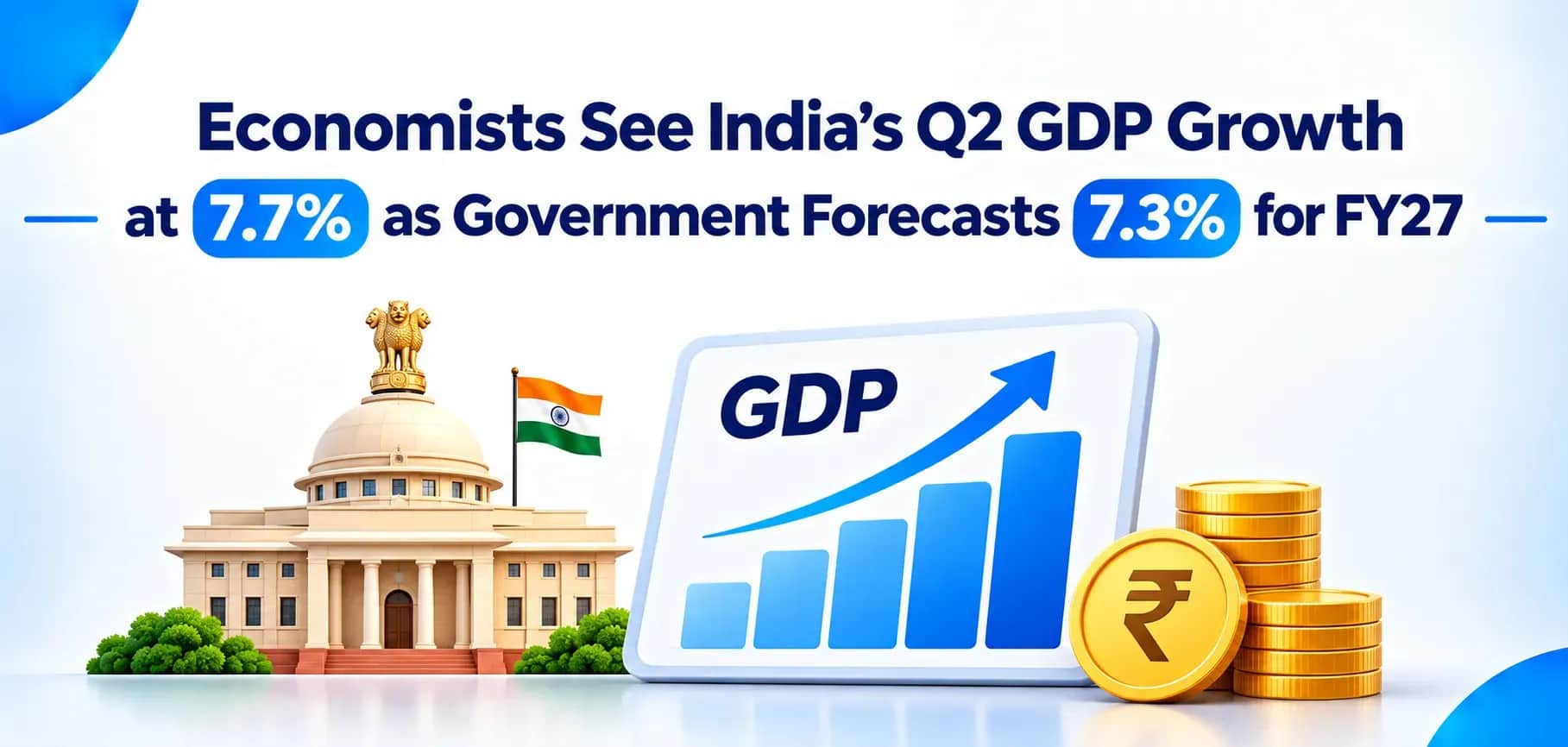
India’s economy likely grew 7.7% year on year in July to September 2026, according to a poll of 10 economists published on 16 November. Household spending held up, manufacturing strengthened and exports climbed despite high crude oil prices and geopolitical uncertainty. The government’s October economic review put growth for the full financial year at 7.3%.
The poll puts the September quarter close to the 7.8% growth recorded in April to June. It also points to a slowdown from the 8.1% expansion in July to September a year earlier. The official release later this month will show how spending, investment and individual sectors contributed to growth.
The economists’ median estimate stands 0.5 percentage points above the Reserve Bank of India’s (RBI) October projection. Ahead of the official GDP release, the Finance Ministry’s October review put its nowcast for real GDP growth in the July–September 2026 quarter at 7.35%, up from 7.3% in its September review. Its calculation drew on early readings on industrial output, energy use, port traffic, Goods and Services Tax (GST) collections and vehicle sales.
The 1.3 percentage point gap between the lowest and highest forecasts leaves room for a surprise when the official data arrive. The September quarter also faces a tougher year-on-year comparison than the June quarter. In FY26, GDP growth picked up from 6.9% in the first quarter to 8.1% in the second.
Read also: Economists See Repo Rate Peaking at 6% as December Hike Looks Likely
Government capital spending and steady consumption helped sustain domestic demand. Industrial production grew faster on average than in the preceding quarter, although the monthly reading eased to 6.7% in September from an initial estimate of 8% in August. Manufacturing output rose 7.6% year on year in September, with motor vehicles and electrical equipment among the main contributors.
The quarterly manufacturing Purchasing Managers’ Index (PMI) was reported at 53.8 and the services reading at 54.5. Both were above 50, the threshold that signals expansion in the surveys. Across roughly 2,300 listed businesses outside banking, financial services and insurance, revenue rose 25% and profit after tax increased 33% from a year earlier.
The trade figures reported alongside the poll showed exports rising 22.8% from a year earlier and imports increasing 13.2%. The increase in overseas sales came as the conflict in West Asia kept crude oil prices elevated and disrupted shipping routes.
The government’s 7.3% FY27 forecast is above the 6.8% to 7.2% range in February’s Economic Survey. The RBI expects the pace to ease through the second half, with growth projected at 6.9% for October to December and 6.8% for January to March. Economists also pointed to tighter monetary conditions, high energy costs and the effects of indirect tax changes on year-on-year comparisons.
A weak monsoon and El Niño could slow farm output growth. Provisional figures for October put retail inflation at 6.09%, up from 5.54% in September, and food inflation at 8.94%. Higher grocery bills leave households with less to spend elsewhere after a quarter in which consumption held up.
The quarterly release will report growth at constant and current prices, with a breakdown of household consumption, government spending, investment and trade. In April to June, real GDP grew 7.8%, while nominal GDP rose 10.3%. Real GDP uses base-year prices to measure changes in output. Nominal GDP uses prices prevailing during the period. The first advance estimate for FY27 as a whole is scheduled for 7 January 2027.
The November poll puts India’s Q2 growth close to its April to June pace, with stronger factory output and exports supporting the estimate. The 30 November release will show how the quarter performed. Higher food and energy prices remain risks to the full-year outlook.
India’s financial year starts in April, making July to September 2026 the second quarter of FY27. The first quarter runs from April to June 2026.
At 7.7%, the figure is the median of 10 economists’ estimates. Official GDP data due 30 November 2026 will cover the July to September quarter.
Yes. The government’s 7.3% forecast covers April 2026 to March 2027. Its separate 7.35% estimate covers July to September 2026, the second quarter of FY27.
Economists use machine learning to find patterns in large datasets. Statistical models can also use recent sales or production figures to estimate growth before publication.
GDP per capita divides national output by population. It gives an average, while household income, its distribution and living costs help explain what families experience.
Start your journey today
Apply Now*T&C apply