By continuing, you agree to LoansJagat's Credit Report Terms of Use, Terms and Conditions, Privacy Policy, and authorize contact via Call, SMS, Email, or WhatsApp
Disclaimer: The information published on LoansJagat is intended for general informational and educational purposes only and should not be considered financial, legal, or investment advice. Interest rates, loan terms, statistics, and other data may change over time and may vary by lender or source. Please verify the latest information and consult a qualified financial advisor or the respective Bank/NBFC before making any financial decisions.
Subscribe Now
About the author

Arshathul Afia
Arshathul Afia is a journalism graduate and fintech content writer with 4+ years of experience in digital publishing and research-led writing. She has written 200+ articles covering personal finance, lending, banking, digital payments, credit, insurance, and major financial developments in India. At LoansJagat, she focuses on simplifying complex fintech news, RBI updates, loan-related changes, policy developments, and industry trends for everyday readers. Her journalism background helps her approach stories with research, context, and clarity, while her SEO experience ensures content remains discoverable and relevant. She aims to make financial news easier to understand, practical, and useful for readers across India.
Related Blog Post
Simplify All Your Loans Into One Affordable EMI

Customers Served

Debt Consolidated

1200+ Reviews

Locations in India
Club all Loans & Credit Card Bills into Single EMI

Quick Apply Loan
Consolidate your debts into one easy EMI.

Takes less than 2 minutes. No paperwork.

10 Lakhs+
Trusted Customers

2000 Cr+
Loans Disbursed

4.7/5
Google Reviews

50+
Banks & NBFCs Offers
Other services mentioned in this article
Chennai ITAT deleted a ₹10 lakh penalty after finding that an employee’s foreign ESOP disclosure lapse was genuine, with related income already taxed in India.
Key Highlights
The Chennai Bench of the Income Tax Appellate Tribunal cancelled a ₹10 lakh Black Money Act penalty imposed on Kishore Kumar Rajagopal for not reporting foreign ESOP shares in his income tax return. The bench pronounced its order on 1 April 2026 after hearing the appeals on 24 March 2026 in Chennai. It found that the ESOP perquisite had faced TDS and that capital gains from the later sale were declared in AY 2019-20.
The ruling can help salaried employees who received shares from foreign parent companies and made a genuine Schedule FA filing error. Yet it does not remove the disclosure duty. In the short term, taxpayers with similar notices may rely on their Form 16, grant records and sale documents. Over a longer period, the order may push tax officers to examine conduct and tax records before raising a fixed penalty.
Indian employees in technology, consulting, manufacturing and financial services often receive ESOPs or restricted stock units from overseas parent companies. Those shares may remain in a foreign brokerage or trustee account. Some employees then assume that no separate disclosure is needed because the employer has already included the taxable perquisite in Form 16. That assumption can bring an income tax notice.
The positive part of the ruling is narrow but useful. A genuine filing lapse does not have to end in an automatic ₹10 lakh penalty when the taxpayer can show a complete tax trail. The employee still needs records. Vesting statements, ESOP grant letters, foreign broker reports, Form 16 entries and capital gains calculations can show that the transaction was reported for tax, even when Schedule FA was missed.
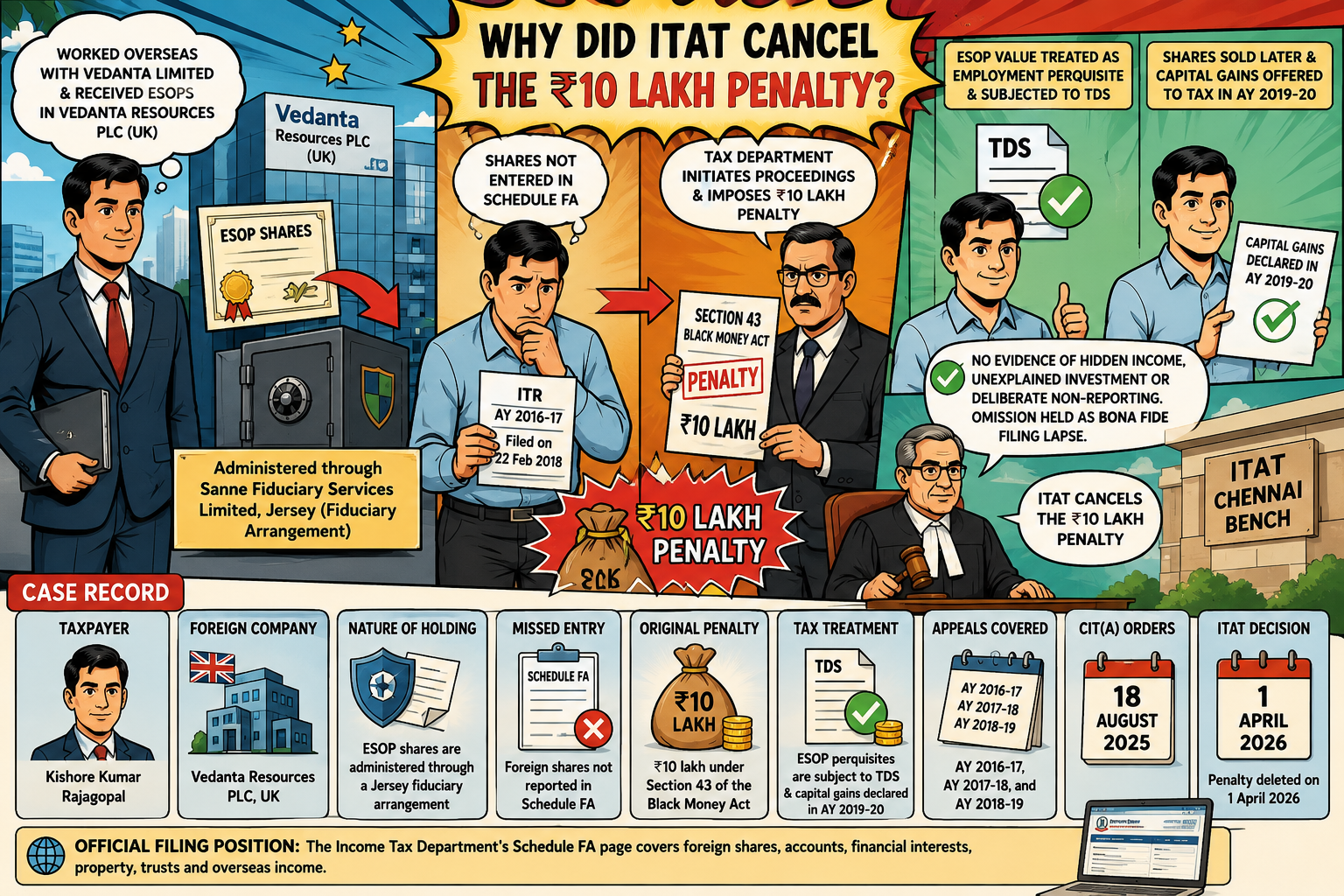
Rajagopal had worked overseas with Vedanta Limited and received ESOPs in Vedanta Resources PLC, its UK-based foreign parent. Sanne Fiduciary Services Limited in Jersey administered the shares through a fiduciary arrangement. He filed his return for AY 2016-17 on 22 February 2018 but did not enter the shares in Schedule FA. The tax department initiated proceedings under Section 43 of the Black Money Act and imposed ₹10 lakh.
The bench found that the foreign shares had not been kept outside the Indian tax record. The ESOP value was treated as an employment perquisite and subjected to TDS. When the employee later sold the shares, he offered the capital gains to tax in AY 2019-20. The tribunal found no evidence of hidden income, unexplained investment or deliberate non-reporting. It called the omission a bona fide filing lapse.
The table below sets out the case record and the filing position that employees should check before submitting their returns.
The official filing rule remains wider than the tax on the ESOP benefit. Schedule FA applies to resident taxpayers who hold, own or have a beneficial interest in a foreign asset or receive income from outside India. It covers equity holdings even when the shares have not been sold. Residents but not ordinarily resident and non-residents generally do not complete this schedule.
The Commissioner of Income Tax (Appeals), Chennai-18, had upheld the penalties through 3 orders dated 18 August 2025. Rajagopal then approached ITAT through BMA Nos. 16, 17 and 18/CHNY/2025. His representative argued that the omission occurred during the initial period of foreign asset reporting and that the fiduciary holding structure created uncertainty around the entry.
A previous Chennai ITAT ruling had already offered relief in a similar ESOP dispute. In Vasanthan Jayaraman v. Addl. CIT, decided on 8 September 2025, the bench deleted the penalty after finding that the perquisite had appeared in Form 16 and tax had been paid on the later sale. Rajagopal’s representative relied on that order before the tribunal.
Another major development came from the Mumbai ITAT Special Bench in Vinil Venugopal v. DDIT (Investigation) and Ranjeeta Vinil v. DDIT (Investigation). On 14 October 2025, the Special Bench held that the word “may” in Section 43 gives the assessing officer discretion. It rejected the view that every missed foreign asset entry must produce a penalty.
Government policy had also started moving towards proportionate treatment for smaller overseas holdings. The Union Budget 2024 memorandum, released on 23 July 2024, recorded concerns that the fixed penalty could exceed the value of a small foreign asset. The amendment provided an exception for non-immovable foreign assets with an aggregate value of up to ₹20 lakh from 1 October 2024. That later relief did not affect Rajagopal’s older assessment years.
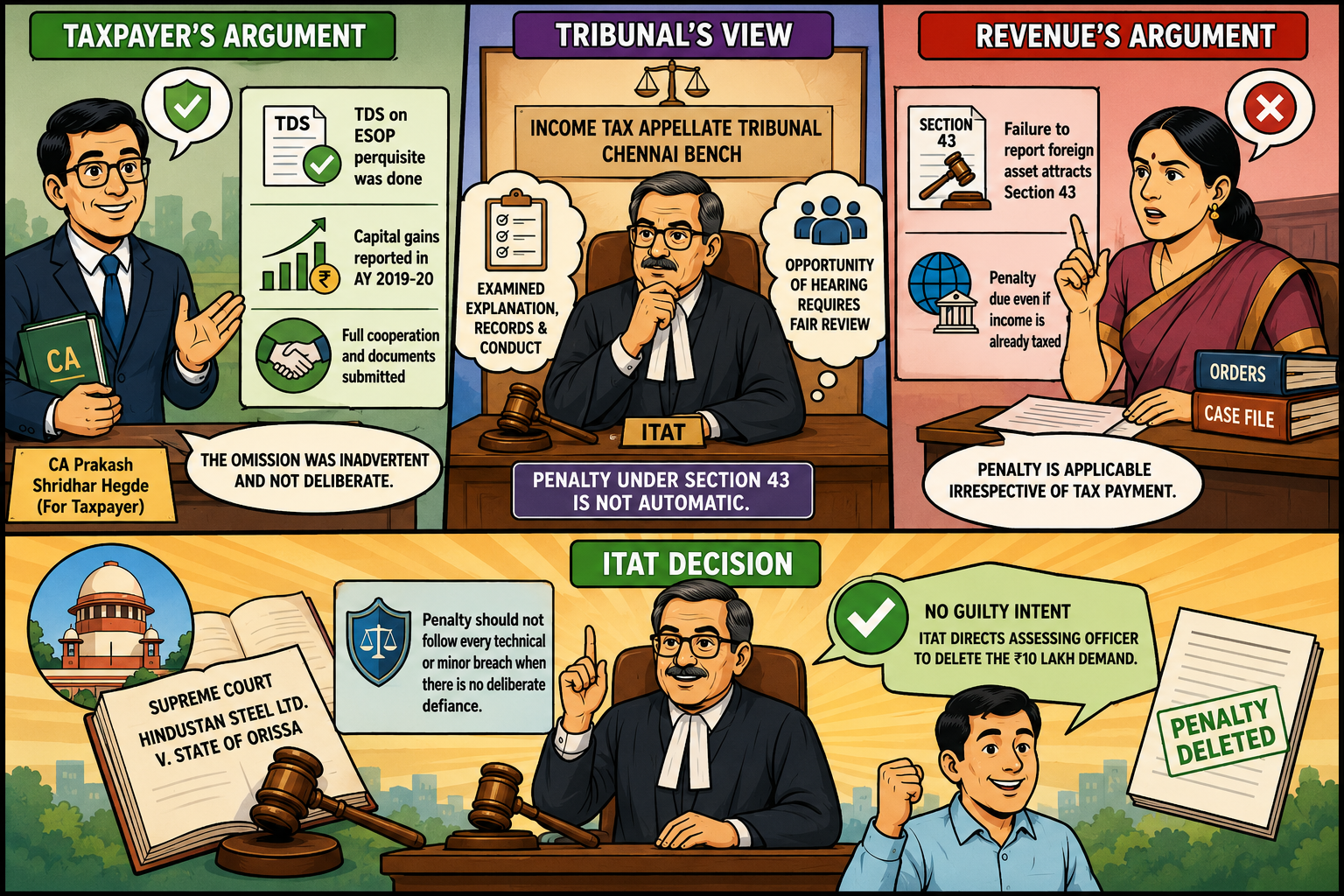
Chartered accountant Prakash Shridhar Hegde, appearing for Rajagopal, told the bench that the omission was inadvertent. He pointed to TDS on the ESOP perquisite, capital gains reported in AY 2019-20 and the employee’s cooperation during the proceedings. His submission was supported by the return and tax documents placed before the ITAT.
R. Anitha, Additional Commissioner of Income Tax, represented the revenue. She supported the earlier orders and argued that failure to report a foreign asset attracted Section 43 regardless of whether its income had already been taxed. The tribunal disagreed with an automatic approach. It found that an opportunity of hearing under the Act requires the officer to examine the taxpayer’s explanation, records and conduct.
The bench also relied on the Supreme Court’s decision in Hindustan Steel Ltd. v. State of Orissa. That judgment held that a penalty should not follow every technical or minor breach, particularly where there is no deliberate defiance. In Rajagopal’s case, ITAT found no guilty intent and directed the assessing officer to delete the ₹10 lakh demand.
The sharper lesson for salaried taxpayers is that Form 16 and Schedule FA perform 2 different jobs. Form 16 can show tax on the employment benefit. Schedule FA tells the department that a foreign asset exists. Reporting the perquisite under salary does not replace the foreign asset entry, and declaring capital gains after a sale does not repair every earlier omission.
Before filing, an employee should confirm residential status and collect the company name, country, vesting date, acquisition value, peak value, closing value, sale proceeds and custodian details. The return form also needs attention. A LoansJagat ITR Filing 2026 guide notes that overseas shares or foreign income may change the form a salaried taxpayer needs, even when salary remains the main source.
From a taxpayer-facing view, the order creates a defence, not immunity. A person who discovers an older lapse should gather records and seek correction before a notice arrives. Repeated omissions, missing foreign income or weak documents may produce the opposite outcome. The ₹10 lakh relief came because Rajagopal’s full transaction had entered the tax system and his explanation matched the records.
The Chennai ITAT ruling protects a taxpayer whose foreign ESOP income was taxed and whose Schedule FA omission was supported by a bona fide explanation. It does not make foreign asset reporting optional. That line remains firm.
Employees with shares in an overseas parent company should check Schedule FA before filing, even when payroll has already deducted tax. For older mistakes, early correction and complete paperwork offer a stronger route than waiting for a ₹10 lakh notice.
Is foreign ESOP disclosure mandatory in ITR?
Resident taxpayers generally need to report foreign ESOP shares in Schedule FA, even when the shares remain unsold.
Does Form 16 reporting complete the ESOP disclosure?
No. Form 16 may report the taxable perquisite, while Schedule FA separately reports the foreign shareholding.
Is the ₹10 lakh section 43 penalty automatic?
The Mumbai ITAT Special Bench held that the penalty is discretionary. Tax officers must review the facts before imposing it.
Can every taxpayer use this ITAT ruling?
No. Relief depends on the tax trail, filing history, documents and whether the omission was genuine.
What records should an employee keep?
Employees should retain grant letters, vesting statements, foreign broker records, Form 16, sale statements and capital gains calculations.









.png&w=3840&q=75)


