
By continuing, you agree to LoansJagat's Credit Report Terms of Use, Terms and Conditions, Privacy Policy, and authorize contact via Call, SMS, Email, or WhatsApp
Disclaimer: The information published on LoansJagat is intended for general informational and educational purposes only and should not be considered financial, legal, or investment advice. Interest rates, loan terms, statistics, and other data may change over time and may vary by lender or source. Please verify the latest information and consult a qualified financial advisor or the respective Bank/NBFC before making any financial decisions.
Subscribe Now
About the author

Arshathul Afia
Arshathul Afia is a journalism graduate and fintech content writer with 4+ years of experience in digital publishing and research-led writing. She has written 200+ articles covering personal finance, lending, banking, digital payments, credit, insurance, and major financial developments in India. At LoansJagat, she focuses on simplifying complex fintech news, RBI updates, loan-related changes, policy developments, and industry trends for everyday readers. Her journalism background helps her approach stories with research, context, and clarity, while her SEO experience ensures content remains discoverable and relevant. She aims to make financial news easier to understand, practical, and useful for readers across India.
Related News
Simplify All Your Loans Into One Affordable EMI

Customers Served

Debt Consolidated

1200+ Reviews

Locations in India
Club all Loans & Credit Card Bills into Single EMI

Quick Apply Loan
Consolidate your debts into one easy EMI.

Takes less than 2 minutes. No paperwork.

10 Lakhs+
Trusted Customers

2000 Cr+
Loans Disbursed

4.7/5
Google Reviews

50+
Banks & NBFCs Offers
ITAT Mumbai has deleted ₹20.39 lakh in tax additions after accepting that disputed cash deposits and credit card spending were linked to Section 44AD income.
The Income Tax Appellate Tribunal, Mumbai, has given relief to Rina Radha Madhab Jena, who ran a manpower consultancy and recruitment business, in a dispute over cash deposits and credit card payments for AY 2023-24. On September 4, 2026, the tribunal deleted additions totalling ₹20,39,312. The Assessing Officer had treated ₹10,24,000 as unexplained money under Section 69A and ₹10,15,312 as unexplained expenditure under Section 69C. Jena had reported ₹52,01,836 as turnover under Section 44AD, and ITAT found no material showing that the disputed business-linked amounts came from a separate undisclosed source.
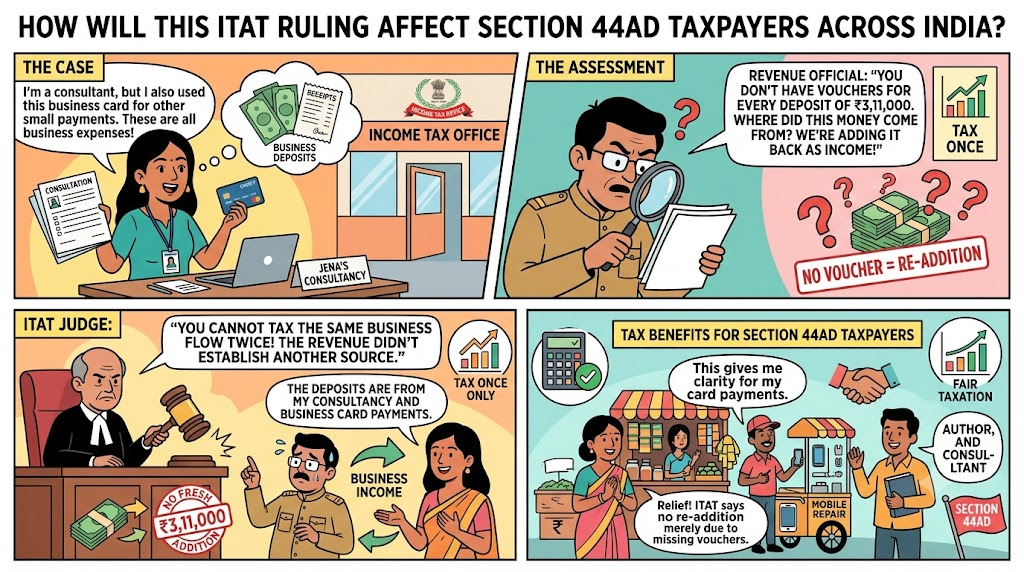
For small traders and service businesses, the useful part is ITAT's refusal to tax the same business flow twice. Jena said ₹3,11,000 of the questioned deposits came from her consultancy and the card payments were tied to business activity. The Revenue did not establish another source. ITAT therefore refused a fresh addition merely because every voucher was unavailable.
Basic records still help. Bank statements, customer receipt details, card statements and a simple cash reconciliation can become important once scrutiny starts. The Income Tax Department currently describes Section 44AD as a presumptive scheme for eligible resident individuals, HUFs and partnership firms other than LLPs. It also states that the turnover ceiling can rise to ₹3 crore where cash receipts do not exceed 5% of total receipts, while the regular ceiling is ₹2 crore.
CA Vijayakumar Shetty, who analysed the September 4 order after its release, cautioned against treating Section 44AD as blanket protection from Sections 69A and 69C. His reading focuses on a credible connection with the disclosed business and the absence of evidence showing another undisclosed source. That is also the practical limit of this ruling. A genuine business trail receives support. Unexplained cash does not become protected merely because a taxpayer later calls it turnover.
There is a financial reason to keep that trail. LoansJagat's Section 115BBE explainer notes that unexplained income covered by Sections 68 to 69D can face tax at 60%, apart from surcharge and cess. For a small business, classification can carry a high cost. Separating personal and business spending, reconciling unusual deposits, and retaining proof for joint-account money can reduce the scope for a similar dispute.
Jena filed her return declaring total income of ₹11,78,580. Her case was selected under Computer-Assisted Scrutiny Selection for “Large cash payments made for credit card purchases (Business ITR)”. The AO examined cash deposits and payments towards credit card bills. After making the 2 additions, the assessment completed on February 25, 2025, put her total income at ₹32,17,892.
For the ₹10,24,000 cash deposit issue, Jena said ₹3,11,000 came from her manpower consultancy. She said the remaining ₹7,13,000 went into a joint overdraft account with her husband, the primary account holder, and belonged to him. For the card dispute, the AO treated ₹10,15,312 as unexplained expenditure. Jena said the customer cash-funded business expenses paid through the cards. Her representative also said actual cash deposited towards the card payments was ₹7,20,500, while the AO used ₹10,15,312. Bank details and credit card statements were placed before the authorities.
The dispute then moved through the following stages:
The dispute turned on source rather than cash alone. Section 69A deals with unexplained money, while Section 69C covers expenditure whose source is not satisfactorily explained. The provisions are available through India Code, the Government of India's official repository for central laws.
ITAT accepted that ₹3,11,000 had been explained as part of Jena's own business receipts. Her Section 44AD turnover was already offered and remained undisputed. Without material showing that the money came from outside the disclosed business, the tribunal found no basis to tax the same amount again under Section 69A.
The ₹7,13,000 had another explanation. Jena said it belonged to her husband and was deposited in their joint overdraft account. After considering the bank material, the ITAT accepted that position and removed the entire ₹10,24,000 Section 69A addition.
For Section 69C, the bench looked at how presumptive taxation works. Once eligible business profit is computed under Section 44AD, normal business expenditure is already absorbed in that computation. ITAT held that business-linked spending cannot ordinarily be added again only because individual bills are missing, unless the department shows an independent unexplained source.
One technical point remains. The order records that Jena offered profit at 6% on ₹52,01,836, although her explanation also referred to some cash receipts. ITAT was not deciding whether all turnover qualified for the 6% rate. Its decision concerned Sections 69A and 69C, so the order should not be read as allowing every cash receipt to be taxed at 6%.
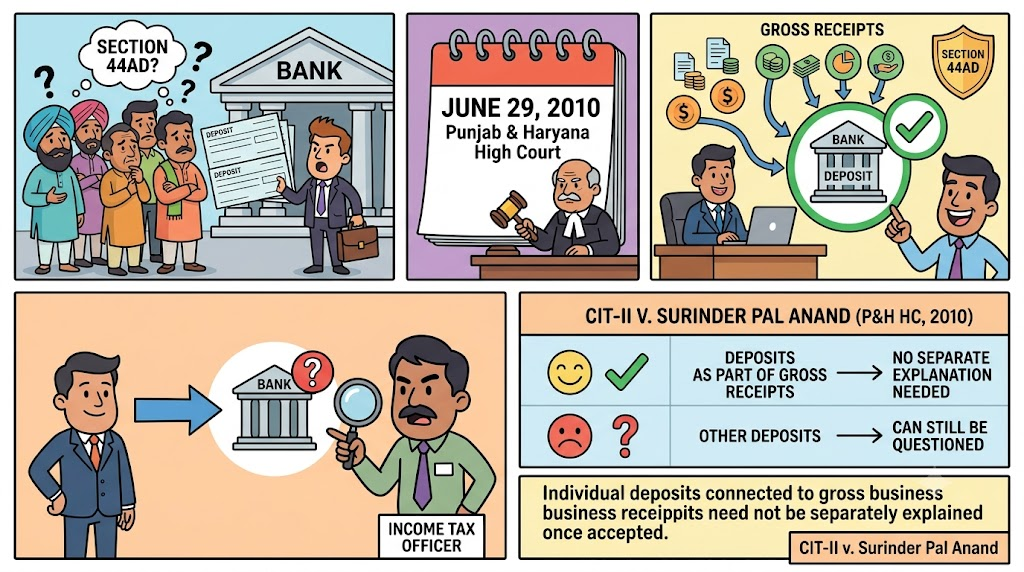
The main precedent was CIT-II v. Surinder Pal Anand, decided by the Punjab and Haryana High Court on June 29, 2010. The High Court held that individual deposits need not be separately explained once accepted as connected with gross business receipts. Deposits without that connection can still be questioned.
A more recent ruling came from Hyderabad ITAT on July 3, 2026 in Amit Dokwal v. ITO. The bench said a Section 44AD return alone does not free a taxpayer from showing that receipts relate to business. Once the AO accepted ₹42.40 lakh as turnover, however, ITAT deleted the separate Section 69A addition. Jena's case follows that approach: establish the business link first.
Jena's authorised representative said the questioned cash and card spending belonged to the manpower consultancy, apart from ₹7,13,000 attributed to her husband. The representative relied on Section 44AD, bank and card documents, and the Surinder Pal Anand judgment. The argument was that business amounts already reflected in presumptive income should not be taxed a second time.
Revenue defended the additions and questioned whether the transactions had been adequately established as business-related. That objection remains important for other taxpayers. Cash does not become business turnover merely because it is described that way during assessment. Someone relying on the Jena ruling still needs enough surrounding evidence to connect the money with the stated business.
The September 4, 2026 ruling gives Section 44AD taxpayers a useful defence against duplicate additions, but facts still decide the outcome. Jena could point to declared turnover, business cash, card statements and joint-account material, while the Revenue did not establish another undisclosed source for the amounts ITAT accepted.
For small businesses, the lesson is practical. Presumptive taxation reduces routine accounting work, yet unusual cash still needs a believable trail. A basic reconciliation kept before scrutiny begins can make a real difference when a bank deposit or credit card repayment appears in tax data.
Yes. The department can ask for the source. Relief becomes stronger when the deposit is shown to form part of turnover already disclosed and accepted under Section 44AD.
No. Detailed books may not be required in the usual way, but supporting records can still be needed to show that questioned receipts actually came from the business.
No. A cash card payment is not automatically an income-tax violation. The source of the money is what becomes important during scrutiny.
Rule 114E requires card issuers to report aggregate cash payments of ₹1 lakh or more in a financial year against one or more credit card bills. Reporting alone does not make the payment taxable.
No. ITAT relied on the business connection and the absence of material pointing to another unexplained source. Different facts can lead to another result.









.png&w=3840&q=75)


