

By continuing, you agree to LoansJagat's Credit Report Terms of Use, Terms and Conditions, Privacy Policy, and authorize contact via Call, SMS, Email, or WhatsApp
Disclaimer: The information published on LoansJagat is intended for general informational and educational purposes only and should not be considered financial, legal, or investment advice. Interest rates, loan terms, statistics, and other data may change over time and may vary by lender or source. Please verify the latest information and consult a qualified financial advisor or the respective Bank/NBFC before making any financial decisions.
Subscribe Now
About the author

Arshathul Afia
Arshathul Afia is a journalism graduate and fintech content writer with 4+ years of experience in digital publishing and research-led writing. She has written 200+ articles covering personal finance, lending, banking, digital payments, credit, insurance, and major financial developments in India. At LoansJagat, she focuses on simplifying complex fintech news, RBI updates, loan-related changes, policy developments, and industry trends for everyday readers. Her journalism background helps her approach stories with research, context, and clarity, while her SEO experience ensures content remains discoverable and relevant. She aims to make financial news easier to understand, practical, and useful for readers across India.
Related News
Simplify All Your Loans Into One Affordable EMI

Customers Served

Debt Consolidated

1200+ Reviews

Locations in India
Club all Loans & Credit Card Bills into Single EMI

Quick Apply Loan
Consolidate your debts into one easy EMI.

Takes less than 2 minutes. No paperwork.

10 Lakhs+
Trusted Customers

2000 Cr+
Loans Disbursed

4.7/5
Google Reviews

50+
Banks & NBFCs Offers
ITAT Jaipur cancelled a ₹8.29 lakh penalty after accepting that an employee’s missed ITR following his overseas job move was genuinely inadvertent and fully explained.
The Jaipur Bench of the Income Tax Appellate Tribunal cancelled a ₹8,29,034 penalty against Abhishubham Bahadur Saxena on August 17, 2026. According to the tribunal order, Saxena missed his Indian return after relocating to the US for employment in August 2018. The bench accepted that the failure was an unintended filing lapse, backed by his past compliance and voluntary tax payment.
The ruling gives Saxena immediate relief from the penalty, though it does not cancel the tax, interest or late fee he had already paid. For other Indians moving overseas, the result offers a possible defence when a genuine disruption causes non-filing. The negative side remains serious. A person who cannot prove voluntary action and complete disclosure may still face a steep penalty under the under-reporting rules.
The ruling could help employees who miss a return during an overseas transfer, medical emergency, employment change or another documented disruption. ITAT did not treat Saxena’s US relocation as an exemption. Instead, it studied what he did before and after the missed deadline. That distinction is important for every taxpayer.
Saxena had filed returns regularly in earlier years. When he discovered the omission, he paid his dues before the department began reassessment. The officer later accepted the income shown in his Section 148 return without adding another rupee. Together, those events supported his claim that the lapse came from disruption rather than an attempt to hide salary.
Indians living abroad cannot assume that an overseas address ends Indian tax duties. Their residential status, days spent in India, Indian income, capital gains, rental earnings and bank interest can affect filing requirements. The official non-resident taxpayer guidance states that income taxable in India may still require an Indian return.
The order may also discourage tax officers from treating every missing return as deliberate misreporting. Section 270A itself allows relief where an assessee gives a bona fide explanation and submits all supporting facts. Still, another taxpayer cannot expect the same result without payment records, filing history and correspondence.
Chartered accountant Suresh Surana explained that Saxena’s income could technically fall within Section 270A(2)(b). The provision covers a case where no original return exists and the taxpayer reports income for the first time after receiving a Section 148 notice. That gave the department a legal starting point for under-reporting proceedings.
Surana also pointed to Section 270A(6)(a). It removes an amount from under-reported income when the taxpayer offers a bona fide explanation and discloses the material facts supporting it. Saxena’s payment on August 23, 2019 came before the reopening notice dated March 16, 2022. That gap strongly supported his version.
Chartered accountant Jitendra Agarwal represented Saxena before the tribunal. The taxpayer’s submission stated that he moved to the US for a new role, faced a demanding joining schedule and lacked familiarity with the belated-return procedure. He also maintained that he never intended to reduce his tax liability.
LoansJagat has separately covered filing errors that may lead to tax notices. From a LoansJagat taxpayer perspective, the strongest point in this case was the sequence of conduct, not the overseas relocation by itself. Saxena noticed the error, paid the admitted amount and kept records long before the department contacted him.
The safer response to a missed return is therefore quick action. A taxpayer should check Form 16, Form 26AS, the Annual Information Statement, bank interest, capital gains and tax challans. If a filing option remains available, the person should use it instead of waiting for a notice.
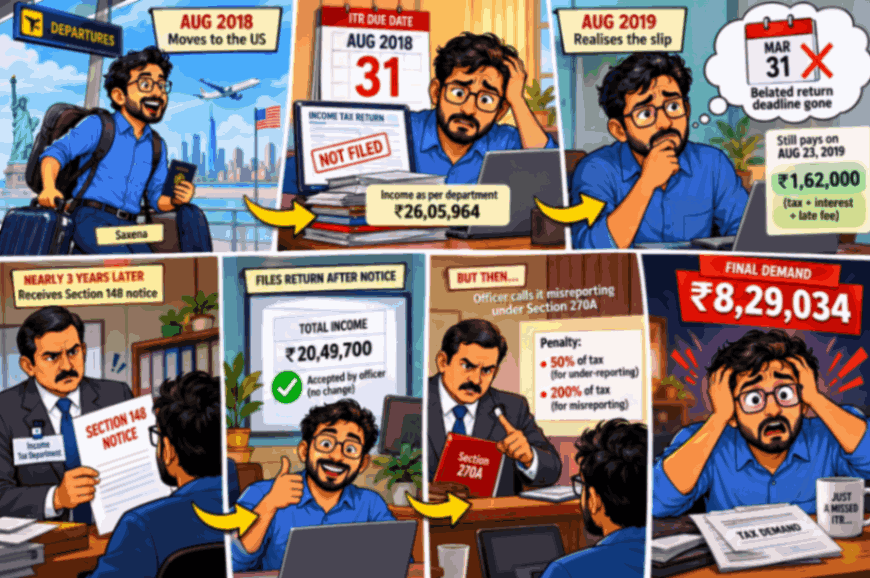
August 2018 brought Saxena a move to the US and an Indian tax deadline. His ITR for AY 2018–19 was due on August 31. Department records showed ₹26,05,964 in salary income, but he did not file the return.
He noticed the slip in August 2019. By then, the March 31 deadline for a belated return had gone. Saxena still paid about ₹1.62 lakh towards tax, interest and the late fee on August 23, 2019.
The tax department approached him nearly 3 years later. After receiving a Section 148 notice, he filed a return showing ₹20,49,700 as total income. The officer accepted that amount without changing it.
The case did not stop there. The officer called the disclosure misreporting under Section 270A. That provision sets the penalty at 50% of the tax for under-reporting and 200% when misreporting is involved. The second rate resulted in a ₹8,29,034 demand.
Several proceedings took place before Saxena received relief. The chronology also shows why ITAT gave weight to his voluntary payment.
Saxena also filed his ITAT appeal late. His PAN details incorrectly placed his tax jurisdiction in Kanpur, although Jaipur had handled his returns for several years. He applied for a PAN address correction on January 8, 2026 and requested a transfer after the update appeared.
The portal changed his jurisdiction only on March 18, 2026. Saxena had already paid the appeal fee within the prescribed period and sent repeated reminders about the transfer. The department’s representative opposed condonation and argued that the delay showed laxity.
ITAT rejected that objection. It recorded a delay of 49 days, found that the portal problem remained outside Saxena’s direct control and admitted the appeal. This procedural relief allowed the bench to examine the penalty itself.

The bench accepted that the officer had technically read Section 270A(2)(b) correctly. Income disclosed for the first time through a Section 148 return can qualify as under-reported income when no original return exists.
However, the enquiry did not stop there. Section 270A(6)(a) excludes income when the taxpayer gives a bona fide explanation and discloses the supporting facts. The bench found both conditions in Saxena’s case.
His earlier returns showed regular compliance. He paid the tax, interest and late fee before the department detected the failure. The assessment also accepted his returned income without alteration. ITAT therefore removed the amount from the under-reporting category.
Once under-reporting failed, the connected misreporting allegation also collapsed. The bench ordered deletion of the complete ₹8,29,034 penalty. This was full relief from the penalty alone, not a cancellation of his original tax liability.
The order currently favours Saxena, though the department can approach a High Court if it raises a substantial question of law. The official tribunal guidance explains this limited route for challenging an ITAT decision.
The Jaipur ruling shows how early voluntary action can change a penalty dispute. Saxena did more than offer a verbal explanation. His previous filing record, payment date, tax challan and accepted return backed his position.
A taxpayer who discovers an omitted return should act before a notice arrives. Depending on the assessment year and eligibility rules, a belated or updated return may remain available. The official updated-return guidance allows eligible taxpayers to report omitted income within the prescribed period, subject to restrictions and additional tax.
The decision does not excuse careless filing. It does show that Section 270A cannot ignore credible facts when the taxpayer has already paid the liability and disclosed the income.
The department imposed ₹8,29,034 under Section 270A after classifying his first disclosure through a Section 148 return as misreporting of income.
No. ITAT deleted only the ₹8.29 lakh penalty. His self-assessment tax, applicable interest and Section 234F late fee remained paid.
Not automatically. Residential status and taxable Indian income decide the filing requirement. Indian rent, capital gains, interest or business income may still require a return.
Relief depends on the facts. Payment before departmental action, full disclosure, earlier compliance and a documented reason can support a bona fide explanation under Section 270A(6)(a).
No. A taxpayer should check available filing routes and pay admitted dues quickly. Waiting can weaken a later claim that the omission was voluntary and accidental.









.png&w=3840&q=75)


