
By continuing, you agree to LoansJagat's Credit Report Terms of Use, Terms and Conditions, Privacy Policy, and authorize contact via Call, SMS, Email, or WhatsApp
Disclaimer: The information published on LoansJagat is intended for general informational and educational purposes only and should not be considered financial, legal, or investment advice. Interest rates, loan terms, statistics, and other data may change over time and may vary by lender or source. Please verify the latest information and consult a qualified financial advisor or the respective Bank/NBFC before making any financial decisions.
Subscribe Now
About the author

Arshathul Afia
Arshathul Afia is a journalism graduate and fintech content writer with 4+ years of experience in digital publishing and research-led writing. She has written 200+ articles covering personal finance, lending, banking, digital payments, credit, insurance, and major financial developments in India. At LoansJagat, she focuses on simplifying complex fintech news, RBI updates, loan-related changes, policy developments, and industry trends for everyday readers. Her journalism background helps her approach stories with research, context, and clarity, while her SEO experience ensures content remains discoverable and relevant. She aims to make financial news easier to understand, practical, and useful for readers across India.
Related Blog Post
Simplify All Your Loans Into One Affordable EMI

Customers Served

Debt Consolidated

1200+ Reviews

Locations in India
Club all Loans & Credit Card Bills into Single EMI

Quick Apply Loan
Consolidate your debts into one easy EMI.

Takes less than 2 minutes. No paperwork.

10 Lakhs+
Trusted Customers

2000 Cr+
Loans Disbursed

4.7/5
Google Reviews

50+
Banks & NBFCs Offers
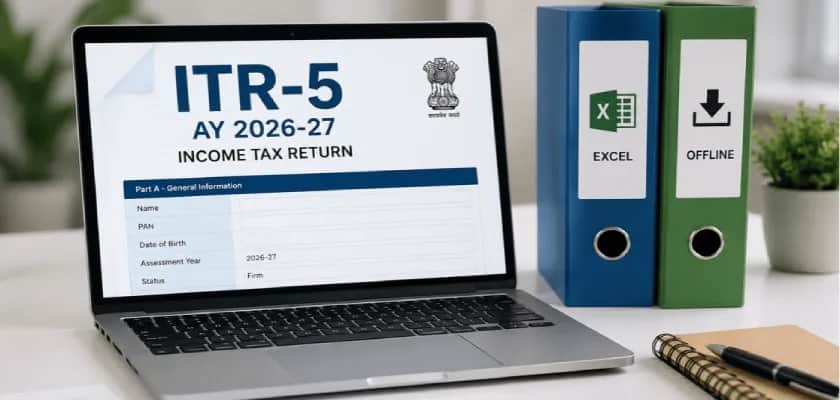
From August, the Income Tax Department began providing eligible entities with additional options to online filing, with the release of the updated ITR-5 utility, including the ability to file ITR-5 in Excel and offline versions for AY 2026-27.
The Income Tax Department has released the latest offline and Excel-based ITR-5 utilities for Assessment Year 2026-27. The standalone Windows and Mac applications became available on 7 August 2026. The Excel utility was also updated to Version 1.3 that day. In the short term, firms, LLPs and other eligible entities now have more ways to prepare their returns.
The rollout should make return preparation easier over the longer period, particularly for entities with large accounting records and several tax schedules. Still, downloading the wrong version can create trouble. Old utilities, unmatched tax credits, incomplete audit details or an incorrect return form may lead to validation errors, defective-return notices and delayed processing.
Standalone ITR-5 Utility Version 1.0.0 for both Windows and Mac was released by the department on 7 August 2026. With this, an entity can enter and validate return information on a computer before uploading the completed file on the e-filing portal.
Excel Version 1.3 was released on 7 August 2026 as well. The first version of the Excel utility was released on 7 July, and now the updated version should be used. Macros have to be enabled on Microsoft Excel 2016 or later licensed versions. A firm working from an older version of the utility may have to transfer or import the data to the latest utility and can no longer upload the older version.
Online filing provides another option. The department opened it on 5 August 2026, allowing eligible entities to prepare ITR-5 within their e-filing accounts. A smaller firm with fewer schedules may prefer that route. An LLP with several partners, multiple business activities and lengthy financial statements may find an offline application easier to manage.
The wider choice helps tax professionals divide return preparation into smaller checks. A partnership firm can first verify turnover and expenses, then review partner remuneration, interest, capital gains, deductions and tax credits. It need not complete every schedule during one portal session.
The benefit also reaches partners. Salary, remuneration, interest and profit shares reported by a firm may enter the partners’ individual returns. An incorrect entry at the firm level can therefore travel into several personal filings. Early preparation gives the firm and its partners time to compare those figures before submission.
LoansJagat’s analysis points to another practical result. A filed return often supports business-loan applications, partner-level borrowing and financial verification. The software itself cannot improve a firm’s loan eligibility, but complete income and bank records can prevent gaps during assessment. Its AY 2026-27 bank-account review also explains why AIS, Form 26AS, bank statements and interest records should be compared before filing.
A successful upload does not finish the filing process. The authorised person must verify the return through the prescribed method. An unverified return may remain invalid even where the financial information was entered correctly.
CBDT notified the form through Notification No. 48/2026 on the Income Tax Department website. The notification, dated 30 March 2026, was issued as G.S.R. 229(E) under Sections 139 and 295 of the Income-tax Act, 1961.
The following table separates the main eligible and excluded categories. It has 2 columns because eligibility depends on legal status as well as the return provision covering that entity.
A trust should check its governing section before downloading the utility. Political parties, charitable or religious trusts and specified institutions covered by ITR-7 provisions must use ITR-7. Availability of the ITR-5 software does not change that legal requirement.
Pranav Sai S, Tax Expert at ClearTax, told Business Standard on 18 May 2026 that taxpayers should download the correct AY 2026-27 utility and confirm form eligibility before entering information. His advice concerned the wider return-filing process, but it applies directly to firms and LLPs using ITR-5.
Sudhir Kaushik, co-founder and chief executive officer of Taxspanner, advised filers to reconcile PAN, bank particulars, AIS and TDS information before generating an upload file. For ITR-5, that review should extend to the balance sheet, profit and loss account, partner details, tax-audit information and deductions.
The practical fix begins before opening the utility. An entity should finalise its FY 2025-26 books, collect audit reports where required and compare tax credits with Form 26AS. AIS entries should be checked against the entity’s own documents rather than accepted without review.
Validation comes next. Each error needs individual attention because some warnings indicate missing information, while others point to a calculation or format problem. Filers should avoid changing a correct financial figure merely to remove a software message. Where the reason is uncertain, a qualified tax professional should review the affected schedule.
The AY 2026-27 form was applied for the first time by the CBDT on March 30, 2026. Amendment 48 of the 2026 Income Tax Rules published a modification effective March 31, 2026.
A second update was released on April 10. To amend a malfunctioning aggregation formula within Schedule CG and the internal references of Schedule UD, the CBDT issued a corrigendum No. 60/2026. These updates established the proper pathway for the form calculations. They also did not create any additional tax liability.
The department released ITR-5 Validation Rules Version 1.0 on 7 July 2026. The first Excel utility and JSON schema appeared on the same date. Those files allowed software providers, tax professionals and entities to begin testing their return data.
On 5 August, the department updated the JSON schema and enabled online filing. The Windows and Mac applications arrived 2 days later. Excel Version 1.3 completed the latest stage of the rollout on 7 August.
The Income Tax Department announced each filing route separately. It confirmed the first Excel utility on 7 July, the online facility on 5 August and the standalone offline applications on 7 August. The dates show a phased technical release rather than a single launch.
Tax specialists have concentrated on accurate preparation. Their advice covers correct form selection, current utility versions, financial-statement matching and prompt verification. That approach addresses the most likely source of filing trouble, which is inconsistent data moving between books, tax statements and the return.
LoansJagat’s view is that filers should use the extra preparation routes to check records earlier. Waiting until the final filing week reduces the time available to correct a missing TDS entry, an invalid bank account or a partner-level mismatch.
The latest ITR-5 release gives eligible entities 3 preparation choices for AY 2026-27. Windows and Mac Utility Version 1.0.0 and Excel Version 1.3 became available on 7 August 2026, following online filing on 5 August.
Firms, LLPs and other covered entities can now begin filing through their preferred route. The final return still depends on correct books, complete schedules, reconciled tax records and valid verification. Software choice helps with preparation. It cannot repair incorrect financial information.
ITR-5 covers firms, LLPs, AOPs, BOIs, cooperative societies and certain trusts. An entity required to submit ITR-7 cannot switch to ITR-5.
Yes. A filer may save the work, return to the unfinished schedules and validate them later. The completed file must still be uploaded and verified.
No. A non-audit business case generally has until 31 August 2026. Tax audit and specified transfer-pricing cases follow later dates.
The conversion changes the filing position. Since an LLP cannot use ITR-4, the entity should examine ITR-5 and report the change with the correct period details.
Using the older file may produce validation or upload errors. The safer route is to download Version 1.3 and move the checked figures into it.








.png&w=3840&q=75)


