
By continuing, you agree to LoansJagat's Credit Report Terms of Use, Terms and Conditions, Privacy Policy, and authorize contact via Call, SMS, Email, or WhatsApp
Disclaimer: The information published on LoansJagat is intended for general informational and educational purposes only and should not be considered financial, legal, or investment advice. Interest rates, loan terms, statistics, and other data may change over time and may vary by lender or source. Please verify the latest information and consult a qualified financial advisor or the respective Bank/NBFC before making any financial decisions.
Subscribe Now
About the author

Arshathul Afia
Arshathul Afia is a journalism graduate and fintech content writer with 4+ years of experience in digital publishing and research-led writing. She has written 200+ articles covering personal finance, lending, banking, digital payments, credit, insurance, and major financial developments in India. At LoansJagat, she focuses on simplifying complex fintech news, RBI updates, loan-related changes, policy developments, and industry trends for everyday readers. Her journalism background helps her approach stories with research, context, and clarity, while her SEO experience ensures content remains discoverable and relevant. She aims to make financial news easier to understand, practical, and useful for readers across India.
Related News
Simplify All Your Loans Into One Affordable EMI

Customers Served

Debt Consolidated

1200+ Reviews

Locations in India
Club all Loans & Credit Card Bills into Single EMI

Quick Apply Loan
Consolidate your debts into one easy EMI.

Takes less than 2 minutes. No paperwork.

10 Lakhs+
Trusted Customers

2000 Cr+
Loans Disbursed

4.7/5
Google Reviews

50+
Banks & NBFCs Offers
Other services mentioned in this article
The filing deadlines for ITR Refund 2026 start with small filing gaps for TDS, AIS, deductions, and bank details that do not match the tax records.
Key Highlights
ITR Refund 2026 is now under closer post-filing review for taxpayers across India. The main issue is simple. A refund may get delayed, reduced or questioned if the taxpayer’s ITR does not match official tax records. The people involved are individual taxpayers, employers, banks, tax deductors and the Income Tax Department. The concern has become stronger after the 31 July 2026 filing deadline for many salaried individuals and other non-audit taxpayers.
The Income Tax Department claims refunds will only be processed after the filed returns are electronically verified. Refund credit can take 4-5 weeks. The periodic processing of an improper return and an unresolved mismatch can obstruct processing loans, visas, employment documents, and financial records.
A refund is not released only because the ITR utility shows an amount payable to the taxpayer. The department first checks whether the claim stands with the data available on the portal. That includes Form 26AS, AIS, TIS, TDS returns filed by employers, TCS records, self-assessment tax challans, bank-reported interest and other third-party information.
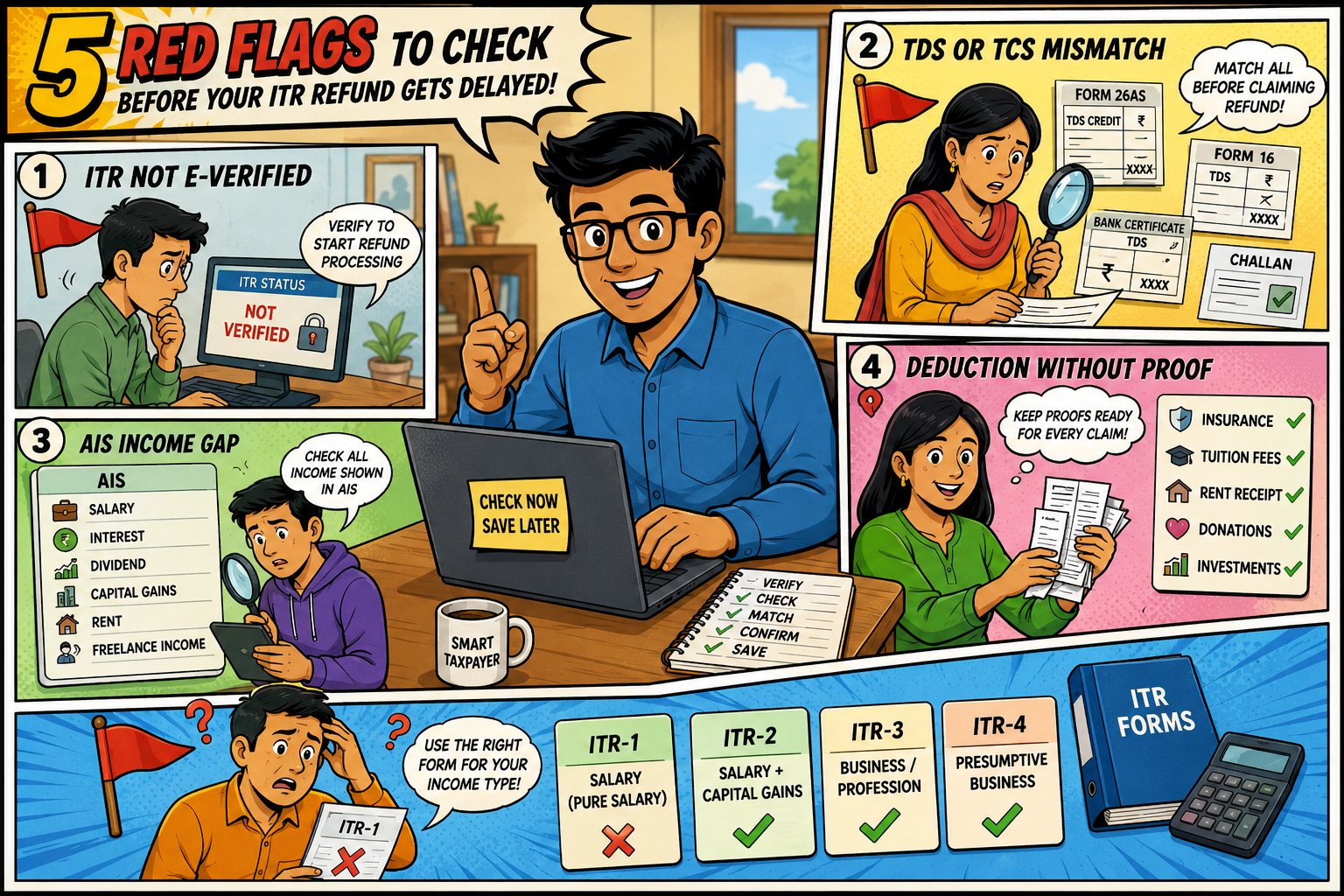
The first red flag is a return that was filed but not e-verified. Many taxpayers submit the ITR and then forget the last step. Without e-verification, the department does not start normal refund processing. The taxpayer may keep checking the bank account, while the return itself remains unfinished on the portal.
The second red flag is a mismatch in TDS or TCS credit. The Income Tax Department says the tax credit claimed in the ITR is restricted to the amount reflected in Form 26AS. This can create trouble when an employer has not correctly filed TDS details, a bank has not reported tax deducted on FD interest, or the taxpayer entered a challan number wrongly.
The third red flag is income missing from the return. A taxpayer may report salary but forget savings account interest, fixed deposit interest, dividends, capital gains, freelance income or rent. AIS may still show some of these entries. If the taxpayer claims a refund while skipping related income, the department can ask for a correction.
The fourth red flag is unsupported deductions. Old-regime deductions need proof. Insurance receipts, tuition fee receipts, home loan interest certificates, rent proof, donation receipts and investment records should support the claim. A refund that becomes high only because of weak deduction entries can attract a closer check.
The fifth red flag is the wrong ITR form selection. A salaried person with capital gains, foreign income or business income cannot casually use the simplest form just because it is faster. Wrong form use can make the return defective and push the taxpayer into a response cycle.
A refund delay does not always mean a notice is coming. A bank account may fail validation. A refund may still be under processing. But when the ITR data itself does not match tax records, the risk becomes sharper. This table gives the main checks a taxpayer should finish before assuming the delay is routine.
The table shows why taxpayers should not treat refund waiting as a passive stage. The return may need action even after filing. A person who checks the portal, email, AIS and Form 26AS early can often fix the issue before the refund delay becomes a larger tax problem.
The effect will be felt most by salaried taxpayers who changed jobs during the year. One employer may deduct tax for a few months, the next employer may calculate salary differently, and the taxpayer may file using only one Form 16. If the second employer’s data, bank interest or stock market entries appear later in AIS, the refund claim can look incomplete.
Small investors also need caution. A person who sold mutual funds, earned dividends or received FD interest may not treat those amounts as high income. The system may still pick them up. If tax has already been deducted on such income, the taxpayer must report the income and then claim credit. Claiming the credit without showing the income is a common route to trouble.
There is a positive side too. Taxpayers now have better access to records before filing. AIS, TIS, Form 26AS, Form 16, bank interest certificates and broker statements are available online. This gives a careful filer enough time to compare numbers before submission. It also reduces dependence on guesswork or memory.
The Press Information Bureau release dated 27 May 2025 had said the CBDT extended the AY 2025-26 ITR filing deadline to 15 September 2025 because of changes in notified ITR forms, system readiness and rollout of utilities. It also referred to TDS-credit reflection after TDS statements. That earlier update shows why correct records and correct timing are linked to smooth filing.
Tax professionals say taxpayers should stop treating the refund amount shown in the filing utility as final money due. That number is based on entered data. The department’s processing checks whether the refund claim agrees with Form 26AS, AIS and other records. If one link fails, the refund can slow down.
The first solution is to download AIS and Form 26AS after logging into the portal. Then match them with Form 16, bank certificates, challan receipts and broker statements. If TDS is missing because the employer or bank made an error, the deductor may need to correct the TDS return. The taxpayer cannot fix every credit mismatch by only changing the ITR.
A LoansJagat view fits this refund season because the platform has earlier flagged AIS errors, Form 26AS mismatches, wrong TDS claims, missed e-verification and unsupported deductions as common tax notice triggers before filing. In borrower terms, a delayed refund can hurt cash flow just when households are paying EMIs, rent or school fees. The better approach is to check the return file first, not chase the refund later through repeated status checks on the portal.
Tax preparers also ask taxpayers to keep documents ready for old-regime claims. A taxpayer claiming HRA should keep rent proof. A person claiming home loan interest should keep the certificate from the lender. Donations need valid receipts. Tuition fee claims need school proof. These papers may not be uploaded with every ITR, but they become important when the department asks for a response.
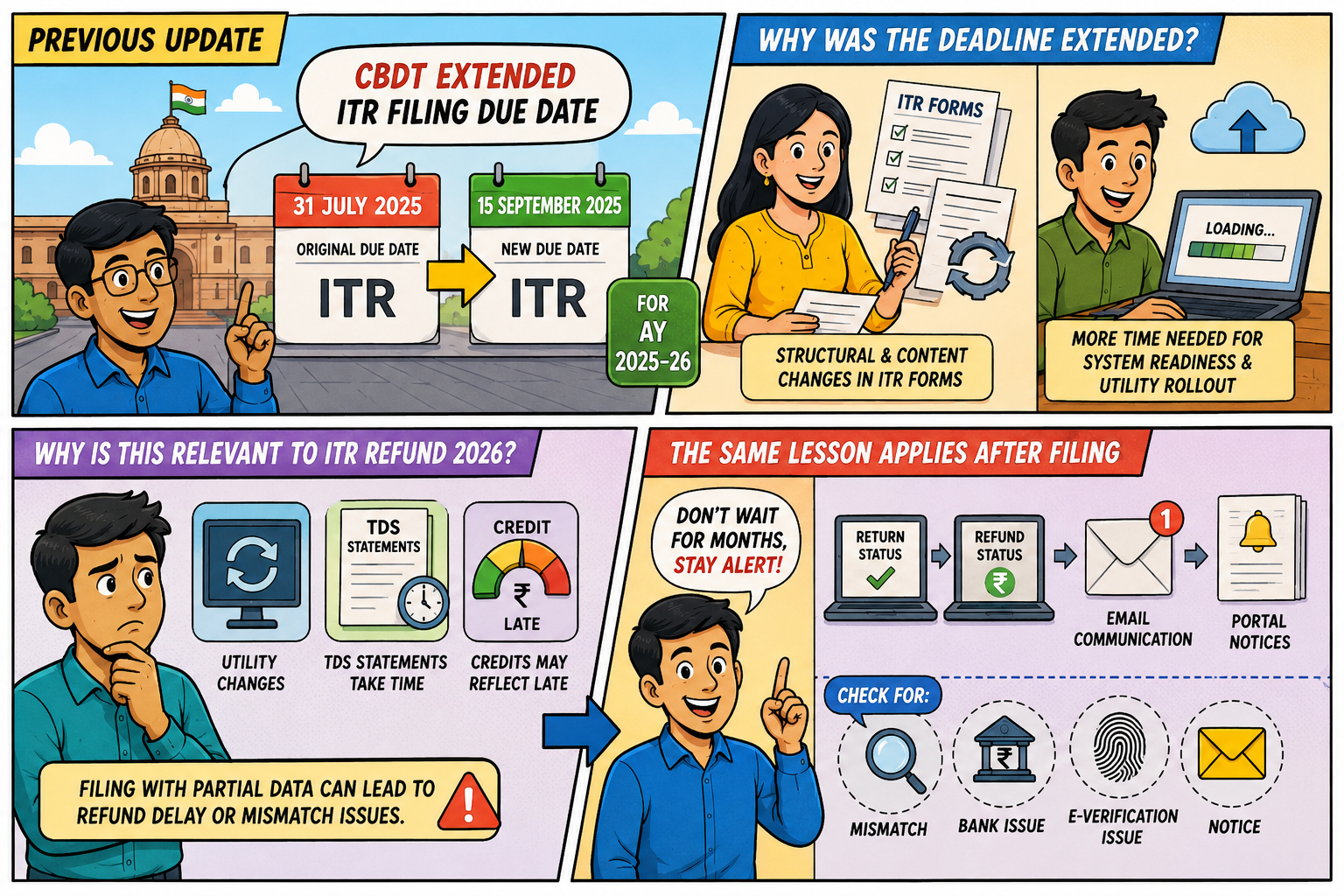
The previous major update came on 27 May 2025, when CBDT extended the due date for ITRs originally due by 31 July 2025 to 15 September 2025 for AY 2025-26. The government said this was done because the ITR forms had gone through structural and content changes, and extra time was needed for system readiness and utility rollout.
That update is relevant to ITR Refund 2026 because it shows how filing accuracy depends on more than taxpayer intent. If the utility changes, if TDS statements take time, or if credits reflect late, taxpayers may file with partial data. A return filed before checking updated records can create refund trouble even when the taxpayer did not plan anything wrong.
The same lesson applies after filing. A refund delay should be checked through return status, refund status, email communication and portal notices. Taxpayers should not wait for months without opening the account. The first 4-5 weeks are normal in many cases. After that, the filer should look for a mismatch, bank issue, e-verification issue or notice.
The Income Tax Department’s official refund guidance puts e-verification at the start of refund processing. It also says taxpayers should check for discrepancies and email communication if refund credit does not arrive within the normal period. That is a direct nudge to act after filing, not just wait.
CBDT’s 27 May 2025 update through the Press Information Bureau focused on accurate filing. The extension was linked to ITR form changes, system readiness and TDS-credit reflection. For taxpayers, the message is plain. Filing early without checking records can create avoidable problems.
Chartered accountants take a stricter view at the ground level. They say pre-filled data helps, but it should not be accepted without review. Banks may report interest differently. Employers may revise TDS. Brokers may show capital gains that taxpayers forgot. A small missed entry can delay a larger refund.
Borrowers also have a stake here. Refund money often gets used for EMIs, insurance renewals or card dues. When refund credit gets blocked because of a filing error, the household pays the price. A clean return protects tax compliance and monthly cash flow at the same time.
ITR Refund 2026 has to be considered as the final check on filing accuracy. Refunds may be delayed due to pending e-verification, mismatches in Form 26AS, missing income in the AIS, lack of proof for deductions, or using the incorrect ITR form.
A taxpayer does not need to worry after every instance of a refund being delayed. Still, legitimately being proactive by checking early would be less risky than not checking at all. That's what makes the most sense.
Verify the return, review the AIS and 26 AS Form, have proof ready, provide financial information if necessary, respond to any notices, and check if any refunds were issued, all within the time restrictions. That saves time and money.
The taxpayer should first check whether the ITR is e-verified, then check refund status, email and portal notices.
A mismatch delays refund because tax credit in the ITR must match the tax credit shown in Form 26AS.
Yes, AIS errors can create notice risk if the taxpayer ignores them and files income or refund claims wrongly.
Yes, even small FD interest can create a mismatch if TDS is claimed, but the interest income is not reported.
Yes. Processing and refunds under Section 143(1) do not close scrutiny risk. The department can still issue a valid Section 143(2) notice within the legal time limit for that return.









.png&w=3840&q=75)


