
.png&w=3840&q=65)
By continuing, you agree to LoansJagat's Credit Report Terms of Use, Terms and Conditions, Privacy Policy, and authorize contact via Call, SMS, Email, or WhatsApp
Disclaimer: The information published on LoansJagat is intended for general informational and educational purposes only and should not be considered financial, legal, or investment advice. Interest rates, loan terms, statistics, and other data may change over time and may vary by lender or source. Please verify the latest information and consult a qualified financial advisor or the respective Bank/NBFC before making any financial decisions.
Subscribe Now
About the author

Arshathul Afia
Arshathul Afia is a journalism graduate and fintech content writer with 4+ years of experience in digital publishing and research-led writing. She has written 200+ articles covering personal finance, lending, banking, digital payments, credit, insurance, and major financial developments in India. At LoansJagat, she focuses on simplifying complex fintech news, RBI updates, loan-related changes, policy developments, and industry trends for everyday readers. Her journalism background helps her approach stories with research, context, and clarity, while her SEO experience ensures content remains discoverable and relevant. She aims to make financial news easier to understand, practical, and useful for readers across India.
Related News
Simplify All Your Loans Into One Affordable EMI

Customers Served

Debt Consolidated

1200+ Reviews

Locations in India
Club all Loans & Credit Card Bills into Single EMI

Quick Apply Loan
Consolidate your debts into one easy EMI.

Takes less than 2 minutes. No paperwork.

10 Lakhs+
Trusted Customers

2000 Cr+
Loans Disbursed

4.7/5
Google Reviews

50+
Banks & NBFCs Offers
India’s ₹5 lakh KCC ceiling widens subsidised farm credit, but approval, collateral and interest benefits will still depend on each bank’s assessment and current rules.
The immediate benefit may be extra room for seed, fertiliser, labour, irrigation and post-harvest costs. The downside is easily missed. ₹5 lakh is not a guaranteed sanction, while collateral-free credit stops at ₹2 lakh. Current official pages still describe the 7% rate and 3% prompt-repayment incentive for an eligible portion up to ₹3 lakh. Borrowers must check the rate on any balance.
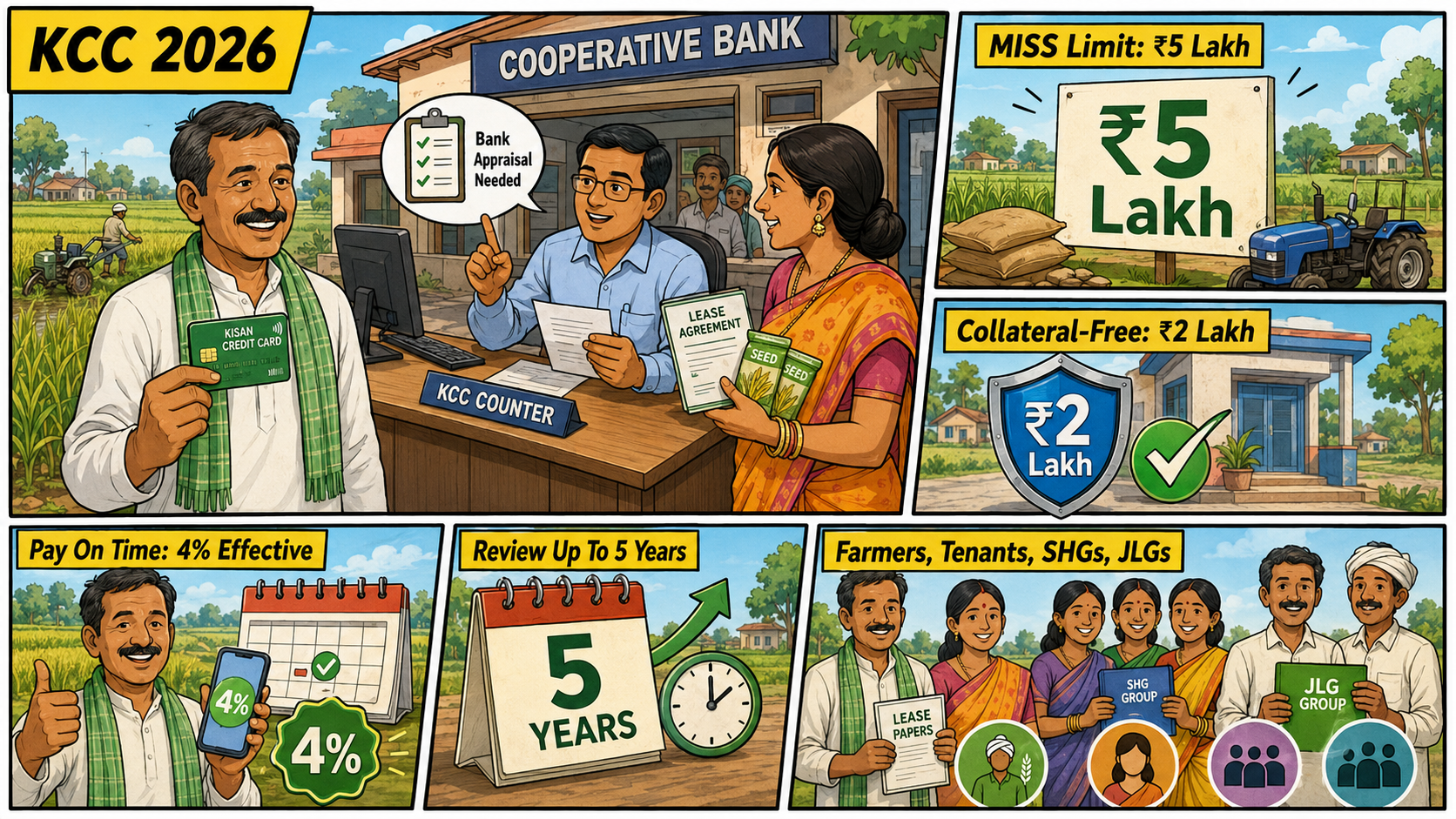
KCC borrowers face several numbers during one application. Each serves a different purpose, so they cannot be treated as one loan promise.
The sanction letter should show the approved limit, usable amount, rate on each portion, security and repayment date.
Farm spending does not arrive in one instalment. A paddy farmer pays for field preparation and seed first, then faces fertiliser, diesel, labour and transport bills. The older ₹3 lakh ceiling could run short before crop sale proceeds arrived. The ₹5 lakh MISS limit gives banks more room for cultivation, permitted post-harvest work and farm-asset maintenance.
Tenant farmers and sharecroppers could also benefit because eligibility is not restricted to landowners. Joint liability groups offer one route where cultivation papers are weak. Dairy, poultry, fisheries and animal husbandry applicants may seek working capital too. Approval will still vary by district, crop and bank.
SBI’s KCC terms, updated on February 5, 2026, describe the facility as need-based. The bank considers acreage, cropping pattern and the district scale of finance. It may also check old loans, repayment history and the proposed activity. The sanction can therefore fall below ₹5 lakh in practice.
Borrowers should request a crop-wise calculation before withdrawing funds. It must separate the subsidised portion from any balance carrying the normal rate, then list collateral and the due date. A verbal quote at the branch is not enough.
Individual and joint owner-cultivators may apply. Tenant farmers, oral lessees, sharecroppers, self-help groups, and joint liability groups are included too.
Approved allied work is covered. Fishers may need a licence, registered boat, pond lease or local permission. Dairy and poultry applicants may have to show lawful use of animals or sheds. Incomplete records and heavy existing debt can still lead to rejection.
A standard file includes a signed application, photographs, Aadhaar or another accepted identity document, address proof and PAN or Form 60. Certified land records or cultivation proof, proposed crops, acreage and existing agricultural borrowing should also be provided.
Tenants may submit a lease, cultivation certificate or another accepted record. Allied workers should carry activity papers. Beyond the collateral-free threshold, banks may seek land-charge, mortgage or other security documents. A written checklist can prevent repeated visits.
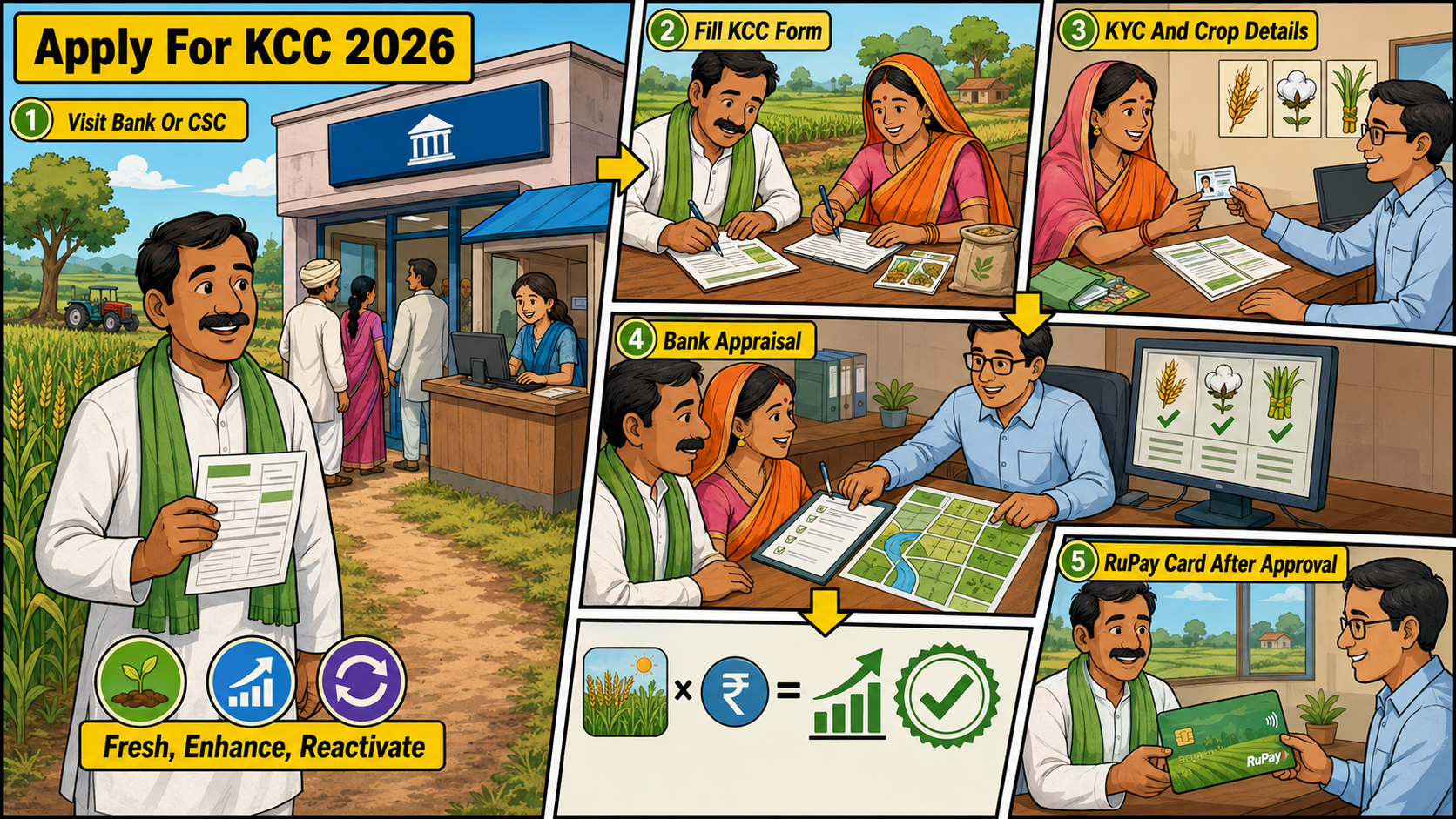
An applicant may visit a commercial, regional rural or cooperative bank offering KCC finance. The form asks for personal details, cultivation information, crops, existing loans and the amount required. It may cover a fresh KCC, enhancement or reactivation.
The bank checks KYC, cultivation status, crop details and liabilities, then calculates the limit from acreage and the district scale of finance. Permitted additions can cover post-harvest needs, farm repairs and eligible insurance. Approval may lead to a RuPay-enabled card. Some lenders offer digital initiation or renewal, while common service centers may help.
The borrower-facing view published by LoansJagat highlights access for owners, tenants, sharecroppers, oral lessees, SHGs and JLGs, plus collateral-free credit up to ₹2 lakh. Eligibility is wider than ownership alone. The borrower must still verify whether 4% applies to the full offer.
One risk is accepting a higher limit without checking the interest benefit. If only ₹3 lakh of a ₹5 lakh withdrawal receives the prompt-repayment incentive, the other ₹2 lakh may carry the bank’s regular rate. The bill will exceed a simple 4% calculation.
That split changes the decision. A farmer needing ₹3.4 lakh should compare a full drawdown with staged withdrawals and ask whether interest applies to the amount used or the entire sanction. This is a direct branch-level check.
Finance Minister Nirmala Sitharaman announced the higher ceiling while presenting the Union Budget 2025-26 on February 1, 2025. The Union Budget portal recorded her statement that Kisan Credit Cards facilitated short-term loans for 7.7 crore farmers, fishers and dairy farmers. The speech proposed increasing the MISS limit from ₹3 lakh to ₹5 lakh.
Before that proposal, eligible short-term agricultural loans up to ₹3 lakh were available at 7%. Timely repayment brought a 3% incentive, lowering the effective rate to 4%. A separate change raised collateral-free agricultural credit from ₹1.6 lakh to ₹2 lakh from January 1, 2025. The later ₹5 lakh ceiling did not turn the complete amount into collateral-free borrowing.
The March 11, 2026, backgrounder reported over 7.72 crore operational KCCs with about ₹10.2 lakh crore outstanding. It listed 457 onboarded banks and 1,998.7 lakh processed applications. Small and marginal farmers held roughly 76% of agricultural credit accounts. These figures do not predict one applicant’s outcome.
The finance minister's budget statement placed farmers, fishers and dairy operators within the higher-credit proposal. By March 2026, the government described ₹5 lakh as the enhanced MISS ceiling and ₹2 lakh as the collateral-free portion. That is the policy position.
Lending banks retain the final appraisal. SBI describes KCC finance as need-based and asks for landholding proof, crop details, photographs and security papers where applicable. Government policy sets the supported boundary, but the branch decides the usable amount.
The ₹5 lakh MISS ceiling gives eligible KCC applicants more room to seek formal farm credit in 2026. It can support rising cultivation and allied costs, especially where the earlier ₹3 lakh ceiling proved too small. Yet the scheme does not promise ₹5 lakh to every borrower or a 4% rate across the full amount.
Farmers should check the sanction, interest split, collateral and repayment date before using the account. A complete document file may shorten appraisal. A written loan calculation can prevent a much larger problem later, when the crop has been sold and the interest bill finally arrives.
No. ₹5 lakh is the enhanced MISS ceiling. The bank calculates the sanction from acreage, crop costs, scale of finance, current liabilities and repayment ability.
Yes. Tenant farmers, oral lessees and sharecroppers are eligible. They may need a lease, cultivation certificate, JLG arrangement or another proof accepted by the bank.
Applicants should not assume so. Current official descriptions retain the 7% rate and 3% timely-repayment incentive for the eligible portion up to ₹3 lakh. The bank must confirm the remaining rate.
Some banks allow digital initiation, review or renewal. Availability differs by lender. Farmers can also use a branch or seek help from a common service center.
The borrower may lose the 3% prompt-repayment incentive and pay a higher effective rate. The exact charge will follow the sanction terms and bank policy.









.png&w=3840&q=75)


