

By continuing, you agree to LoansJagat's Credit Report Terms of Use, Terms and Conditions, Privacy Policy, and authorize contact via Call, SMS, Email, or WhatsApp
Disclaimer: The information published on LoansJagat is intended for general informational and educational purposes only and should not be considered financial, legal, or investment advice. Interest rates, loan terms, statistics, and other data may change over time and may vary by lender or source. Please verify the latest information and consult a qualified financial advisor or the respective Bank/NBFC before making any financial decisions.
Subscribe Now
About the author

Arshathul Afia
Arshathul Afia is a journalism graduate and fintech content writer with 4+ years of experience in digital publishing and research-led writing. She has written 200+ articles covering personal finance, lending, banking, digital payments, credit, insurance, and major financial developments in India. At LoansJagat, she focuses on simplifying complex fintech news, RBI updates, loan-related changes, policy developments, and industry trends for everyday readers. Her journalism background helps her approach stories with research, context, and clarity, while her SEO experience ensures content remains discoverable and relevant. She aims to make financial news easier to understand, practical, and useful for readers across India.
Related Blog Post
Simplify All Your Loans Into One Affordable EMI

Customers Served

Debt Consolidated

1200+ Reviews

Locations in India
Club all Loans & Credit Card Bills into Single EMI

Quick Apply Loan
Consolidate your debts into one easy EMI.

Takes less than 2 minutes. No paperwork.

10 Lakhs+
Trusted Customers

2000 Cr+
Loans Disbursed

4.7/5
Google Reviews

50+
Banks & NBFCs Offers
NRIs with inoperative PANs should verify their tax residency first, as eligible non-residents can seek correction without automatically paying the ₹1,000 linking fee online today.
The distinction has an immediate financial impact. A taxpayer may see a refund held, face higher TDS or TCS, or run into verification trouble with a bank, broker or property transaction. If the incorrect status stays in the database, the same problem can return during later filings. The exemption is also not a new waiver announced in August 2026. It comes from an older government notification, followed by a correction process for NRIs whose status was not properly recorded.
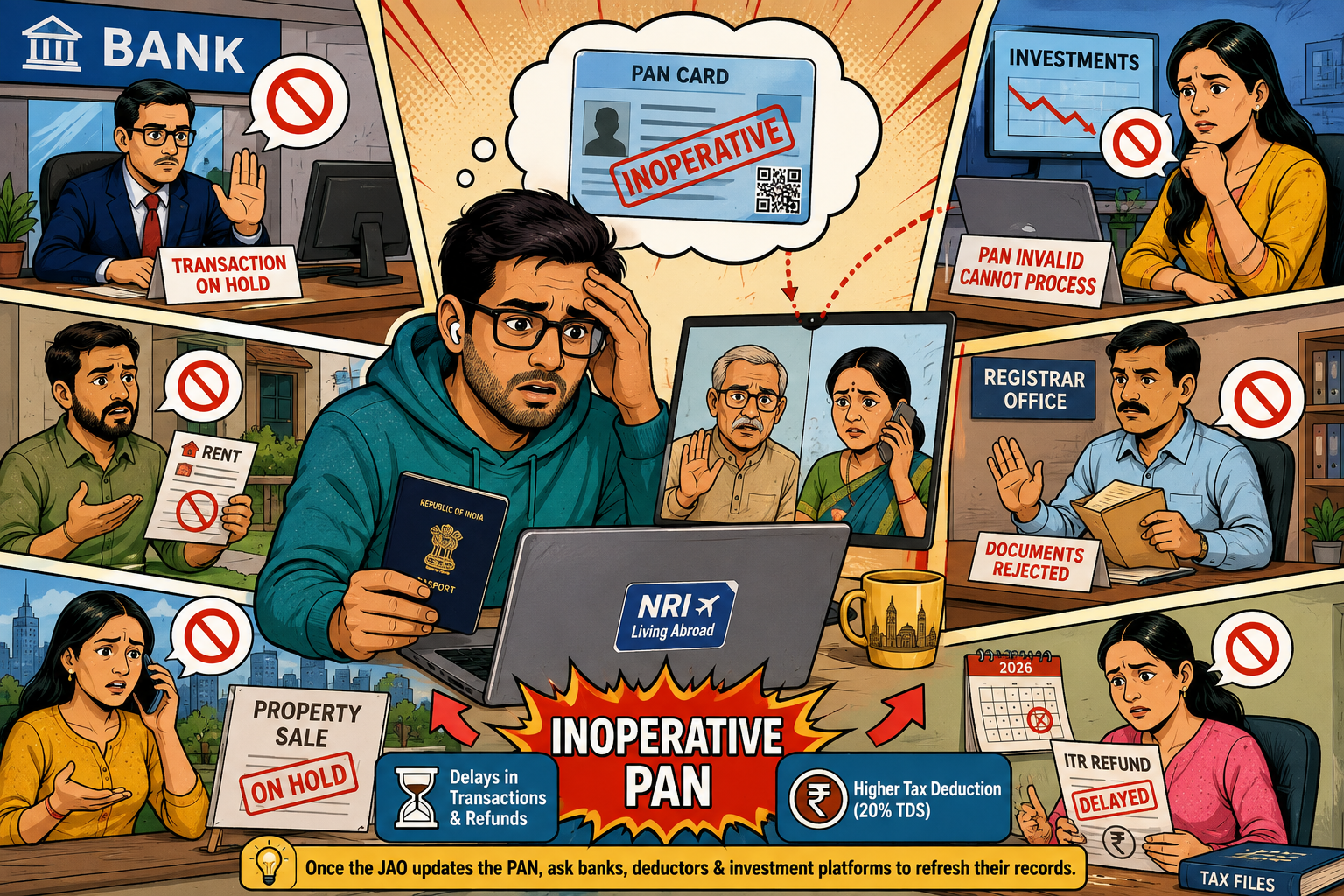
The portal message can disrupt several Indian financial tasks at once. Many NRIs continue to earn bank interest, collect rent, sell property, hold securities or file an Indian return. Banks, tenants, registrars and investment platforms rely on the PAN status visible in the tax database. When it shows "inoperative," they may stop a transaction, request fresh documents or apply the tax treatment linked to an invalid PAN.
Relatives handling paperwork in India can also get caught in the delay. A parent following up on a refund or a spouse managing rental income may have little power to correct the core record. LoansJagat analysis of ITR refund delays in 2026 included PAN-Aadhaar problems among the issues that can hold up payment. Once the JAO updates the PAN, the taxpayer can ask banks, deductors and investment providers to refresh their records.
Tax advisers would begin with the person’s residential status for the relevant year. An overseas address, NRE account, foreign job or OCI card does not settle the income-tax test on its own. The calculation can depend on days spent in India, the reason for travel, Indian income and special provisions for Indian citizens or persons of Indian origin. Someone who moved abroad recently may have a different result from another person who has lived overseas for years.
That review prevents the wrong remedy. An eligible non-resident whose PAN was tagged because the department lacked updated information needs a status correction. A resident taxpayer who was required to link Aadhaar needs the delayed-linking process. For someone awaiting a ₹75,000 refund, paying ₹1,000 without checking the exemption may add cost while leaving the incorrect residency entry untouched. Tax professionals may compare passport travel records with earlier returns to locate the cause.
The Income Tax Department’s current Link Aadhaar FAQ lists non-residents under income tax law among the exempt categories. It also lists individuals aged 80 years or above during the relevant previous year, residents of Assam, Jammu and Kashmir or Meghalaya, and people who are not Indian citizens.
The table separates the common situations. It does not replace a tax-residency calculation where the taxpayer spent a lengthy period in India.
Paying first can create another task. The portal may accept a fee, yet the residential-status record can remain wrong. An NRI should identify the cause, save the status screenshot and retain every submission.
The Income Tax Department issued instructions on 21 July 2023 for NRIs whose PAN remained inoperative. It asked them to intimate their NRI status to the respective JAO and provide a copy of the PAN card. The supporting proof can include a passport showing overseas stay, a PIO card, an OCI card, a foreign citizenship identification number or a foreign taxpayer identification number.
Some foreign identification records require an apostille or formal attestation. The department permits attestation by the Indian embassy, high commission or consulate in the country where the applicant lives. An authorised official at an overseas branch of an Indian scheduled bank may also attest to eligible records. The taxpayer can find the officer through the pre-login “Know Your AO” service and should retain the email, documents and delivery acknowledgement.
A short request should state the PAN, overseas address, relevant tax year and reason for restoration. Passport pages must be readable. After the update, the taxpayer should verify PAN status again rather than rely only on an email reply.
The Central Board of Direct Taxes has maintained that people within notified exempt categories should not face the consequences attached to an inoperative PAN caused by non-linking. Its July 2023 message was direct: affected NRIs should inform the JAO of their residential status and attach the prescribed evidence. The department did not ask every NRI receiving the warning to pay ₹1,000.
The earlier legal base came through Notification No. 37/2017, dated 11 May 2017. A Press Information Bureau release published on 12 May 2017 recorded the specified exemptions, including a non-resident under income-tax law. The notification took effect on 1 July 2017. For taxpayers outside the exempt groups, unlinked PANs became inoperative from 1 July 2023, after the general linking deadline ended on 30 June 2023.
Banks and tax deductors see the system status, not the taxpayer’s full travel history. A tenant deducting tax on rent, for example, may react to the inoperative flag even when the owner believes an exemption applies. That can create a higher deduction, reconciliation work and a later refund claim. The JAO correction therefore helps both sides because it changes the record used during tax reporting.
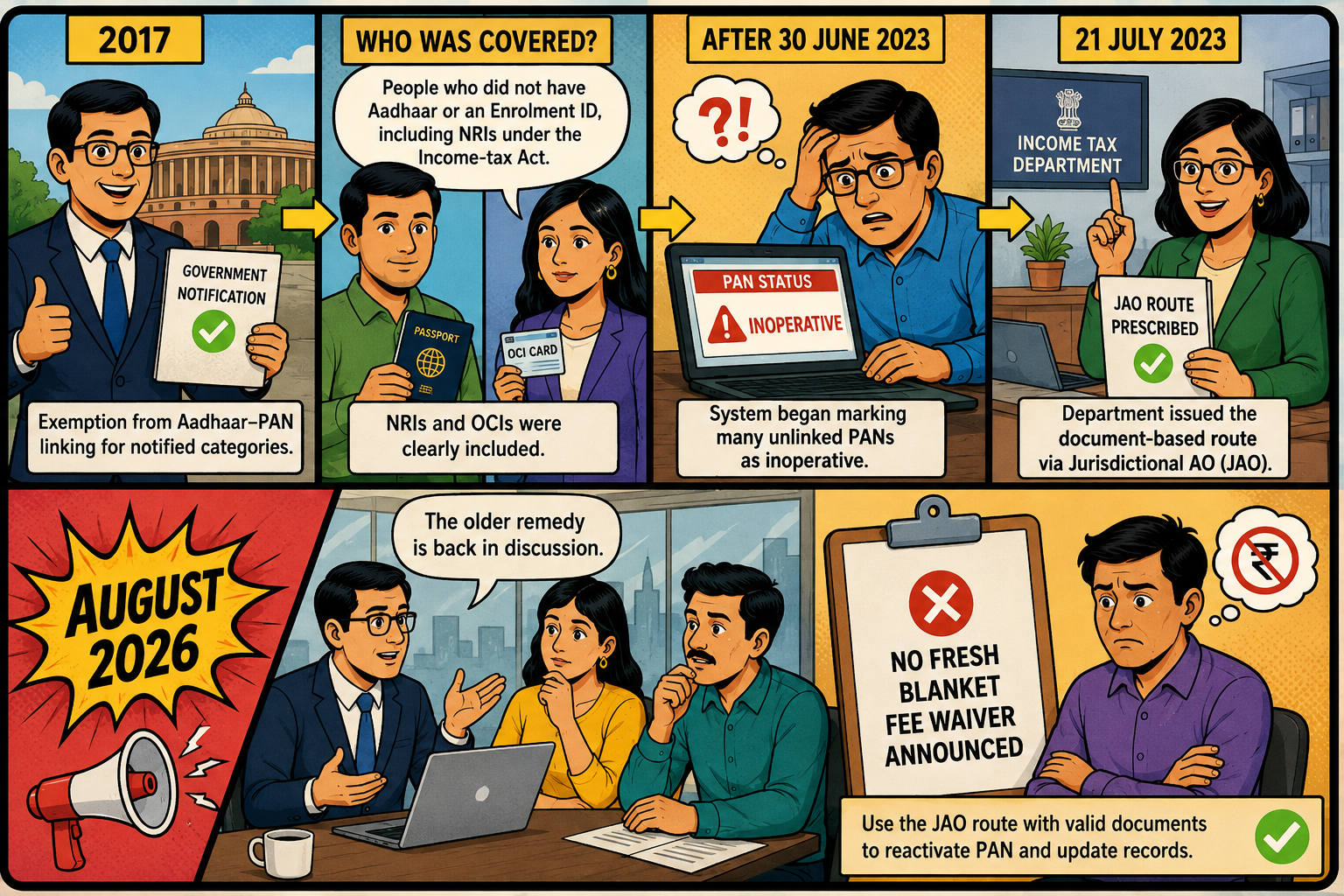
The exemption started in 2017, years before PANs became inoperative under the later compliance timetable. The government’s notification covered people who did not possess Aadhaar or an Aadhaar enrolment ID and belonged to a notified category. Non-residents under income-tax law formed one of those groups.
After 30 June 2023, the system marked many unlinked PANs inoperative. NRIs and OCIs then reported that their PAN had been affected despite the exemption. On 21 July 2023, the department published the document-based JAO route. The August 2026 discussion has revived that older remedy. No fresh blanket fee waiver has been announced.
An NRI who sees an inoperative PAN should not assume that ₹1,000 is automatically due. The correct answer depends on tax residency, Aadhaar status and the reason recorded in the department’s system. Eligible non-residents can approach the JAO with PAN and overseas-status evidence. Others may need to pay the fee and link Aadhaar.
Checking first can protect a refund, reduce higher tax deduction and prevent repeated KYC trouble. The exemption route already exists. The taxpayer’s job is to prove eligibility and get the PAN database updated.
No. Tax-law non-residents within the notified exemption may seek correction instead of completing mandatory linking.
The taxpayer can use “Know Your AO” on the Income Tax e-filing portal without logging in.
The department gives no single turnaround for every JAO case, so applicants should track their written request.
The portal may permit filing with warnings, but refunds and certain services can remain restricted until correction.
Should An NRI Pay ₹1,000 If The Portal Shows PAN Inoperative?
Not immediately. The taxpayer should verify exemption eligibility and the recorded residential status before paying.








.png&w=3840&q=75)


