By continuing, you agree to LoansJagat's Credit Report Terms of Use, Terms and Conditions, Privacy Policy, and authorize contact via Call, SMS, Email, or WhatsApp
Disclaimer: The information published on LoansJagat is intended for general informational and educational purposes only and should not be considered financial, legal, or investment advice. Interest rates, loan terms, statistics, and other data may change over time and may vary by lender or source. Please verify the latest information and consult a qualified financial advisor or the respective Bank/NBFC before making any financial decisions.
Subscribe Now
About the author

‘Simplify Finance for Everyone.’ This is the common goal of our team, as we try to explain any topic with relatable examples. From personal to business finance, managing EMIs to becoming debt-free, we do extensive research on each and every parameter, so you don’t have to. Scroll up and have a look at what 15+ years of experience in the BFSI sector looks like.
Related News
Simplify All Your Loans Into One Affordable EMI

Customers Served

Debt Consolidated

1200+ Reviews

Locations in India
Club all Loans & Credit Card Bills into Single EMI

Quick Apply Loan
Consolidate your debts into one easy EMI.

Takes less than 2 minutes. No paperwork.

10 Lakhs+
Trusted Customers

2000 Cr+
Loans Disbursed

4.7/5
Google Reviews

50+
Banks & NBFCs Offers
Other services mentioned in this article
Key Takeaways
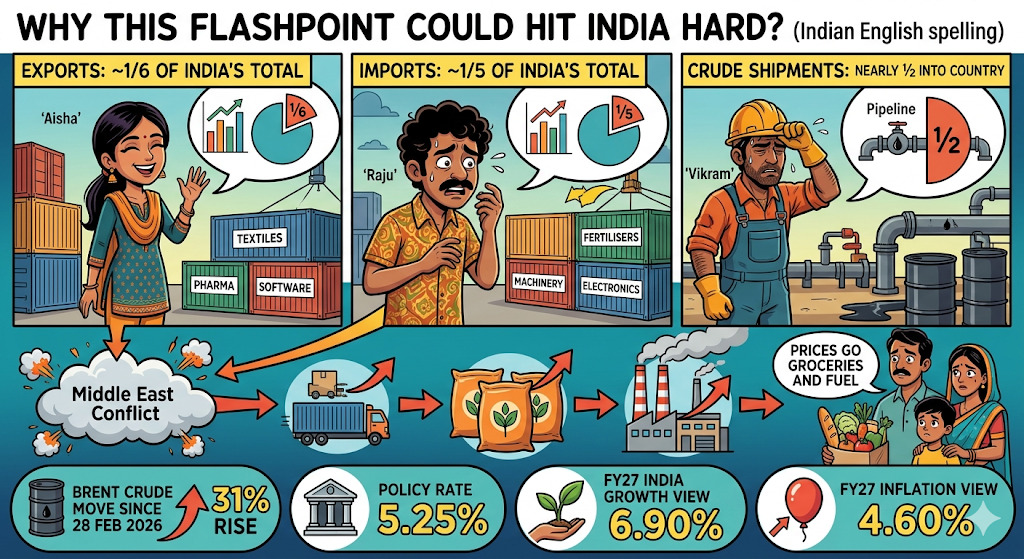
India’s exposure is sizeable. NDTV Profit Reports say the Middle East accounts for about 1/6 of India’s exports, 1/5 of imports, and nearly 1/2 of crude shipments into the country. That means a prolonged supply hit can quickly feed into freight, fertilisers and factory input costs.
The short-term risk is costlier fuel and imported inputs. The longer-term risk is broader price pressure if businesses pass on higher costs and inflation expectations harden. Reuters reported Brent crude had risen 31% since the conflict began on 28 February 2026.
For households, the biggest risk is indirect. Even if pump prices do not jump immediately, higher crude can raise logistics bills, packaged food prices, fertiliser costs and prices of daily-use goods. NDTV Profit reported India has avoided sharp retail fuel hikes so far, but that cushion may weaken if disruption drags on.
There is one small relief point for borrowers. LoansJagat said on 9 April 2026 that the 5.25% status quo means most floating-rate home loan EMIs are likely to stay unchanged for now. That helps existing borrowers, though fresh rate relief is not in sight yet.
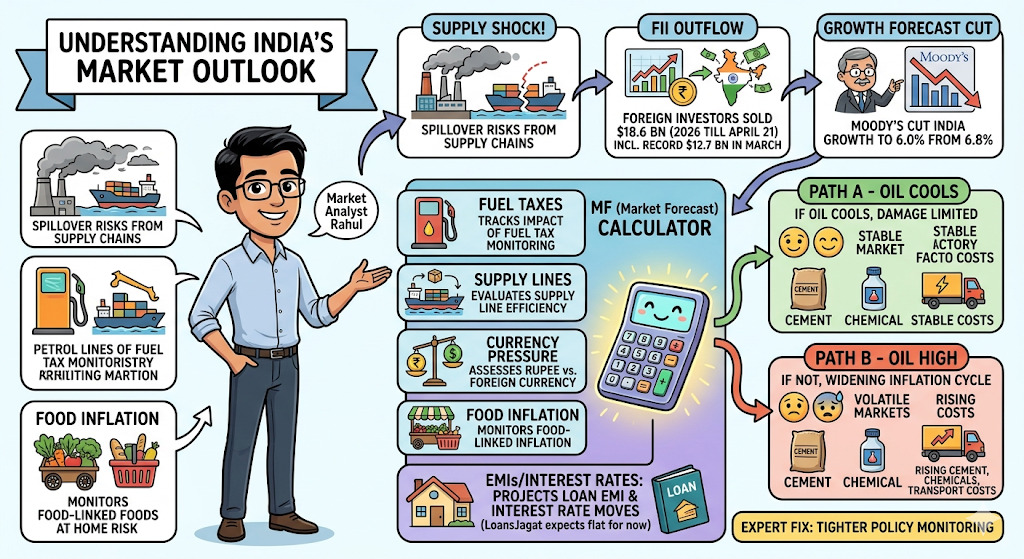
Analysts are now tracking whether this remains an oil spike or turns into a wider inflation cycle. Reuters reported foreign investors sold $18.6 bn worth of Indian equities in 2026 till 21 April, including a record $12.7 bn in March. Moody’s also cut its FY27 India growth forecast to 6.0% from 6.8%.
The likely fix is not quick. Economists are pointing to tighter monitoring of fuel taxes, supply lines, currency pressure and food-linked inflation. If oil cools, the damage may stay limited. If not, price pressure could spread faster across sectors like cement, chemicals and transport.
India is not facing only an oil headline. It is facing the risk of costlier imports turning into wider price pressure across the economy.
If the West Asia conflict drags on, households, markets and borrowers may all feel the strain in different ways.
Will Fuel Prices In India Go Up In The Coming Months?
Petrol prices in India may not rise immediately, but the risk is real if global crude stays high. Recent reports say Brent crude has climbed sharply since the West Asia conflict began, which can raise India’s import cost and put pressure on fuel retailers.
Reuters also reported that the policy rate was kept at 5.25% on 8 April 2026, showing inflation risks are still active. So, a sudden jump is not certain today, but a gradual increase later cannot be ruled out, especially if oil remains expensive and the government does not cut taxes further.
*T&C Apply
Why Is India Taking A Bigger Economic Hit From The West Asia Crisis?
India is getting hit harder because it depends heavily on West Asia for oil, gas, trade and remittances. The region accounts for about 1/6 of India’s exports, 1/5 of imports and around half of crude shipments, so any conflict there quickly raises fuel and shipping costs.
India also imports more than 80% of its crude needs, which increases pressure on inflation, the trade deficit and the rupee when global oil prices rise. Reuters reported Brent crude had jumped 31% since the conflict began, while Moody’s warned prolonged disruption could cut India’s FY27 growth forecast to 6%.
Related Financial News | |||









.png&w=3840&q=75)



