By continuing, you agree to LoansJagat's Credit Report Terms of Use, Terms and Conditions, Privacy Policy, and authorize contact via Call, SMS, Email, or WhatsApp
Disclaimer: The information published on LoansJagat is intended for general informational and educational purposes only and should not be considered financial, legal, or investment advice. Interest rates, loan terms, statistics, and other data may change over time and may vary by lender or source. Please verify the latest information and consult a qualified financial advisor or the respective Bank/NBFC before making any financial decisions.
Subscribe Now
About the author

LoansJagat Team
‘Simplify Finance for Everyone.’ This is the common goal of our team, as we try to explain any topic with relatable examples. From personal to business finance, managing EMIs to becoming debt-free, we do extensive research on each and every parameter, so you don’t have to. Scroll up and have a look at what 15+ years of experience in the BFSI sector looks like.
Related Blog Post
Simplify All Your Loans Into One Affordable EMI

Customers Served

Debt Consolidated

1200+ Reviews

Locations in India
Club all Loans & Credit Card Bills into Single EMI

Quick Apply Loan
Consolidate your debts into one easy EMI.

Takes less than 2 minutes. No paperwork.

10 Lakhs+
Trusted Customers

2000 Cr+
Loans Disbursed

4.7/5
Google Reviews

50+
Banks & NBFCs Offers
Other services mentioned in this article
Key Takeaways
You set up an auto-payment for your Netflix subscription or SIP a year ago and completely forgot about it. One fine morning, money quietly disappears from your account and you are left scrambling.
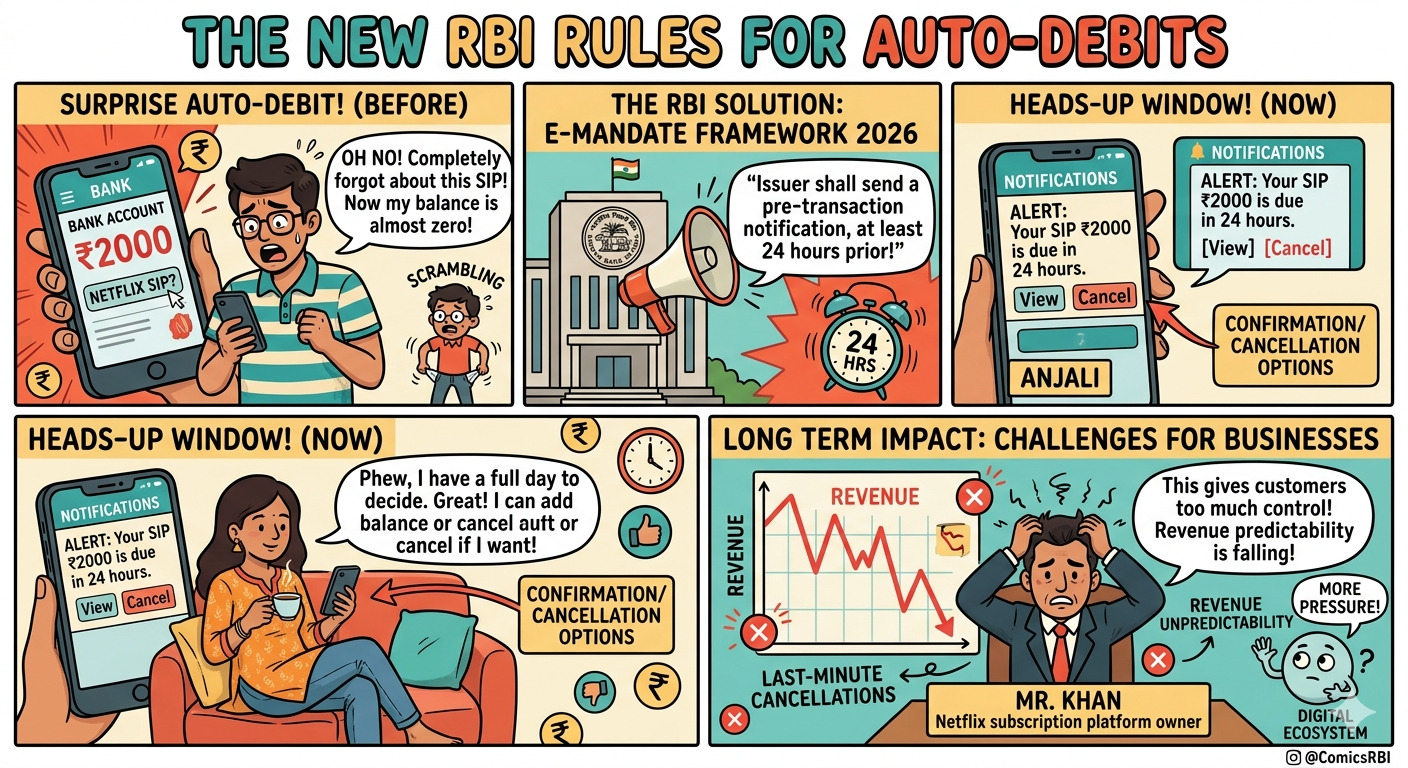
Millions of Indians have lived this moment. The RBI has now decided to put an end to it.
The RBI has issued the Digital Payments E-mandate Framework, 2026 to streamline and safeguard recurring transactions across all digital payment channels.
The central bank stated, “An issuer shall send a pre-transaction notification to the customer, at least 24 hours prior to the actual charge or debit.”
The Tribune This gives every Indian bank customer a heads-up window to check their balance or opt out of a payment they do not want in the short term.
In the long term, however, businesses and subscription platforms may face a higher rate of last-minute cancellations, which could affect their revenue predictability and add pressure on digital payment ecosystems.
The RBI said customers must explicitly approve auto-debit instructions at the time of registration through an additional factor of authentication (AFA) to ensure better control.
The central bank also emphasised flexibility, saying that users can modify or cancel such mandates anytime and can even block individual transactions before they are processed, without cancelling the entire mandate.
On transaction limits, the RBI said recurring payments up to ₹15,000 can be processed without additional authentication, while higher-value transactions will require user approval.
The limit has been relaxed to ₹1,00,000 per transaction without AFA for critical payments like insurance premiums, mutual fund subscriptions, and credit card bills.
Importantly, no charges will be levied on customers for using this e-mandate facility.
Consumer protection advocates have widely welcomed the move, pointing out that surprise auto-debits have been one of the leading causes of unintended overdrafts and financial stress among middle-income households in India.
The 24-hour alert system puts the customer back in the driver's seat, something that was long overdue in India's booming digital payments landscape.
However, some fintech and banking professionals raise a concern adding more authentication steps could make setting up SIPs and paying bills more cumbersome, especially for elderly or less tech-savvy users.
The solution, experts suggest, is smooth bank-level implementation with clear grievance redressal channels.
*T&C Apply
The RBI has already mandated that details of grievance redressal must be included in every post-transaction notification, which should help customers raise complaints fast if something goes wrong.
The RBI's E-mandate Framework 2026 is a big win for India's 500 million+ digital payment users. With 24-hour alerts, zero charges, and easy opt-outs, every Indian now has the power to see, stop, and manage every automatic payment before it leaves their account.
Why is India’s RBI changing the Auto-Debit Rules, and what is wrong with the original one?
The RBI is enhancing auto-debit rules (e-mandate framework) to shift control to users by mandating 24-hour pre-debit alerts, allowing, and enabling opt-outs to increase security and transparency in recurring payments.
What are the RBI's new auto-debit rules that kick in from today?
Effective April 22, 2026, the RBI’s updated e-mandate rules increase the auto-debit limit to ₹15,000 without requiring an OTP (one-time password) for recurring transactions like utility bills, OTT subscriptions, and SIPs.
Related Financial News | |||









.png&w=3840&q=75)



