
By continuing, you agree to LoansJagat's Credit Report Terms of Use, Terms and Conditions, Privacy Policy, and authorize contact via Call, SMS, Email, or WhatsApp
Disclaimer: The information published on LoansJagat is intended for general informational and educational purposes only and should not be considered financial, legal, or investment advice. Interest rates, loan terms, statistics, and other data may change over time and may vary by lender or source. Please verify the latest information and consult a qualified financial advisor or the respective Bank/NBFC before making any financial decisions.
Subscribe Now
About the author

Arshathul Afia
Arshathul Afia is a journalism graduate and fintech content writer with 4+ years of experience in digital publishing and research-led writing. She has written 200+ articles covering personal finance, lending, banking, digital payments, credit, insurance, and major financial developments in India. At LoansJagat, she focuses on simplifying complex fintech news, RBI updates, loan-related changes, policy developments, and industry trends for everyday readers. Her journalism background helps her approach stories with research, context, and clarity, while her SEO experience ensures content remains discoverable and relevant. She aims to make financial news easier to understand, practical, and useful for readers across India.
Related News
Simplify All Your Loans Into One Affordable EMI

Customers Served

Debt Consolidated

1200+ Reviews

Locations in India
Club all Loans & Credit Card Bills into Single EMI

Quick Apply Loan
Consolidate your debts into one easy EMI.

Takes less than 2 minutes. No paperwork.

10 Lakhs+
Trusted Customers

2000 Cr+
Loans Disbursed

4.7/5
Google Reviews

50+
Banks & NBFCs Offers
A ₹20,000 monthly surplus may save more against a costly personal loan than through an SIP, because debt reduction carries no market uncertainty for borrowers.
The calculation begins with a ₹5 lakh personal loan carrying 14% interest for 3 years. Its monthly EMI comes to roughly ₹17,100. Now assume the borrower finds an additional ₹20,000 in the monthly budget. Putting that amount towards the loan takes the total payment to about ₹37,100 and closes the account nearly 21 months early..
The short-term gain comes from stopping interest sooner. Later, the household can send the released EMI towards investments. The negative side appears when a borrower uses every available rupee and leaves no emergency reserve. A medical expense, missed salary or urgent repair could then force another round of borrowing, sometimes at an even higher rate.
Personal loan interest usually follows a reducing-balance calculation. Every EMI contains principal and interest, but the interest portion depends on the outstanding amount. An extra payment made early lowers that balance before the lender calculates the following months. The saving therefore arrives through many smaller interest reductions, not through a separate reward from the bank.
In Livemint’s example, paying only the scheduled EMI keeps the account running for 36 months and takes total interest to roughly ₹1.15 lakh. Adding ₹20,000 every month lifts the outflow to around ₹37,100. The account then closes in approximately 15 months, with interest falling to nearly ₹47,000. That is where the estimated ₹68,000 saving comes from.
The result can affect salaried households across India because the EMI keeps returning long after the original expense has passed. Ending that liability 21 months early leaves more money for rent, school fees, insurance or saving. A guaranteed reduction in interest also does not depend on a rising stock market.
The figures below separate the 2 routes and include the original calculation prepared for this article. Both 5-year routes use the same monthly cash capacity, so neither option receives an unfair contribution advantage.
The final row adds original analysis. It assumes month-end payments, a steady 12% return and no tax, exit load or foreclosure fee. Loan-first remains ahead by around ₹14,800 because the SIP-first borrower invests the released ₹17,100 EMI after month 36, which the published ₹16.33 lakh comparison did not include.
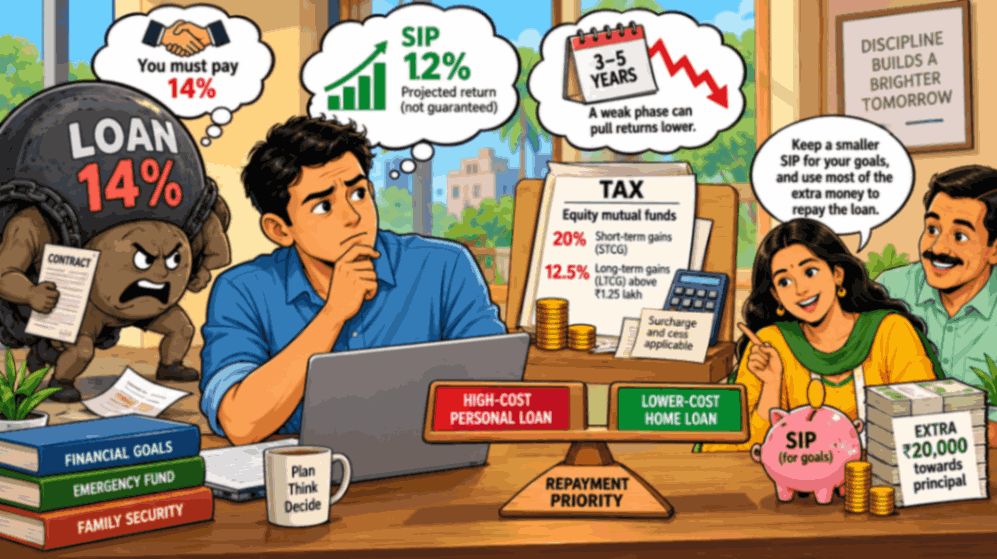
The borrower must pay the 14% loan rate under the contract. A 12% SIP return is a projection. Equity funds may earn more over a long holding period, but a weak 3-year or 5-year stretch can pull the result below the illustration. That difference between a contractual cost and an uncertain return gives expensive debt the stronger claim on spare cash.
Tax creates another gap. The Income Tax Department explains through its capital-gains guidance that qualifying short-term gains from equity-oriented mutual funds attract 20% tax. Long-term gains above the annual ₹1.25 lakh threshold attract 12.5%, along with applicable surcharge and cess. Loan interest avoided on ordinary personal spending does not create a mutual fund redemption bill.
Every SIP need not stop. A borrower may retain a smaller goal-linked investment while sending most of the extra ₹20,000 towards principal. High-cost personal debt presents a stronger repayment case than a lower-cost home loan.
SEBI’s Think Before You Borrow guidance says a shorter repayment period lowers overall interest. It also advises borrowers with spare cash to repay part or all of a loan early after checking the prepayment charge. That second step cannot be skipped. A lender may impose conditions on fixed-rate loans, restrict the number of part-payments or require a minimum amount.
AMFI describes an SIP as regular mutual fund investment and says purchases across changing prices can average the acquisition cost. It also warns that the process neither assures profit nor protects against a falling market. The 12% figure remains an illustration.
The LoansJagat personal loan foreclosure calculator guide compares outstanding principal, remaining interest and foreclosure cost. Borrowers should run that check before sending a large payment. The ₹68,000 saving can shrink if charges apply or the loan is near its final instalments.
The original cash-flow test adds the released EMI to the SIP-first route after month 36. Many comparisons invest the former EMI for the debt-first borrower but ignore it when the other borrower’s loan ends. Equal monthly budgets show that the winning gap may remain modest.
Before the additional ₹20,000 appeared, the borrower faced a 36-month schedule. Paying about ₹17,100 each month meant a total repayment near ₹6.15 lakh, including almost ₹1.15 lakh in interest.
The surplus created 2 routes. Every extra rupee could reduce principal, or the EMI could remain unchanged while ₹20,000 entered an equity fund. Livemint placed the 3-year SIP near ₹8.62 lakh at 12%, against ₹7.20 lakh contributed.
Its longer comparison then invested roughly ₹37,100 for 45 months after early loan closure, producing nearly ₹20.95 lakh. The alternative invested only ₹20,000 for all 60 months and reached about ₹16.33 lakh. That is arithmetically correct for those cash flows, yet the 2 households do not invest equal amounts after month 36. The original analysis above repairs that gap.
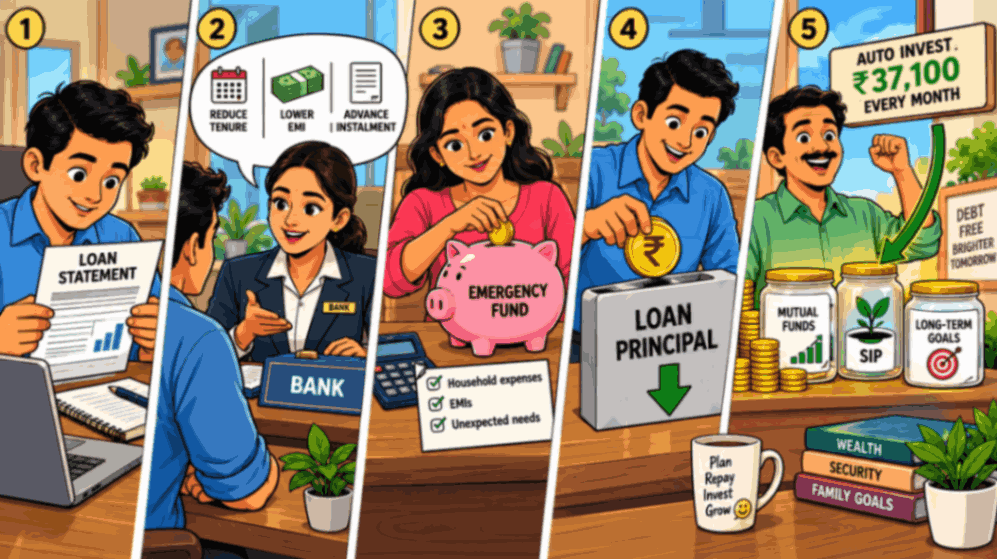
Borrowers should start with the latest loan statement, which shows outstanding principal and instalments left. The lender should then confirm whether extra money reduces tenure, lowers the EMI or becomes an advance instalment.
An emergency fund needs protection before aggressive repayment begins. A household may retain several months of expenses and EMIs, then use the remaining surplus against principal. After closure, an automatic instruction can send the full ₹37,100 towards investments instead of everyday spending.
For this borrower, the extra ₹20,000 has a better job to do first. The personal loan charges 14%, while the projected SIP return stands at 12%. Paying more towards the principal closes the loan around 21 months early and cuts nearly ₹68,000 from the interest due under the original schedule.
The answer may change with a cheaper loan or a costly foreclosure fee. Here, it remains fairly straightforward. The borrower can finish the expensive debt, retain emergency savings and then invest the full ₹37,100 each month after the loan ends.
The estimated saving is nearly ₹68,000 before charges. The actual amount depends on outstanding principal, payment date and loan terms.
Not automatically. A borrower can retain a goal-linked SIP and use new income for the loan. High rates and low prepayment costs favour faster repayment.
At a 14% loan rate, early repayment offers a known saving. Mutual funds may outperform, but they do not promise a return. Tax and market losses can also reduce the final investment value.
The answer starts with the loan rate and emergency reserve. For costly personal debt, repayment usually comes first. A split approach may suit a borrower who wants to keep a smaller monthly investment running.
The borrower can redirect the former EMI and surplus into goal-linked investments. An automatic transfer reduces the chance of spending the money elsewhere.









.png&w=3840&q=75)


