
By continuing, you agree to LoansJagat's Credit Report Terms of Use, Terms and Conditions, Privacy Policy, and authorize contact via Call, SMS, Email, or WhatsApp
Disclaimer: The information published on LoansJagat is intended for general informational and educational purposes only and should not be considered financial, legal, or investment advice. Interest rates, loan terms, statistics, and other data may change over time and may vary by lender or source. Please verify the latest information and consult a qualified financial advisor or the respective Bank/NBFC before making any financial decisions.
Subscribe Now
About the author

Arshathul Afia
Arshathul Afia is a journalism graduate and fintech content writer with 4+ years of experience in digital publishing and research-led writing. She has written 200+ articles covering personal finance, lending, banking, digital payments, credit, insurance, and major financial developments in India. At LoansJagat, she focuses on simplifying complex fintech news, RBI updates, loan-related changes, policy developments, and industry trends for everyday readers. Her journalism background helps her approach stories with research, context, and clarity, while her SEO experience ensures content remains discoverable and relevant. She aims to make financial news easier to understand, practical, and useful for readers across India.
Related News
Simplify All Your Loans Into One Affordable EMI

Customers Served

Debt Consolidated

1200+ Reviews

Locations in India
Club all Loans & Credit Card Bills into Single EMI

Quick Apply Loan
Consolidate your debts into one easy EMI.

Takes less than 2 minutes. No paperwork.

10 Lakhs+
Trusted Customers

2000 Cr+
Loans Disbursed

4.7/5
Google Reviews

50+
Banks & NBFCs Offers
Other services mentioned in this article
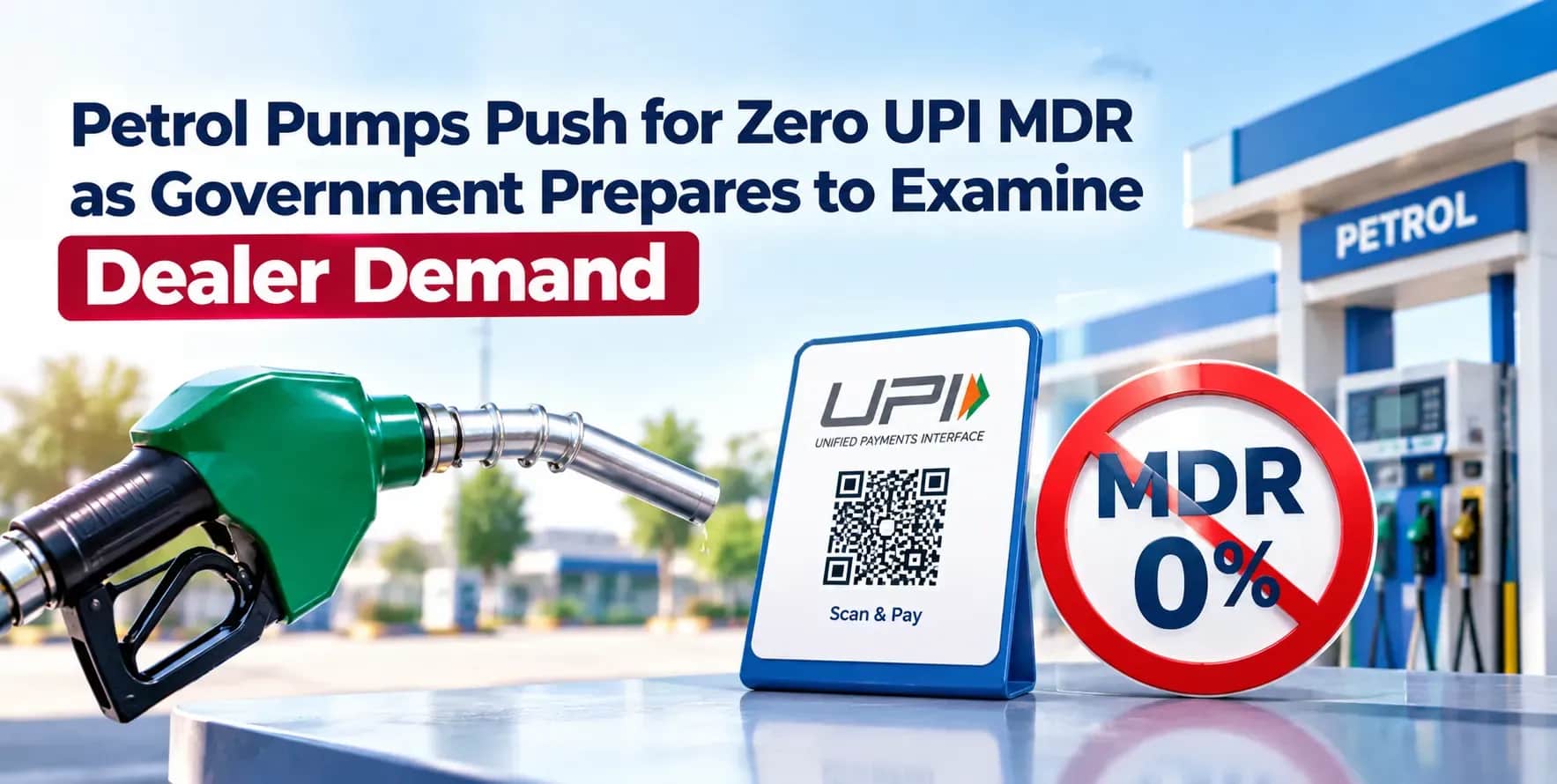
Petrol pump dealers are seeking a complete UPI MDR waiver as the government prepares to review their demand before the October 15 framework takes effect.
Key Highlights
Petrol pump dealers have taken their UPI payment-cost dispute to the Centre weeks before the revised MDR framework starts on October 15, 2026. The All India Petroleum Dealers Association, led by President Ajay Bansal, wrote to Finance Minister Nirmala Sitharaman on September 16 seeking a complete exemption for fuel outlets. On September 24, government sources said the Department of Financial Services was likely to examine the representation. The Petroleum Ministry had also forwarded the dealers’ demand to the Finance Ministry.
For motorists, the immediate position does not change. MDR is a merchant-side charge, not an extra fee that a customer is supposed to pay while using UPI. The concern is payment acceptance. Dealer groups in Madhya Pradesh and Punjab have said they plan to stop taking UPI for bills above ₹2,000 when the new framework starts. If that happens at individual outlets, some motorists may need to use cards or cash for larger fuel purchases.
The positive part for customers is simple. UPI remains free at the payment screen. The Ministry of Finance release dated September 15, 2026, says person-to-person transfers remain free, merchant payments up to ₹2,000 stay outside MDR, and fuel is placed in an essential and thin-margin category. Instead of the standard 0.4% MDR for specified larger merchant payments, qualifying fuel transactions above ₹2,000 carry a flat ₹5 merchant charge.
The same framework says banks should ensure that merchants do not pass MDR to customers. It also states that about 96% of person-to-merchant UPI transactions will remain unaffected because they fall below the threshold or qualify for zero-MDR treatment. That protects everyday users from a direct UPI fee. The problem could arise only if an outlet chooses not to accept a higher-value UPI payment.
The table also shows why the petrol-pump dispute is narrower than the wider UPI fee debate. Fuel outlets already have the lower ₹5 treatment instead of the standard 0.4% rate for qualifying transactions. Dealers now want that remaining charge removed.
AIPDA says a fuel dealer cannot simply earn more because the value of a digital payment rises. Dealer commissions are set through the oil marketing company system and are linked largely to fuel volumes. Official petroleum data updated on September 23, 2026, lists the dealer commission from December 1, 2024, at ₹3,144.03 per KL plus 0.870% of the product billable price for petrol and ₹2,332.51 per KL plus 0.266% for diesel. The record also confirms that dealer commissions were revised in 2024.
Former SBI Chairman Rajnish Kumar offered the other side of the payment-cost debate on September 15. He said UPI infrastructure carries expenses linked to compliance, cybersecurity and fraud prevention, and merchant revenue helps fund those costs. A LoansJagat analysis published on September 19 takes a customer-focused view: the likely impact on users is indirect because MDR belongs to the merchant side. For fuel outlets, a workable solution would need to address dealer acceptance costs without shifting the charge to motorists.
The policy sequence moved quickly. On September 14, 2026, the Centre issued a notification protecting UPI payments up to ₹2,000 from MDR. Detailed rates followed on September 15 after deliberations by the UPI Steering Committee. The framework set 0.4% MDR for specified person-to-merchant payments above ₹2,000. Fuel, railways, telecom, insurance and agricultural inputs received the flat ₹5 rate.
AIPDA responded on September 16, 2026, with President Ajay Bansal writing to Finance Minister Nirmala Sitharaman seeking an MDR exemption for petrol pumps. During discussions with Petroleum Ministry officials on September 17, the association said additional payment-processing costs could put pressure on prescribed dealer margins. By September 21, Maharashtra dealers had also approached the Centre seeking a complete waiver. On September 24, government sources said the Department of Financial Services was likely to examine the representation.
Ajay Bansal’s September 16 representation sought a full waiver of MDR and related transaction charges at petrol pumps. The association’s position is that fuel outlets should receive separate treatment because dealers cannot freely alter pump prices or their prescribed commission structure when payment costs rise.
State dealer groups have added pressure to that request. Dealers in Madhya Pradesh and Punjab have spoken about restricting UPI payments above ₹2,000 once the framework begins. These are industry decisions or warnings, not instructions in the government’s MDR framework. The official rule continues to keep customers outside the fee while charging qualifying fuel merchants ₹5.
The petrol pump MDR dispute has reached the Centre after AIPDA’s September 16 representation and the Petroleum Ministry’s forwarding of the demand. Dealers are not asking for the standard 0.4% rate to be lowered. Fuel already gets a flat ₹5 rate. They want zero MDR.
For customers, the announced rules keep UPI payments free. The open policy issue is the merchant cost faced by fuel retailers. As of September 24, 2026, DFS is likely to examine the demand, while the October 15 framework remains the applicable position.
No. The ₹5 MDR applies on the merchant side for qualifying fuel payments above ₹2,000. The government framework says customers should not be charged MDR.
Dealers say their commission is prescribed through the oil marketing company system and does not rise simply because a customer makes a larger UPI payment. They want the processing charge removed.
A Reddit discussion on September 20 raised this after dealer warnings in some states. The government’s MDR framework does not direct petrol pumps to stop accepting UPI. Any restriction announced by a dealer association is separate from the government payment rule.
No. The Ministry of Finance describes MDR as a merchant-payment ecosystem charge. It is not a tax collected by the government and is not meant to be added to the customer’s UPI bill.
The announced implementation date is October 15, 2026. Fuel is listed under the flat ₹5 MDR category for qualifying payments above ₹2,000 unless that treatment is officially changed.









.png&w=3840&q=75)


