
By continuing, you agree to LoansJagat's Credit Report Terms of Use, Terms and Conditions, Privacy Policy, and authorize contact via Call, SMS, Email, or WhatsApp
Disclaimer: The information published on LoansJagat is intended for general informational and educational purposes only and should not be considered financial, legal, or investment advice. Interest rates, loan terms, statistics, and other data may change over time and may vary by lender or source. Please verify the latest information and consult a qualified financial advisor or the respective Bank/NBFC before making any financial decisions.
Subscribe Now
About the author

Arshathul Afia
Arshathul Afia is a journalism graduate and fintech content writer with 4+ years of experience in digital publishing and research-led writing. She has written 200+ articles covering personal finance, lending, banking, digital payments, credit, insurance, and major financial developments in India. At LoansJagat, she focuses on simplifying complex fintech news, RBI updates, loan-related changes, policy developments, and industry trends for everyday readers. Her journalism background helps her approach stories with research, context, and clarity, while her SEO experience ensures content remains discoverable and relevant. She aims to make financial news easier to understand, practical, and useful for readers across India.
Related Blog Post
Simplify All Your Loans Into One Affordable EMI

Customers Served

Debt Consolidated

1200+ Reviews

Locations in India
Club all Loans & Credit Card Bills into Single EMI

Quick Apply Loan
Consolidate your debts into one easy EMI.

Takes less than 2 minutes. No paperwork.

10 Lakhs+
Trusted Customers

2000 Cr+
Loans Disbursed

4.7/5
Google Reviews

50+
Banks & NBFCs Offers
Other services mentioned in this article
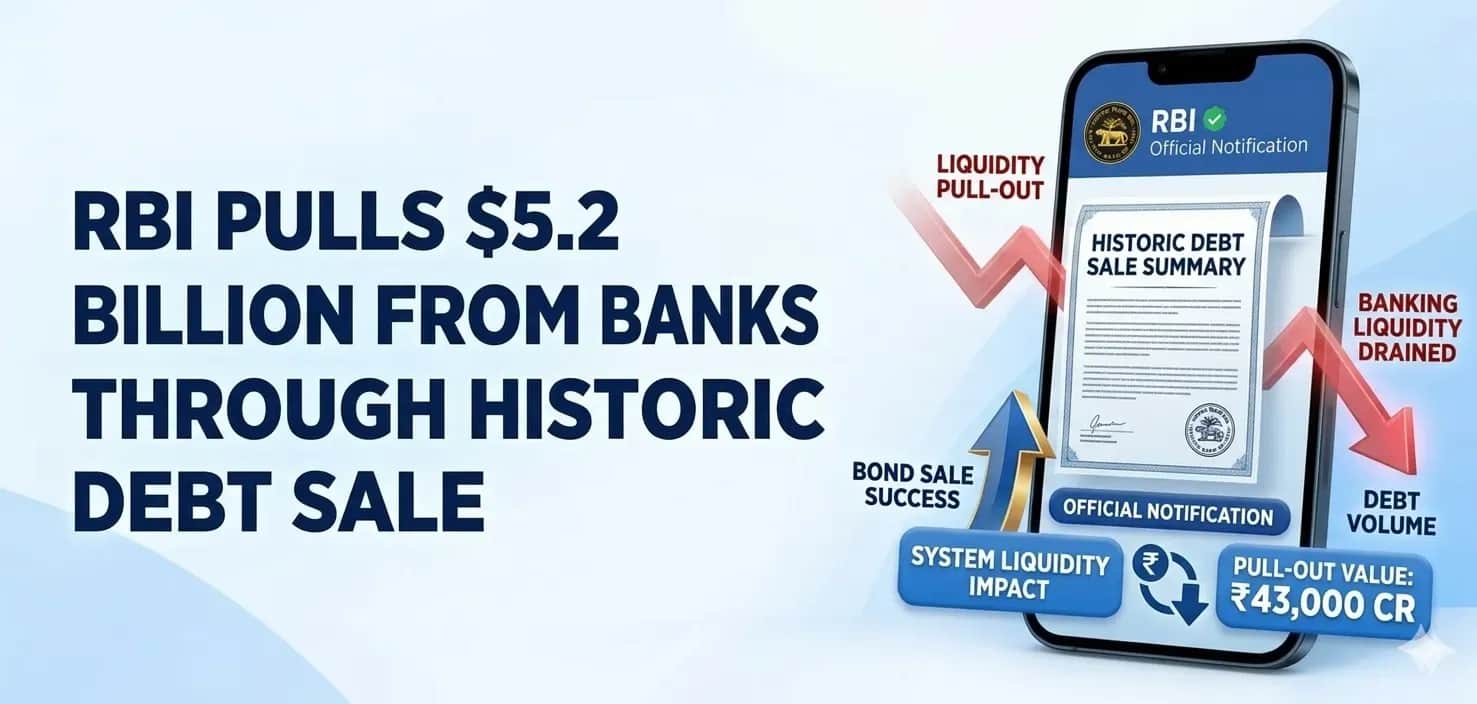
India’s central bank removed ₹50,000 crore through its first net open market debt sale in nearly 9 years, tightening surplus banking-system liquidity conditions across India.
Key Highlights
The Reserve Bank of India accepted the full ₹50,000 crore notified amount at an auction held in Mumbai on 17 September 2026. Banks and other eligible market participants bought government securities from the central bank, and their payments removed rupee liquidity from the financial system. The operation was the country’s first net open market debt sale since November 2017.
The withdrawal equalled nearly 0.2% of total bank deposits. Its immediate target was the unusually large cash surplus held by banks, not household loan accounts. In the near term, lower surplus liquidity can help overnight interest rates move closer to the policy rate. If withdrawals continue for several weeks, government bond yields and market-based funding costs may rise. That is the main downside to watch.
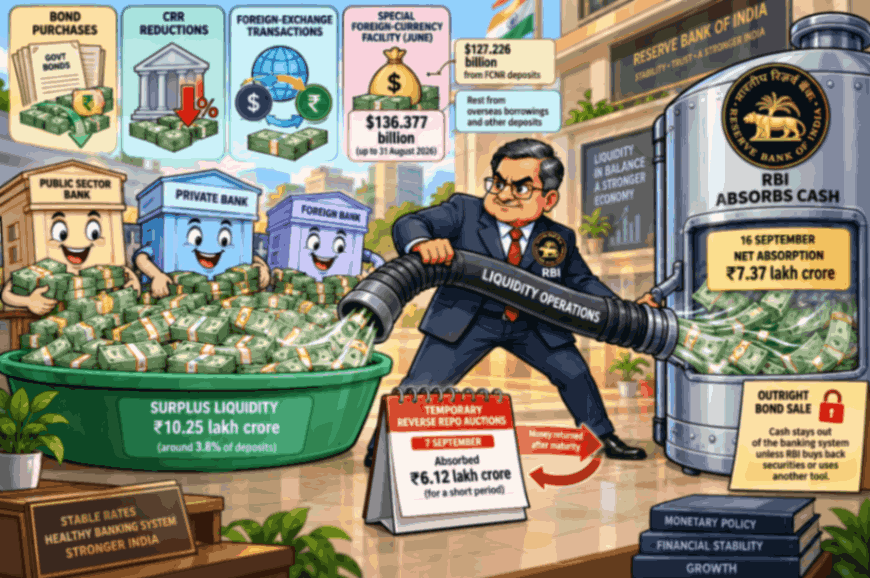
Indian banks entered September with far more cash than they required for routine payments and regulatory needs. Average surplus liquidity during the month stood near ₹10.25 lakh crore, or around 3.8% of deposits. On 16 September, liquidity operations still showed net absorption above ₹7.37 lakh crore. Such a large pool can push overnight borrowing rates below the level intended by monetary policy.
The surplus did not appear in a single day. Bond purchases, cash reserve ratio reductions and foreign-exchange transactions had released rupees into banks over the preceding months. A special foreign-currency facility introduced in June also attracted $136.377 billion up to 31 August 2026. Foreign currency non-resident deposits contributed $127.226 billion of that amount, while overseas borrowings and other deposits supplied the balance.
Temporary reverse repo auctions had already removed large amounts for short periods. On 7 September, 2 such auctions absorbed ₹6.12 lakh crore, but the money returned when those transactions matured. An outright bond sale works differently. The cash remains out of the banking system unless the RBI later buys securities or uses another tool to inject it again.
Also Read: Hero Motors IPO
The RBI offered 6 securities carrying coupon rates from 5.77% to 8.28%, with maturities ranging from 2029 to 2032. Buyers submitted the amount, price and yield they were willing to accept. The central bank used a multiple-price process, which meant successful bidders paid the prices quoted in their individual bids.
The main auction figures are brought together below. They show both the completed sale and the remaining September schedule.
The ₹18,840 crore allocation to the 2032 security accounted for more than one-third of the accepted amount. In later auctions, the RBI may change allocations, accept less or reject bids if quoted yields become unfavourable.
An open market sale does not revise the repo rate. It also does not allow a bank to alter an existing EMI outside the reset terms written into the loan agreement. A home loan linked to an external benchmark will continue to follow its contracted reset date. Fixed-rate borrowers should see no change unless their contract permits repricing.
The indirect route takes longer. When banks hold less spare cash, they may compete harder for deposits or borrow at higher market rates. Those costs can later enter the pricing of fresh home, vehicle, personal and business loans. Government bond yields also influence corporate borrowing rates, so a persistent rise can reach companies that raise money through debt markets.
Depositors could receive a small benefit if lenders need fresh funds. A bank that wants more deposits may hold fixed deposit rates steady or raise selected tenures. That outcome is not assured after one sale. Credit demand, policy-rate expectations and the size of the next 2 auctions will shape each bank’s response.
The borrower-side view from LoansJagat is straightforward: the ₹50,000 crore operation should be treated as a liquidity event, not an EMI announcement. A borrower considering a new loan should compare the annual rate, processing fee, benchmark, reset frequency and foreclosure terms. Waiting for an assumed rate change could prove costly when no lender has announced one.
Governor Sanjay Malhotra had identified variable-rate reverse repos, open market operations and foreign-exchange swaps as available tools for removing surplus funds. He also said that “nothing is off the table”. The statement prepared the market for action beyond overnight auctions, though it did not commit the RBI to selling the entire announced amount at any price.
VRC Reddy, Treasury Head at Karur Vysya Bank, preferred sell-buy foreign-exchange swaps along with an incremental cash reserve requirement. He viewed outright bond sales as a later option because extra supply can lift government yields. His suggested route would temporarily remove rupees without requiring the bond market to absorb the full burden.
For borrowers, the practical answer lies in gradual action. The RBI can divide withdrawals across reverse repos, currency swaps, reserve requirements and bond sales. Smaller steps give banks time to arrange funding and reduce the risk of a sudden yield spike. They also allow the central bank to stop once overnight rates return to the desired area.
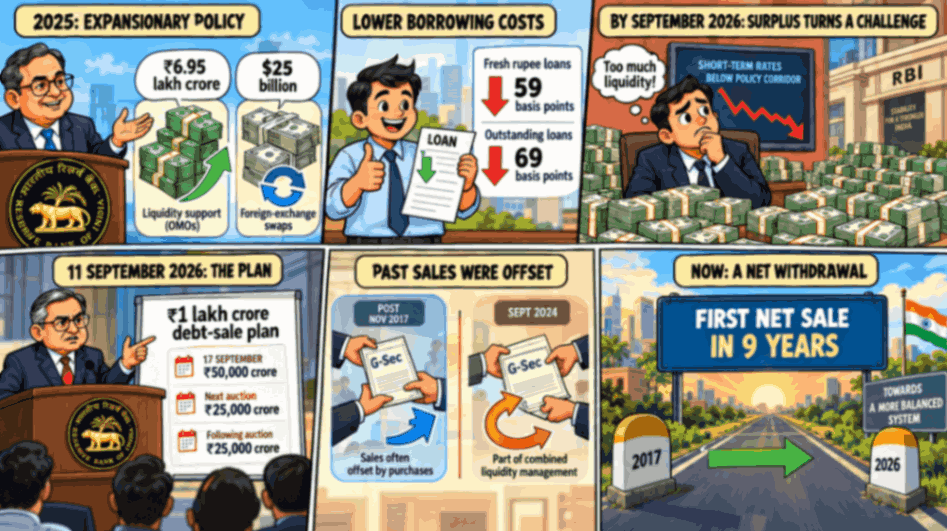
The policy direction during 2025 had been largely expansionary. The Economic Survey 2025-26 recorded ₹6.95 lakh crore of liquidity support through open market purchases and around $25 billion through foreign-exchange swaps. It also reported that the weighted average rate on fresh rupee loans fell by 59 basis points between February and November 2025, while the rate on outstanding loans declined by 69 basis points.
By September 2026, the problem had reversed. Banks had abundant rupees, short-term rates were trading below the policy corridor, and repeated temporary withdrawals were required. The RBI announced the ₹1 lakh crore debt-sale plan on 11 September, splitting it into ₹50,000 crore on 17 September and ₹25,000 crore on each of the next 2 auction dates.
India had seen secondary-market bond sales after November 2017, including transactions in September 2024. Those operations were offset by purchases or formed part of combined liquidity management. The latest transaction produced a net withdrawal through an outright debt sale, which explains the 9-year comparison.
The RBI’s ₹50,000 crore auction removed about $5.2 billion from India’s banking system and ended a nearly 9-year gap between comparable net open market debt sales. It addressed surplus cash that had pushed short-term rates below the intended policy level. The operation did not change the repo rate or rewrite any existing loan contract.
Attention now turns to the ₹25,000 crore auctions planned for 21 and 28 September. Their bid levels, accepted amounts and cut-off yields will show whether the banking surplus can be reduced without sharp pressure on government borrowing costs. Borrowers should watch actual lender rates and reset notices. Depositors can track whether banks begin offering better returns as spare cash declines.
The RBI sells government securities to banks and other eligible participants. Buyers pay in rupees, which reduces the funds available within the banking system. An open market purchase does the reverse because the RBI pays buyers and adds liquidity.
No immediate increase follows from the auction. A floating-rate EMI changes only when the linked benchmark moves and the lender applies that revision under the loan’s reset schedule. A prolonged rise in bank funding costs could affect new loans later.
No. The RBI sold government bonds to eligible market participants and received their payment. It did not deduct money from individual savings accounts or fixed deposits. Customers retain access to their balances under normal banking rules.
The auctions alone provide no assured rate direction. A borrower with an urgent need should compare available offers and repayment costs now. Someone without an immediate deadline can watch lender announcements after 21 and 28 September, but delay carries no guaranteed savings.
Additional securities increase the amount investors must absorb. Buyers may demand a lower price to purchase that supply, which raises the bond’s yield. Higher sovereign yields can later influence corporate debt pricing and market-linked lending benchmarks.








.png&w=3840&q=75)


