
By continuing, you agree to LoansJagat's Credit Report Terms of Use, Terms and Conditions, Privacy Policy, and authorize contact via Call, SMS, Email, or WhatsApp
Disclaimer: The information published on LoansJagat is intended for general informational and educational purposes only and should not be considered financial, legal, or investment advice. Interest rates, loan terms, statistics, and other data may change over time and may vary by lender or source. Please verify the latest information and consult a qualified financial advisor or the respective Bank/NBFC before making any financial decisions.
Subscribe Now
About the author

Arshathul Afia
Arshathul Afia is a journalism graduate and fintech content writer with 4+ years of experience in digital publishing and research-led writing. She has written 200+ articles covering personal finance, lending, banking, digital payments, credit, insurance, and major financial developments in India. At LoansJagat, she focuses on simplifying complex fintech news, RBI updates, loan-related changes, policy developments, and industry trends for everyday readers. Her journalism background helps her approach stories with research, context, and clarity, while her SEO experience ensures content remains discoverable and relevant. She aims to make financial news easier to understand, practical, and useful for readers across India.
Related News
Simplify All Your Loans Into One Affordable EMI

Customers Served

Debt Consolidated

1200+ Reviews

Locations in India
Club all Loans & Credit Card Bills into Single EMI

Quick Apply Loan
Consolidate your debts into one easy EMI.

Takes less than 2 minutes. No paperwork.

10 Lakhs+
Trusted Customers

2000 Cr+
Loans Disbursed

4.7/5
Google Reviews

50+
Banks & NBFCs Offers
The RBI has proposed a 60-day limit on debit holds for suspected money mule transactions, with customer response deadlines and safeguards against unnecessary account restrictions.
Key Highlights
The Reserve Bank of India wants banks to act sooner when they detect suspected money-mule payments, while giving account holders a timed way to answer an alert. Its draft KYC amendment, announced in Press Release No. 2026-2027/1109 on September 11, 2026, covers commercial and urban cooperative banks. It would restrict the outgoing use of suspect funds. The draft awaits comments until October 2, 2026; implementation is proposed by April 1, 2027.
That could help a fraud victim whose money reaches an account used to move scam proceeds. A bank may stop the next withdrawal before the funds travel farther. There is another side to the same decision. If the bank flags a genuine payment and blocks the whole account, the holder may miss rent, a supplier transfer or a loan instalment. The proposed review deadlines could reduce that disruption, provided banks apply the narrower hold wherever the suspected amount can be identified.
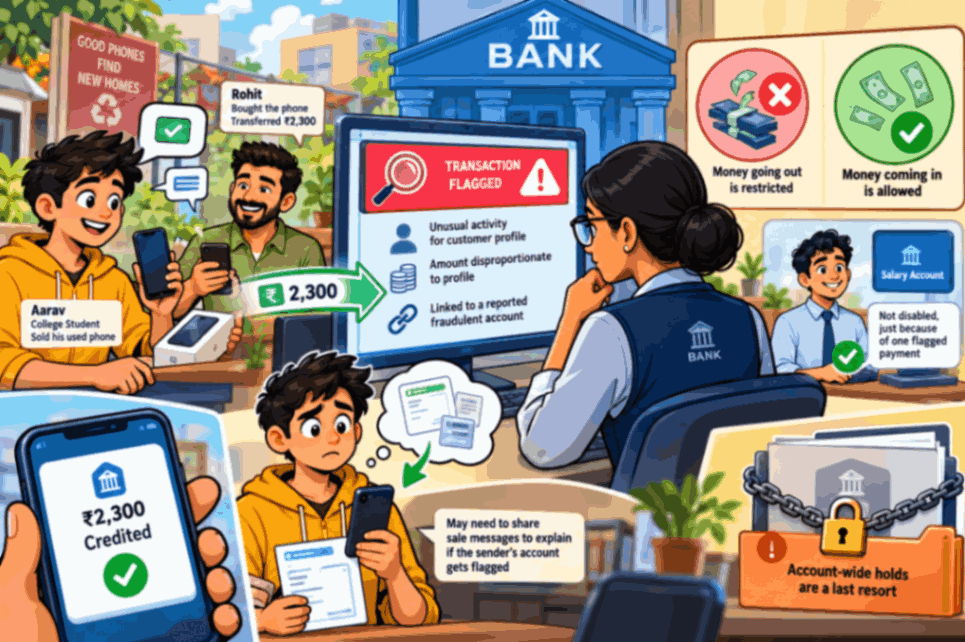
A debit hold restricts money going out. It does not prohibit money coming in, and the proposal does not order a full freeze for every payment above ₹1,000. The bank’s system must also flag the transfer as suspected fraud proceeds. The draft names examples: activity unusual for the customer’s declared profile, an amount disproportionate to that profile or a link to an account already reported as fraudulent.
A customer who receives ₹2,300 after selling a used phone may need sale messages to explain it if the sender’s account gets flagged. Holding that payment affects the customer differently from disabling a salary account. The draft makes account-wide holds a last resort.
A bank would hold a suspected transfer immediately, then tell the holder why it acted, how to seek removal and which officer to contact. Digital notice goes out immediately if contact details are registered; otherwise, physical notice must follow by the end of the next day.
Customers get 20 calendar days to explain the transaction. The bank has 10 days after receiving an answer and must lift the hold immediately if satisfied. Without an answer, it must still decide within 30 days of the original hold.
Here is the proposed sequence. The source appears in the table, and each deadline is measured from the event named in its row.
That last condition is easy to miss. An authorised police instruction or a direction from an empowered court or tribunal can require a restriction to continue. The bank’s proposed 60-day deadline does not cancel such a direction. If it keeps a hold after reviewing a customer’s answer, the bank must report the unresolved case to the jurisdictional police through NCRP-CFCFRMS, give reasons and inform the account holder. The draft also requires nodal officers for complaints, with 30 days to resolve a complaint made under this procedure.
The RBI says the Supreme Court’s August 4, 2026 order prompted it to prepare a standard procedure for banks placing temporary debit holds linked to mule activity and cyber-enabled fraud. The government account published that day records the court’s direction and its concern about frozen-account grievances and returning defrauded money. The proposed change describes what happens after a bank itself identifies a suspicious payment, including notice, review and, where needed, a police reference.
On July 21, 2026, a Ministry of Home Affairs reply reported that its financial-fraud reporting system helped save more than ₹11,158 crore across more than 32.80 lakh complaints up to June 30. Those are results of the existing complaint system, not a forecast for the draft.
In January 2026, the Ministry of Home Affairs issued a procedure for handling fraud reports and restoring blocked money to victims. A June 17 review of the helpline and restoration process also raised the problem of unnecessarily frozen accounts. That earlier procedure helps banks, police and other institutions deal with funds already blocked after a complaint.
Another step came on May 12, 2026. The Indian Cyber Crime Coordination Centre and the Reserve Bank Innovation Hub agreed to share suspect information to improve AI-assisted detection of mule accounts. More alerts could send genuine customers into a review queue if banks do not check them carefully. In its June 11 analysis, LoansJagat raised that false-positive concern, particularly for small business owners whose accounts handle varied legitimate payments.
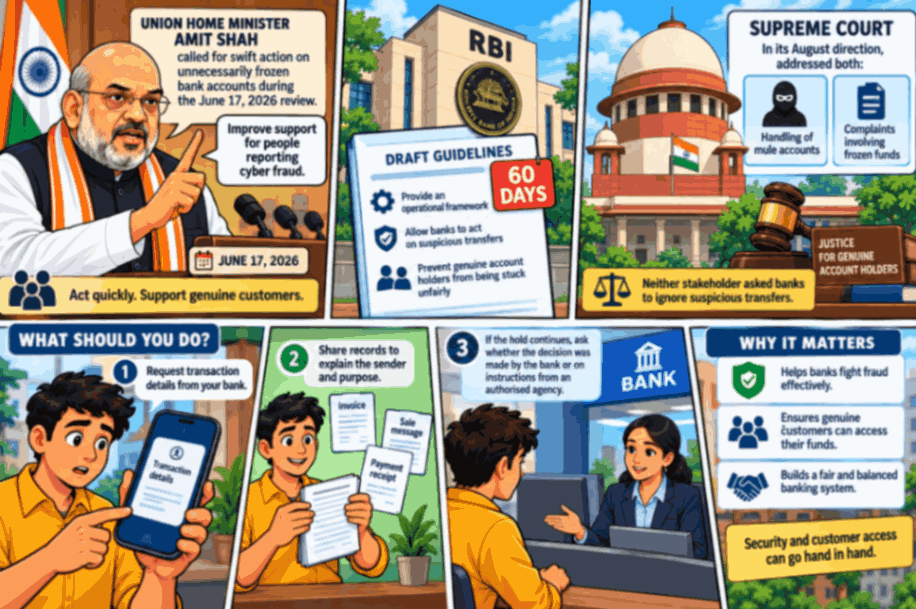
Union Home Minister Amit Shah called for swift action on unnecessarily frozen bank accounts during the June 17, 2026 review. He also asked officials to improve support for people reporting cyber fraud. These remarks preceded the RBI draft; they should not be mistaken for a response to its 60-day proposal. The Supreme Court’s August direction likewise addressed both the handling of mule accounts and complaints involving frozen funds. Neither stakeholder asked banks to ignore suspicious transfers. Both developments show why banks need a way to act without leaving a genuine account holder unable to use unrelated funds for an open-ended period.
The draft offers an operational answer, though its success would depend on bank decisions case by case. The customer’s safest first response would be to request the transaction details and send records explaining the sender and purpose, such as an invoice, sale message or payment receipt. If the hold continues, the holder should ask whether the bank made the decision under its own review or received an instruction from an authorised agency. That distinction changes which deadline applies.
The proposal sets a deadline for the bank to answer a customer’s explanation, while allowing it to preserve suspicious funds and involve police when the evidence warrants it. The RBI has not issued final directions yet. Comments remain open until October 2, 2026, with implementation proposed by April 1, 2027 or earlier at a bank’s choice.
No. The ₹1,000 threshold is only part of the draft’s definition of a suspected money-mule transaction. The bank’s monitoring system must also flag grounds for suspicion, such as unusual activity for the account profile or a connection to an account already reported as fraudulent. A routine transfer above that amount does not automatically qualify.
The draft allows an account-level debit hold when the bank identifies the account itself as a suspected money-mule account. It tells banks to use that broader restriction only in exceptional circumstances, as a last resort. A direction from police or another competent authority may involve separate legal instructions that the bank must follow.
If the bank accepts the customer’s explanation, it must remove its temporary hold immediately. If the case goes to police and no legally supported instruction requires continuation within 30 days of referral, the bank removes it on the 31st day. The 60-day maximum from the original hold applies only without contrary authorised instructions.
The account can be used knowingly or unknowingly to move fraud proceeds. The customer should therefore explain the transfer rather than assume a flag establishes guilt. Records showing a genuine sale, service or repayment may help the bank review what happened.
The RBI draft would make a bank’s own account-wide hold a last resort. The holder should ask the bank which transfer caused the restriction, whether it acted on its own or followed a police direction, and who can review the remaining restriction.









.png&w=3840&q=75)


